Prep Tools
Spice Tin (Masala Dabba)
A round metal box holding several small cups of everyday spices for quick reach.
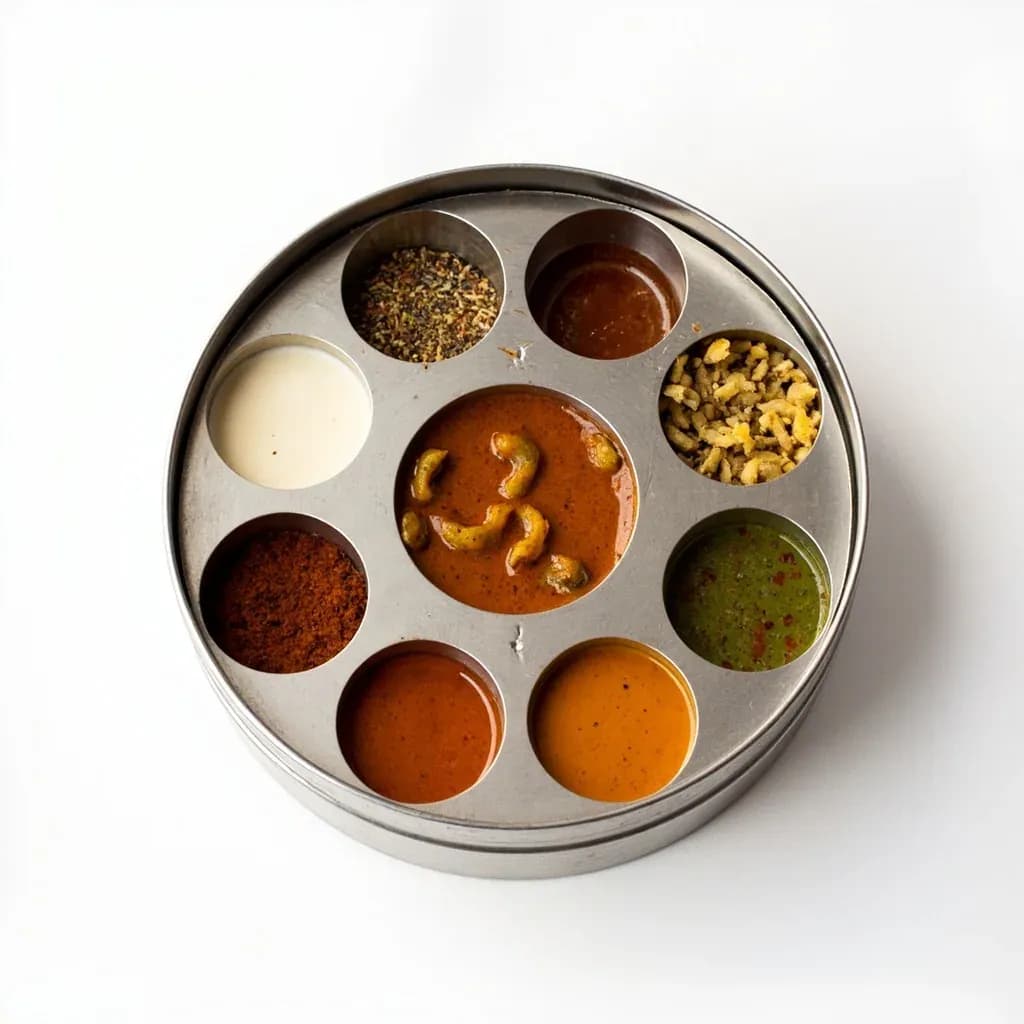
A spice tin, called a masala dabba in Indian kitchens, is a round stainless steel container holding several small open cups, each filled with a frequently used spice and a clear inner lid over them all. Cooks keep their core spices together for fast, one-hand access while cooking. It usually includes a tiny spoon and the most-reached-for masalas.
The masala dabba is the beating heart of a traditional Indian kitchen — a round metal box holding seven (or more) small cups of spice, kept on the counter within arm's reach of the stove. It collapses a wall of jars into a single pivot point the cook can pull from mid-sauté without breaking stride.
What makes it more than storage is the design. The tight-fitting lid lifts off and doubles as a small plate for toasting whole seeds or mixing a quick blend. A matching spoon (the chammach) usually rides in the center of the tin, so the hand moves from cup to pan without setting anything down. Ground staples — turmeric, red chili, coriander, cumin, garam masala — sit alongside a few whole seeds like mustard, cumin, and fenugreek, arranged so the cook can find each one by touch.
In practice the dabba reshapes the rhythm of cooking. Spices are spooned out by instinct rather than measured from jars across the kitchen, and a tadka is built right on the inverted lid before being tipped into the pot. Care is simple but not optional: hand-wash, towel-dry the seams, and never return a wet spoon to a cup. Stainless steel is the practical default; brass and copper are handsome but heavier and need occasional polishing.
Alternatives
Types & varieties
The standard home version — round tin, seven cups, snug lid, small spoon
Larger size for busy households or cooks who keep more regional spice mixes on hand
Heavier and decorative, often given as wedding gifts; brass patinas and needs occasional polishing
Light and inexpensive; less durable than steel and can react with very salty or acidic blends
Modern variant with a transparent cover so cooks can see the cups without lifting
Smaller, lighter versions for trips or cooks new to Indian spice organization
A Traditional Seven-Cup Lineup
A well-stocked dabba reflects the rhythm of the kitchen rather than a fixed recipe. Most Indian households arrange the seven cups so the ground spices used in nearly every dish sit at the front — where the hand lands first — while whole seeds, used more selectively, sit toward the back or around the perimeter. The spoon lives dead center. One common arrangement looks like this:
- Cup 1 (front-center): Turmeric — the most-spooned spice of the day
- Cup 2: Red chili powder or Kashmiri chili for color without overwhelming heat
- Cup 3: Coriander powder — the workhorse of North Indian gravies
- Cup 4: Cumin powder — pairs with coriander in nearly every base masala
- Cup 5: Garam masala — finishing spice, sprinkled in at the end of cooking
- Cup 6: Whole mustard seeds — for the first crackle of any tadka
- Cup 7: Whole cumin seeds, or a regional swap like fenugreek, nigella, fennel, or ajwain depending on the cuisine
The Lid as a Mini Prep Surface
The lid is the dabba's most underrated feature. Lifted off and inverted, it becomes a shallow stainless tray that holds heat well and wipes clean — exactly the right scale for the quick work that happens in the seconds before spices meet the pot.
- Toasting: dry-roast whole cumin or mustard on the lid over a low flame until fragrant, then slide into the dish
- Blending: spoon from several cups onto the lid to mix a quick garam masala or chaat masala before adding
- Building a tadka: bloom seeds in oil or ghee right on the lid, then pour the whole thing into a dal or vegetable
- Portioning: pre-measure spices for a recipe onto the lid so the cook moves quickly once onions hit the pan
- Tasting: rub a pinch of toasted spice between thumb and finger to check aroma before committing it to the dish
Common uses
Tips & pitfalls
- Refill only what you'll use in 2–4 weeks; ground spices lose aroma quickly once the dabba is opened daily.
- Always use a dry spoon — water dripping into a cup will clump whole seeds and cake ground spices into rocks.
- Never store wet pastes, fried masalas, or oil-heavy blends (garlic-ginger paste, onion masala) in the cups; those belong in sealed jars in the fridge.
- When two ground spices look alike (coriander vs. cumin powder), stick a small piece of tape on the cup's rim and pencil in the name.
- Wipe the inside of the lid dry after washing; trapped moisture causes rust spots at the seams, even on stainless steel.
- Keep whole seeds in the dabba and grind them fresh when a dish needs extra punch — they outlast ground spices by months.
- Move the dabba back from the burner; sitting in the direct heat of a gas flame fades chili and turmeric fast.
- Stagger refills — restock one or two cups at a time rather than emptying and refilling the whole tin in a single afternoon.
Good to know
- Also called
- Masala Dabba, Masala Box, Indian Spice Box, Masala Container, Spice Dabba
- Origin
- Indian subcontinent; standard in traditional home kitchens for generations
- Typical material
- Stainless steel; brass, copper, aluminum, and acrylic variants also exist
- Standard capacity
- Seven small round cups (katoris), each holding roughly 1.5–3 tablespoons
- Dimensions
- Outer tin typically 7–8 in (18–20 cm) in diameter and 3–4 in (8–10 cm) deep
- Included utensil
- A small matching spoon (chammach) that lives in the center or under the lid
- Lid function
- Lifts off and inverts as a small plate for toasting, blending, or assembling a tadka
- Storage location
- Countertop within arm's reach of the stove; never the refrigerator
- Care
- Hand-wash and towel-dry; stainless steel is rust-resistant but seams can trap moisture
Also called
Masala Dabba · spice box
Related

Peeler
Swift blade for stripping skin off fruit and vegetables

Grater
Sharp-toothed surface for shredding cheese and vegetables

Microplane
Ultra-fine rasp for citrus zest, garlic, and hard cheese

Mixing Bowl
All-purpose bowl for combining, whisking, and tossing

Whisk
Looped wires that beat air into eggs, cream, and sauces

Spatula
Flat blade for flipping, lifting, and scraping

Slotted Spoon
Pierced spoon that lifts solids and drains the liquid behind

Wooden Spoon
Gentle, heat-friendly spoon for stirring anything