Prep Tools
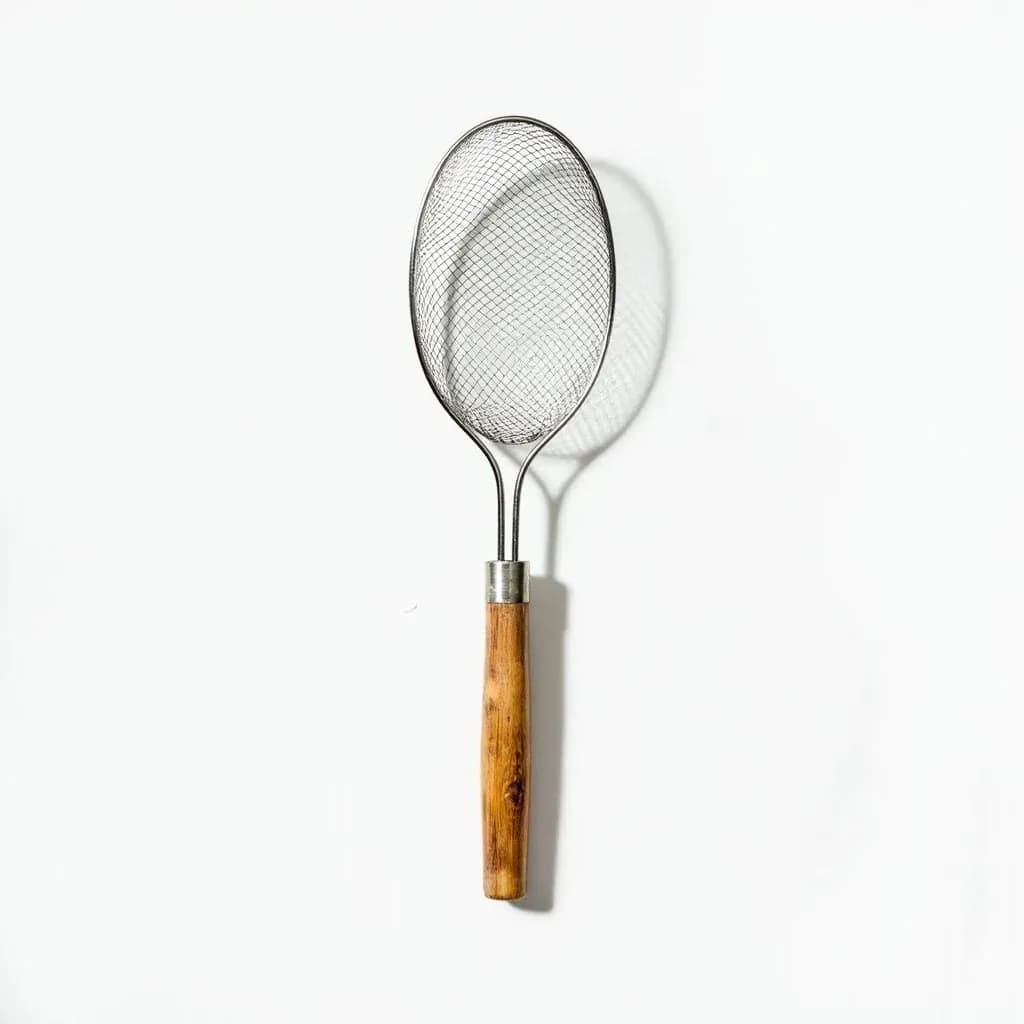
Spider / Wire Skimmer (Serok)
A wide shallow wire-mesh scoop for lifting food out of hot oil or boiling water.
A spider strainer is a wide, shallow basket of coiled wire mesh on a long handle, named for its web-like pattern. It scoops blanched vegetables, fried foods, dumplings, or hot-pot ingredients out of boiling liquid or hot oil while draining quickly. The open mesh lets fat and water fall away fast, making it the standard tool for deep frying and hot-pot service.
The spider — also called a wire skimmer, mesh skimmer, or, across much of East and Southeast Asia, a serok, zhàolí, or vợt — is the cook's extension of the hand into hot oil and boiling water. The bowl-shaped wire mesh dips into the pot, scoops the food, and drains the cooking liquid in a single motion, which is exactly why no serious deep-fryer or noodle cook works without one. Its genius is the combination of two opposing jobs: contain the food briefly while letting the oil or water fall through almost instantly, so what reaches the plate or rack is dry, crisp, and ready to eat.
A typical spider has a 10–18 cm (4–7 in) mesh bowl on a 25–40 cm (10–16 in) handle, which keeps the cook's hand well clear of the splatter zone. Stainless steel is the default material because it tolerates any cooking temperature and sheds oil and water cleanly. Nylon and silicone versions exist for non-stick cookware but cannot handle sustained deep-frying heat, while traditional bamboo forms (common in Chinese, Vietnamese, and Southeast Asian kitchens) are designed for noodles and blanched greens rather than immersion in hot oil.
Choose by mesh size, not by handle color. A wide, open mesh drains oil fast and is right for chunky fritters, croquettes, and chips; a fine mesh holds tortellini, gnocchi, and small dumplings that would otherwise escape. A flat mesh skimmer is a related but different tool — a wide shallow disc tuned for skimming foam off stocks rather than lifting food — and the two are often sold in the same rack and called by the same name.
Alternatives
Types & varieties
The standard workhorse; available in fine or coarse mesh; tolerates any cooking temperature and is dishwasher-safe.
Gentle on non-stick cookware; not rated for deep-frying above ~200°C / 400°F.
Higher heat tolerance than nylon, non-reactive, and non-scratching; noticeably pricier than plain wire.
Faster oil drainage for chunky fried foods like fritters, croquettes, and chips; lets small items slip through.
Holds dumplings, gnocchi, tortellini, blanched vegetables, and small fritters that would escape a coarse basket.
Traditional East and Southeast Asian form, used for noodles, dumplings, and blanched greens; not designed for hot oil.
Wide, shallow disc on a long handle; optimized for skimming foam and impurities from stocks, not for lifting food out of a pot.
Spider versus slotted spoon
A slotted spoon drains slowly and carries only a few pieces at a time; a spider scoops a whole batch of dumplings or fritters in a single pass and drains as you lift. Reach for the slotted spoon when you need precision — plating a single piece of poached fish, lifting a bay leaf from a sauce — and reach for the spider whenever you are clearing food from a pot in volume.
Choosing a mesh size
Mesh fineness is the single most important buying decision after material. Coarse, open weaves shed oil almost instantly, which is what you want for tempura, doughnuts, croquettes, and chips, because retained oil is the enemy of a crisp crust. Fine meshes are slower to drain but necessary for tortellini, ravioli, gnocchi, blanched fava beans, and small dumplings, which would otherwise escape through the wires into the cooking liquid.
Material tradeoffs
Stainless steel is the right answer for almost everyone. It is indifferent to heat, dishwasher-safe, and the open wire cleans easily. Nylon and silicone exist only because they will not scratch a non-stick pan, and they pay for that gentleness with a heat ceiling well below deep-frying temperature. Bamboo is the traditional choice for noodle and blanching work in Asian kitchens and is not meant for hot oil; treat it like a wooden spoon and rinse it rather than soaking it.
Care and storage
Wipe a stainless spider down with a paper towel once it has cooled enough to handle, then wash it in hot soapy water. Cleaning while the residual oil is still warm and liquid is far easier than scrubbing once it has congealed on the wires. Dry the basket before putting it away. Hang the spider on a hook near the stove so it stays within arm's reach during a busy service.
Common uses
Tips & pitfalls
- Pat food dry before frying — wet food hitting hot oil through a damp spider causes violent splatter.
- Fry in small batches; overloading the basket drops the oil temperature and yields greasy food.
- Hold the spider over the pot for a few seconds after lifting so excess oil or water drains back into the pot.
- Match mesh size to the job: fine for gnocchi, tortellini, and small dumplings; wide and open for chunky fritters and chips.
- Use stainless steel for deep-frying; switch to nylon or silicone only when working in non-stick pans.
- Never leave a nylon or silicone spider resting against the hot side of a pot — radiant heat softens or melts the mesh.
- Shake the spider gently side-to-side rather than tapping it on the pot rim, which bends the wires over time.
- Don't use the spider to stir or move heavy foods around in a pot — it is built for lifting, not for pushing.
- After deep-frying, transfer food from the spider to a rack, not paper towels, so steam escapes and the crust stays crisp.
Good to know
- Other names
- Wire skimmer, mesh skimmer, skimmer, araignée, écumoire, ragno, Schaumlöffel, serok, 笊篱 (zhàolí), vợt
- Type
- Long-handled, bowl-shaped wire-mesh scoop
- Primary materials
- Stainless steel (standard), nylon mesh, silicone-coated wire, bamboo (traditional Asian forms)
- Typical basket diameter
- 10–18 cm (4–7 in)
- Typical handle length
- 25–40 cm (10–16 in)
- Heat tolerance
- Stainless steel: unlimited; nylon: up to ~200°C / 400°F; silicone-coated: up to ~230°C / 450°F
- Best for
- Lifting and draining small to medium pieces of food from hot oil or boiling water
- Name origin
- American "spider" refers to the web-like pattern of the wire mesh; the tool is unrelated to the three-legged cast-iron "spider" skillet used over coals
Also called
strainer-spider · hot-pot-strainer-basket-spider · Spider Skimmer · Wire Skimmer · Serok
Related

Peeler
Swift blade for stripping skin off fruit and vegetables

Grater
Sharp-toothed surface for shredding cheese and vegetables

Microplane
Ultra-fine rasp for citrus zest, garlic, and hard cheese

Mixing Bowl
All-purpose bowl for combining, whisking, and tossing

Whisk
Looped wires that beat air into eggs, cream, and sauces

Spatula
Flat blade for flipping, lifting, and scraping

Slotted Spoon
Pierced spoon that lifts solids and drains the liquid behind

Wooden Spoon
Gentle, heat-friendly spoon for stirring anything