Prep Tools
Spiralizer
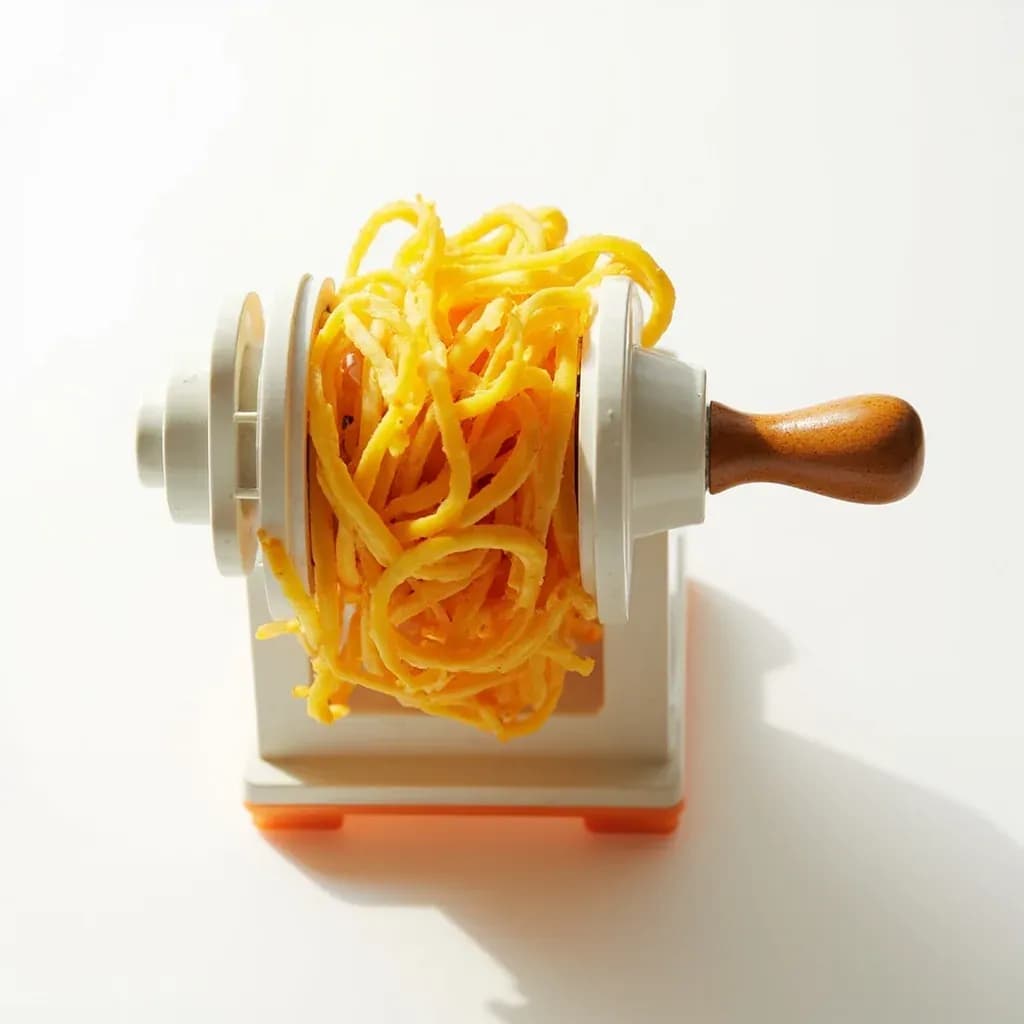
A crank gadget that cuts vegetables into long noodle-like spirals and ribbons.
A spiralizer is a hand-cranked or handheld tool that pushes firm vegetables against a rotating blade to produce long curling strands. Cooks use it to turn zucchini, carrots, beets, and squash into low-carb noodles, salads, and garnishes. Interchangeable blades change the cut from fine angel-hair spirals to thick ribbons, making it popular for veggie-noodle dishes.
A spiralizer is a mechanical tool that holds a firm piece of produce on a set of prongs and rotates it against a fixed blade, shaving it into long, continuous noodle-like strands or flat ribbons. The geometry is what makes the cut unique: because the food is spinning as it meets the blade, you get an unbroken helix that no knife or julienne can replicate, with strands of consistent thickness from end to end. The classic countertop model is a crank-driven device with two to four interchangeable blades that produce different shapes — typically spaghetti-cut, fettuccine-cut, and a flat ribbon.
The spiralizer's real value isn't just turning vegetables into low-carb pasta substitutes, though that use made it famous. It's that the long, springy strands hold sauces, dress well in cold salads, and brown evenly when roasted, opening up textures that grated or julienned vegetables don't offer. To work well, the food has to be firm and fairly uniform in diameter: zucchini, sweet potato, butternut squash, beets, carrots, cucumber, daikon, apples, and broccoli stems are all good candidates. Soft, hollow, or irregular produce — mushrooms, eggplant, ripe tomatoes, leafy greens — will jam, shatter, or yield nothing useful.
Alternatives
Types & varieties
Palm-sized tool where you turn the vegetable against fixed blades by hand. Cheap and fine for an occasional zucchini, but only produces one cut size and tends to break down.
The classic workhorse: a side handle turns the food against interchangeable blades held in a base. Most versatile option, with 2–4 blades and the best leverage for harder vegetables.
Motorized version that does the cranking for you. Worthwhile only for large batches or tough items like butternut squash; otherwise overkill for home use.
Suction-cup base with a horizontal blade; the user pushes the food by hand. Compact and stable but requires more downward force and tends to produce shorter strands.
Japanese rotary mandoline that produces long vegetable curls. Often grouped with spiralizers, though traditionally classed as a mandoline.
Choosing the right vegetables
A spiralizer is only as useful as the produce you put into it. The cut depends on the food being uniformly firm and roughly cylindrical, so reach for dense roots, firm gourds, and crisp fruits.
- Excellent: zucchini, yellow squash, sweet potato, butternut squash neck, beet, carrot, cucumber, daikon, broccoli stems, kohlrabi, firm apple, pear
- Acceptable with care: red cabbage (cut into wedges first), rutabaga, parsnip
- Avoid: eggplant (too soft), ripe tomato (collapses), mushrooms (crumbly), leafy greens, anything hollow like bell pepper cores or seedy zucchini that has gone soft
Cooking spiralized vegetables
Spiralized strands have a lot of surface area and very little structural backbone, so they go from tender to mushy in a hurry. Treat them more like a delicate green than a pasta.
- Hot pan: 1–3 minutes over medium-high heat in a wide skillet, tossing constantly. Anything longer and the strands collapse into wet clumps.
- Boiling: blanch for 30–60 seconds only, then shock in cold water to stop the cooking.
- Roasting: pat dry first, toss with a small amount of oil, and spread on a sheet pan in a single layer at 220 °C / 425 °F. Crowding steams them; under-oiling dries them out.
- Raw: toss with acid (lemon, vinegar) and salt just before serving; salt draws out moisture and will pool on the plate if done too early.
Care and storage
The blades are the only part that matters for longevity. A quick habit of hand-drying them after washing will keep the set cutting cleanly for years.
- Most plastic bodies are top-rack dishwasher safe; blades should be hand-washed and dried immediately to prevent spotting or pitting.
- Store blades separately — stacked or jostled together they dull the cutting edges quickly.
- If a strand starts coming out ragged or torn, the blade is likely dull and should be replaced rather than forced through harder vegetables.
- After use, push out the small core nub still attached to the prongs before storing so it doesn't dry onto the holder.
Common uses
Tips & pitfalls
- Cut a flat base on round vegetables so they sit flush against the blade platform and don't wobble on the prongs.
- Center the food carefully — an off-center piece produces uneven, broken strands and jams the blade.
- Leave a 2–3 cm core un-spiralized so the prongs never meet the blade; this is what protects your fingers.
- For watery vegetables like zucchini, toss the noodles with a teaspoon of salt, rest 10 minutes, then squeeze dry in a clean towel before cooking — otherwise they leach water into the pan.
- Cook spiralized vegetables briefly: 1–3 minutes in a hot, wide pan is usually enough. They go from tender to mushy in seconds.
- Use a large enough pan that the strands spread in a single layer; overcrowding steams them and turns them soggy.
- Pat dry starchy vegetables like sweet potato and squash before roasting so they brown rather than steam.
- Cut very long vegetables (full-length carrots, large daikon) down to 7–10 cm so they balance on the prongs without tipping.
Good to know
- Type
- Mechanical kitchen tool, typically hand-cranked; electric models are available
- Standard blades
- Three interchangeable blades typical: spaghetti (~3×3 mm), fettuccine (~5×5 mm), and a flat ribbon
- Common materials
- ABS or reinforced plastic body with stainless steel cutting blades
- Countertop footprint
- Roughly 24 cm tall × 15 cm wide × 14 cm deep for crank models
- Working size range
- Best with produce ~3.5–7 cm in diameter; minimum length ~5 cm to grip the prongs; trim longer items to 7–10 cm so they balance without tipping
- Typical yield
- One medium zucchini (~200 g) yields about 2 cups of noodles
- Best for
- Zucchini, sweet potato, butternut squash, beet, carrot, cucumber, apple, daikon, broccoli stems
- Origin of trend
- Popularized in the US around 2014 by the Paderno World Cuisine model alongside Ali Maffucci's Inspiralized blog and cookbook
Also called
Vegetable Spiralizer · Spiral Slicer · Zoodle Maker
Related

Peeler
Swift blade for stripping skin off fruit and vegetables

Grater
Sharp-toothed surface for shredding cheese and vegetables

Microplane
Ultra-fine rasp for citrus zest, garlic, and hard cheese

Mixing Bowl
All-purpose bowl for combining, whisking, and tossing

Whisk
Looped wires that beat air into eggs, cream, and sauces

Spatula
Flat blade for flipping, lifting, and scraping

Slotted Spoon
Pierced spoon that lifts solids and drains the liquid behind

Wooden Spoon
Gentle, heat-friendly spoon for stirring anything