Cookware
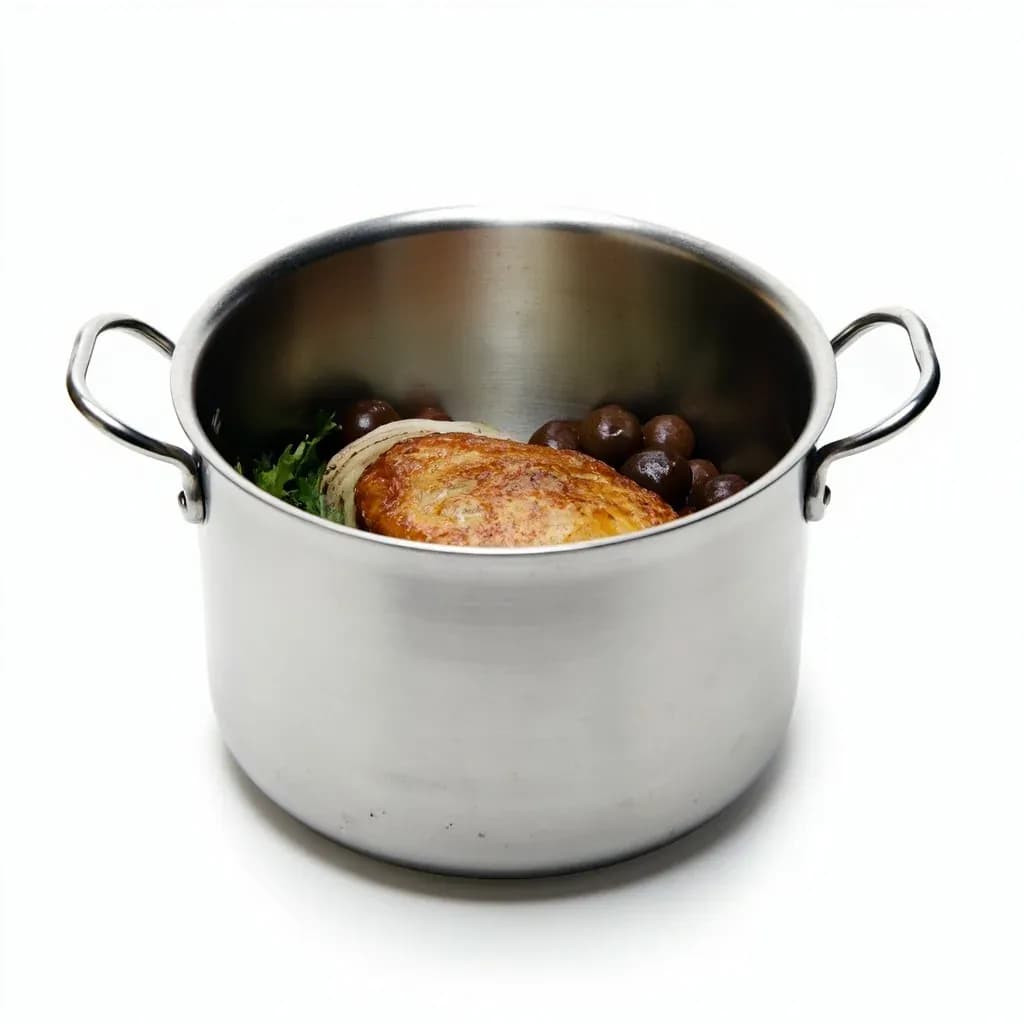
Stainless Steel Stockpot
A tall wide pot for simmering stocks, soups, pasta, and large-batch cooking.
A stainless steel stockpot is a deep, straight-sided pot with two looped handles, sized for cooking large volumes of liquid. Cooks use it to simmer stocks and broths for hours, make big batches of soup and stew, boil pasta, and blanch vegetables. Stainless construction is durable and non-reactive, so acidic ingredients and long simmers won't pit the metal or pick up off-flavors.
The stainless steel stockpot is the workhorse of any serious kitchen — a tall, deep vessel built for cooking in volume. Where a saucepan handles a quart and a Dutch oven handles a roast, the stockpot is built for quantities: a gallon of chicken stock, a pound of pasta, a lobster boil for eight. Its size and depth shape how it cooks: tall narrow pots lose liquid slowly and concentrate flavor gradually, while wider, shorter versions reduce faster and suit pasta, blanching, and any job where you want more surface area.
The "stainless steel" part of the name is somewhat misleading on its own, because pure stainless is a poor heat conductor. Every quality stockpot is clad — layers of stainless bonded to aluminum or copper that do the actual heat-spreading work. This construction is what separates a serious stockpot from a cheap one: a fully clad pot heats evenly from base to rim, while a disc-bottomed pot will scorch food right where the sidewall meets the base. The stainless interior is what makes the pot non-reactive, durable, and indifferent to long simmers of acidic or salty liquid.
For most home cooks, a single 12-quart fully clad stockpot covers the bulk of batch cooking — stock, soup, chili, pasta, corn on the cob, blanched vegetables — and replaces any number of specialized vessels. It is the second piece of cookware to buy after a good skillet, and arguably the first for anyone who cooks for a household or keeps a freezer.
Alternatives
Types & varieties
Stainless–aluminum–stainless from base to rim. Even heating, the standard for mid- to high-end home pots.
Adds layers of stainless and aluminum (sometimes copper) for faster, more even response. Common in professional lines like Demeyere, Mauviel M'cook, and Fissler.
Aluminum or copper disc fused to the base only. Cheaper and lighter, but produces a hot spot where the sidewall meets the base.
Best for stocks, broths, corn on the cob, and lobster boils — less evaporation, more vertical room for bones and foam.
Often called a soup pot or pasta pot. Faster reduction, fits a pasta insert, easier to skim.
Stainless perforated or mesh insert that lifts out for draining without a colander — safer and faster for large batches.
A smaller inset that nests inside the stockpot to turn it into a water bath for custards, hollandaise, or melting chocolate.
Clamped-lid stainless pot that cooks at modest pressure (around 15 psi). Kuhn Rikon and Fissler are well-known makers.
Extra-tall, narrow stockpot designed to hold a rack and jars for water-bath canning.
Brushed exteriors hide scratches; mirror/polished exteriors are more decorative. Interiors are usually polished for easier cleaning and deglazing.
Cladding: What Matters and What Doesn't
The single biggest factor in how a stockpot cooks is how much of it is clad. Tri-ply and 5-ply pots are stainless on the outside, aluminum (and sometimes copper) in the middle, and stainless again on the inside, running the full height of the vessel. Heat spreads evenly up the sidewalls, so a simmer stays a simmer from top to bottom and you get fewer scorch marks during long stock reductions.
Disc-bottom pots have the conductive metal bonded only to the base. They are cheaper, lighter, and perfectly adequate for boiling water or simmering soup for an hour, but they have a known weak point: the junction where the thin sidewall meets the thicker base. Sauces reduce faster there, milk scalds there, and that is where the pot will eventually scorch if you walk away. For stock work specifically — where a pot may sit at a bare simmer for six hours — fully clad is worth the premium.
- Fully clad (tri-ply or 5-ply) is the right choice if you simmer stocks or reduce sauces often.
- Disc-bottom is fine for boiling pasta, blanching, and canning, where heat uniformity matters less.
- 18/10 stainless polishes brighter and resists corrosion slightly better than 18/8 — a small but real quality marker.
- Weight is a rough proxy: a 12-quart clad pot runs 5–8 lb empty; disc-bottom pots come in closer to 3–4 lb.
Size and Shape: Matching the Pot to the Job
Capacity is measured to the rim, but practical working capacity is roughly 70–80% of stated volume once you account for headspace, rolling boils, and skimming. A 12-quart pot will comfortably simmer about 9 quarts of stock; a 20-quart, about 15. For most home cooks, 12 quarts hits the sweet spot — large enough for a chicken stock or a pound of pasta, small enough to lift one-handed off the stove when full.
- Tall narrow: stocks, broths, corn on the cob, lobster boils. Forgiving of foaming, slow to reduce.
- Wide low: pasta, blanching, chili, soup. Faster reduction, more surface for skimming, easier to reach into.
- Leave 2–3 inches of headspace when simmering stocks and cooking beans — foam climbs fast and a boilover with 3 gallons of stock is a kitchen disaster.
- If you cook for two most nights but host a crowd a few times a year, a 12-qt is more useful than a 20-qt you rarely fill.
Common uses
Tips & pitfalls
- Heat on medium — stainless is a poor conductor, and cranking the burner causes scorching and warping rather than faster cooking.
- Bring water to a full boil before salting; adding salt to cold water can contribute to pitting corrosion, especially with hard water or high-chloride salts.
- To prevent sticking when sautéing aromatics, preheat the pot, add oil, let the oil shimmer, then add food — a drop of water that dances on the surface is a useful preheat indicator.
- Deglaze with wine, stock, or water to lift fond; stainless develops an excellent fond for pan sauces, which is one of its quiet advantages over nonstick.
- Avoid thermal shock: never run cold water into a screaming-hot pot, and don't set a hot empty pot on a cold or wet stone counter — both invite warping.
- Clean stuck-on food by simmering an inch of water in the pot and scraping with a wooden spoon; for rainbow discoloration, use Bar Keepers Friend or a baking-soda paste.
- Skip steel wool and abrasive scouring pads on polished interiors — they scratch. Use nylon scrubbers or a stainless chain-mail scrubber.
- If you only own one, buy a 12-quart fully clad model: large enough for stock and a small pasta batch, small enough to handle one-handed on the stove.
Good to know
- Material
- Stainless steel, most often 18/10 (18% chromium, 10% nickel) or 18/8 interior, with a magnetic 18/0 base on induction-compatible models.
- Construction
- Almost always clad — layers of stainless bonded to an aluminum and/or copper core, since stainless alone conducts heat poorly.
- Common home sizes
- 8, 12, 16, 20, and 24 quarts; the 12-quart is the workhorse for most households.
- Commercial sizes
- 20 to 80+ quarts; 40- and 60-quart pots are restaurant standards for stocks and pasta.
- Stovetop compatibility
- Gas, electric, induction (magnetic base), halogen, and ceramic glass.
- Oven-safe temperature
- Typically 500–600°F / 260–315°C, depending on handle and lid-knob material.
- Dishwasher safe
- Generally yes, though hand-washing preserves polished finishes and avoids water-spot etching over time.
- History
- Bonded-metal cookware technology was patented in 1949 (U.S. Steel); All-Clad popularized fully clad cookware for home cooks beginning in 1971.
Also called
Stockpot · Soup Pot · Stock Pot
Related

Steamer
Gentle moist heat that keeps vegetables, fish, and dumplings tender

Frying Pan
Shallow sloped pan for frying, sautéing, and quick sears

Saucepan
Tall, straight-sided pot for sauces, grains, and small batches

Sauté Pan
Wide straight-sided pan with room to brown and braise

Dutch Oven
Heavy lidded pot that turns tough cuts tender over hours

Stock Pot
Tall, roomy pot for stocks, pasta, and big-batch cooking

Wok
High-sided bowl pan built for blistering-hot stir-fries

Griddle
Flat, broad surface for pancakes, smash burgers, and breakfast