Appliances & Heat
Standard Countertop Blender
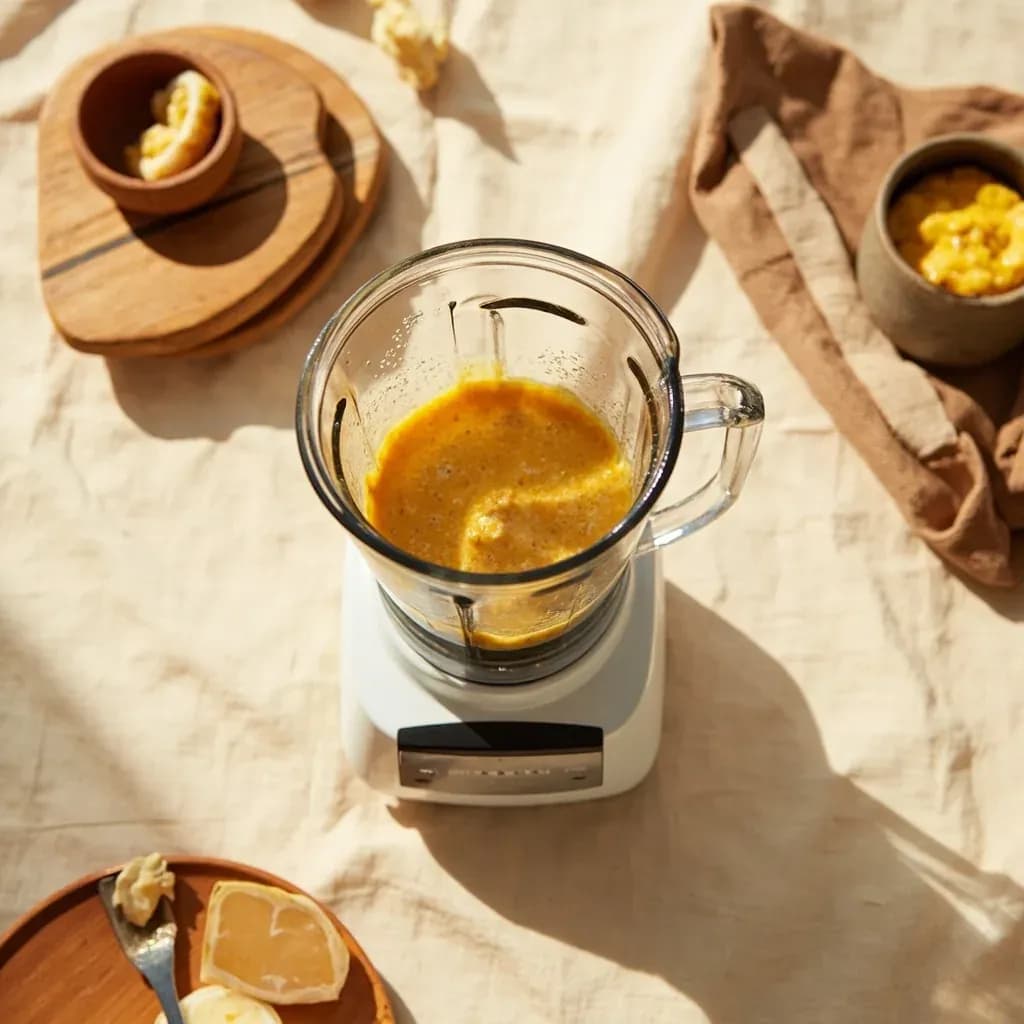
A tall jar over a motor base for purees, smoothies, and emulsified sauces; the upright pitcher and lid handle hot soups and crushed ice better than a handheld stick.
A countertop blender is a tall, lidded pitcher seated on a motor base, with a multi-pronged blade spinning at the bottom of the jar. A rotating blade alone would just fling food outward, so the real genius is the jar's shape: the rounded bottom and slightly tapered walls create a vortex that continuously pulls ingredients down into the cutting zone, recirculating them until they reach the texture you want. That circulation is why a blender excels at anything that should end up smooth or emulsified — purées, sauces, shakes, and frozen drinks — and why it struggles with anything you want to keep chunky.
The workhorse role in a modern kitchen is hard to overstate. A blender is the only everyday tool that can take raw vegetables and ice to a pourable purée in under a minute, build a stable emulsion out of oil and egg yolk, or mill oats into flour. Motor wattage and blade speed determine how far it can push that envelope: a basic 500-watt machine handles smoothies and sauces, while a 1,000-watt-plus machine with a tamper can heat soup from friction, churn nut butter, and turn frozen fruit into sorbet.
The upright design is the meaningful difference between this tool and its close cousin, the immersion (stick) blender. A countertop jar gives you a sealed, ventable lid, more headroom for expanding ingredients like ice, a heavier blade running at higher speed, and a safer way to deal with hot liquids — all of which make it the better choice for ice, frozen fruit, and large-batch purées.
Alternatives
Types & varieties
Mid-range motor (500–900 W), glass or plastic jar, 3–5 speeds. Fine for smoothies, puréed soups, and basic sauces; will stall on thick nut butter or very tough fiber.
Powerful motor (1,000–1,500+ W, 2–3+ HP), aircraft-grade blade, and a tamper for thick loads. Capable of friction-heated hot soup, smooth nut butter, frozen desserts, and ultra-fine purées (Vitamix, Blendtec).
Compact 16–24 oz jar that doubles as a travel cup; lower wattage, best for smoothies and shakes rather than heavy grinding.
Heavy-duty motor with a metal drive coupling, often a stainless jar; designed to take repeated hits from ice and frozen-drink service in cafés and bars.
Borosilicate; resists odor and staining, heavier, can shatter if dropped.
Lightweight, shatter-resistant, BPA-free on most modern units; can absorb stain from turmeric, paprika, or tomato over time.
Virtually unbreakable but opaque, so you can't monitor texture; common on commercial units.
Some high-end machines offer two blade assemblies — sharp for smoothies and purées, blunt for grain, coffee, and nut grinding.
Variable-speed dials give precise control for purées and emulsions; one-touch presets are convenient for smoothies, soup, and ice crush.
Anatomy of a countertop blender
Every blender has the same five working parts, and knowing what each does is the difference between a good blend and a stalled motor.
- Motor base: houses the motor and, on most home units, the control dial or buttons. Wattage and thermal design determine how hard and how long the machine can run.
- Jar (pitcher): the container that holds the food. Its shape — a rounded bottom and slightly tapered walls — creates the vortex that drives circulation.
- Blade assembly: a 2-, 4-, or 6-prong steel blade on a removable base that locks into the bottom of the jar.
- Lid: seals the jar during operation. The removable center cap is both a feed port for adding ingredients mid-run and a vent for steam.
- Gasket: the rubber ring between the jar and blade base. A worn or misaligned gasket is the most common cause of leaks.
How the vortex works
Blades spin fast enough to fling food outward, but the jar walls redirect that motion into a downward spiral along the sides and back up the middle. The result is a continuous conveyor: ingredients at the top get pulled down the walls, hit the blades, rise through the center, and repeat. Liquids are essential to this flow — they act as both the transport medium and the lubricant for the blade bearings. That is why a blender loaded with nothing but ice stalls: there is no liquid to keep the circuit moving, and the motor grinds metal on dry food.
Countertop blender vs the alternatives
The two tools a blender is most often confused with are the immersion (stick) blender and the food processor. They overlap but do not substitute for one another.
- Immersion blender: handheld, used in the pot. Better for small jobs, purées cooked in the pan, and fast cleanup; weaker on ice, frozen fruit, and large batches.
- Food processor: uses a wider, shallower bowl and a horizontal S-blade that chops rather than pulls food into a vortex. Better for anything you want to keep some texture in — chunky pesto, sliced vegetables, pie dough, coarse crumbs — and for shredding or slicing.
- High-performance blender: the only everyday machine that can replace a small grinder for nut butter, fine purées, and frozen desserts.
Common uses
Tips & pitfalls
- Always add liquids to the jar first; they pull solids down into the blade and prevent stalling.
- Layer ingredients in this order: liquids → leafy greens → soft fruit → frozen fruit → ice or hardest items on top.
- Never fill above the jar's max line, especially with hot liquid — steam needs room to vent.
- For hot soups, remove the center cap and cover the opening loosely with a folded kitchen towel; start on low and ramp up so steam can escape without popping the lid.
- Never blend carbonated beverages — pressure can blow the lid off and make a dangerous mess.
- Never run the blender empty or with only ice and no liquid; the blade bearings need food or liquid for lubrication.
- Use pulse for chopping (salsa, nuts, coarse crumbs) and a continuous run for smooth purées; pulse prevents over-processing.
- Use the tamper on Vitamix-style machines to push thick mixtures into the blade. Never reach in with a spoon, spatula, or hand.
- To make nut butter, run continuously for 1–3 minutes; the mixture will go from crumbs to paste to a runny 'tahini stage' before thickening into butter — don't stop at the runny phase.
- Soften hard roots (carrots, beets, squash) by steaming or microwaving first; raw roots can stall the blade on most home units.
- Clean immediately by rinsing the jar, then blending warm water with a drop of dish soap on high for 15–30 seconds; rinse well.
- Remove stains from turmeric, paprika, or tomato by blending a paste of baking soda and water, then rinsing.
- Inspect the rubber gasket on the blade base periodically; a worn gasket is the most common cause of leaks.
- If the motor stalls, stop, unplug, remove the jar, redistribute the contents, and restart on low.
- For mayonnaise, add oil slowly through the feed port while the machine runs on low — this is what builds a stable emulsion.
Good to know
- Inventor
- Stephen Poplawski patented the agitator-style blender in 1922, originally for making malted-milk drinks; Fred Osius refined the design and Fred Waring commercialized it in 1934 as the 'Waring Blendor.'
- Common jar capacity
- 40–64 oz (1.2–1.9 L) for full-size; 16–24 oz for personal/single-serve units.
- Typical motor
- 500–900 W for standard home models; 1,000–1,500+ W (2–3+ peak horsepower) for high-performance and professional units.
- Jar materials
- Borosilicate glass (heavy, stain- and odor-resistant, can shatter); copolyester/Tritan (light, shatter-resistant, can stain); stainless steel (unbreakable, opaque, common on commercial units). Polycarbonate jars exist on older models but are uncommon in new designs.
- Blade configuration
- 2-, 4-, or 6-prong stainless-steel assembly on a removable base; 'wet' blades are sharp for purées, 'dry' or blunt blades are used for grinding grain, nuts, and coffee on machines that offer both.
- Speeds
- 3–10 variable speeds plus pulse; high-end models add presets for smoothie, soup, ice cream, and self-clean.
- Blade speed
- Roughly 3,000–24,000 RPM depending on model and load; higher tip speeds give finer emulsions and faster ice crushing.
- Safety features
- Magnetic or mechanical interlock (won't run with lid or jar removed), motor thermal cut-out, and overcurrent protection on better models.
- Cleaning
- Most jars are top-rack dishwasher-safe; many can be self-cleaned by blending warm water with a drop of dish soap for 15–30 seconds.
Also called
countertop blender · jug blender · jar blender
