Prep Tools
Steamer Rack / Trivet
A raised metal rack that holds food above simmering water so steam can cook it evenly.
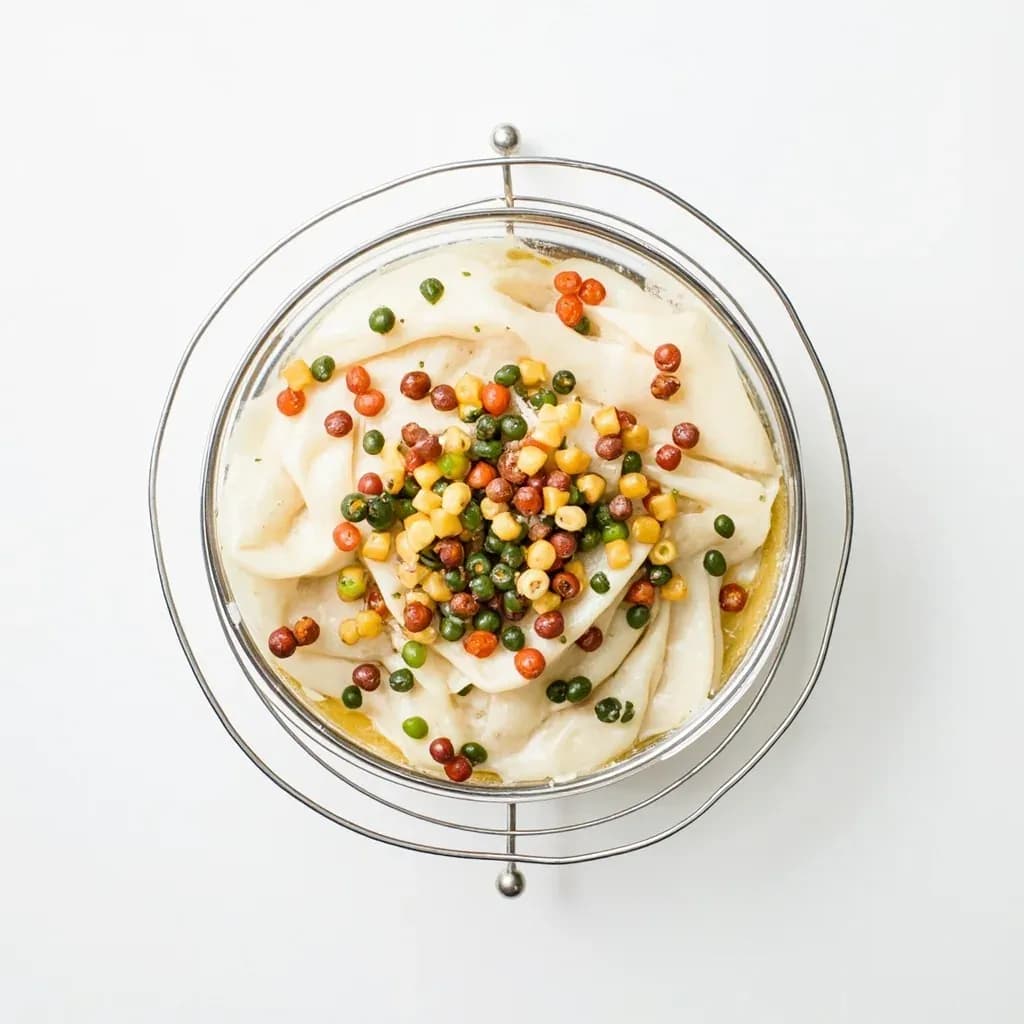
A steamer rack or trivet sits inside a pot or wok to keep plates, dumplings, or bowls of food clear of the boiling water beneath. It lets steam circulate all around the food for gentle, moist cooking, and is also used to elevate dishes in a pressure cooker. A wok ring performs a related job by stabilizing a round-bottomed wok over the burner.
A steamer rack — also called a steam trivet, steamer insert, or simply "the trivet" in pressure-cooker kitchens — is a raised platform placed inside a pot so food sits above a shallow pool of simmering water. The water boils, the steam rises, and the food cooks in that vapor rather than in the liquid. Because steam circulates around every exposed surface, the dish cooks gently and evenly without submersion. The tool is sometimes confused with a table trivet, the heat-resistant mat or stand set on a counter under a hot dish; they share a name but do different jobs.
Steam is a particularly gentle heat-transfer medium. At 100 °C / 212 °F it carries more latent heat than water at the same temperature, but it transfers that energy without the mechanical agitation of a rolling boil. Vegetables hold their color and snap, fish stays moist and flaky, and dumplings keep a tender skin that would dissolve in a pot of water. Soluble flavor and water-soluble nutrients stay in the food rather than leaching into cooking liquid that gets poured away.
Material changes the result. Stainless steel is the workhorse for everyday vegetables and fish and tolerates any heat a home stove can produce. Bamboo, the traditional Chinese steamer basket, absorbs the condensate that drips from the lid — exactly what you want for buns, dumplings, and tamales, where dripping water would sog out the skin. Silicone collapses flat for storage and is gentler on nonstick cookware. In a pressure cooker, a small footed trivet is the foundation of pot-in-pot cooking: it lifts an inner dish above the liquid so custards set, cheesecakes bake, and rice steams rather than boils.
Alternatives
Types & varieties
Stackable traditional Chinese design with woven lid; the wood absorbs excess condensation so dumplings and buns don't get soggy.
Spring-style ring that adjusts to fit multiple pot diameters; perforated sides for steam circulation.
Folds flat for storage; heat-resistant, non-reactive, dishwasher-safe, and gentle on nonstick cookware.
Short three-legged or low-footed metal rack used inside Instant Pot–style cookers; keeps food above the liquid for pot-in-pot steaming.
Solid metal disc with short legs, used in pressure cookers to hold pans or dishes above the cooking liquid.
Domed or ring-shaped rack sized to sit inside a wok above water for steaming whole fish or buns.
Solid perforated tray that rests on a pot's rim or internal ledge, used for vegetables and fish.
Lightweight and highly conductive; often sold as a tiered insert; not ideal for acidic foods over long cooks.
Reading the term 'trivet'
The word 'trivet' pulls double duty in a cook's kitchen, and reaching for the wrong one is a common reason a recipe seems to misbehave.
- In-pot steam or elevating trivet: a footed, perforated, or ringed stand placed inside a saucepan, stockpot, or pressure cooker to lift food above simmering water. The subject of this entry.
- Table trivet: a heat-resistant mat, tile, cork pad, or cast-iron stand set on the counter or dining table to protect surfaces from a hot vessel. It never goes in the pot.
- Pressure-cooker manuals and most British recipes use 'trivet' in the in-pot sense; American kitchenware catalogs and many cookbooks use it in the table sense. Read the context before you shop.
Bamboo vs. metal vs. silicone
No single rack is best for every job. Match the material to the food, the heat, and the storage you have.
- Stainless steel: the all-rounder. Withstands the highest sustained heat, vents steam efficiently, and is dishwasher-safe. Reach for it for green vegetables, root vegetables, fish, and anything that needs a long, hard steam.
- Bamboo: best for delicate, sticky, or flour-dusted foods — dumplings, bao, momos, tamales, fish with skin. The wood wicks condensate off the lid so drops fall on the bamboo rather than the food. Never soak it, and never put it over a direct flame or in the dishwasher; the basket sits on top of a pot of boiling water (above the water line) and is air-dried after washing.
- Silicone: collapses flat, stores in a drawer, and is gentle on nonstick and enameled interiors. Heat tolerance typically tops out around 230 °C / 450 °F, fine for any stovetop steaming.
- Aluminum: light and quick to heat, but reactive with acidic foods (tomato, lemon, wine) over long cooks. Use it for quick vegetable steams, not for braised fish in citrus.
Common uses
Tips & pitfalls
- Keep water 2.5–5 cm (1–2 in) below the rack. If it touches the food, you are boiling, not steaming — and the texture will suffer.
- Bring the water to a boil before adding food, then drop to a steady, vigorous simmer so steam is continuous but the pot doesn't boil dry.
- Cover with a tight-fitting lid. Even a small gap noticeably slows cooking and produces uneven texture across the batch.
- Leave space between pieces. Steam must circulate; overcrowding gives you gummy outsides and undercooked centers.
- Add aromatics to the water — lemon slices, ginger, garlic, fresh herbs, star anise, dried chilies — to flavor the steam and gently perfume the food.
- For long steams, top up with hot water from a kettle rather than cold, so the pot temperature doesn't drop and stall the cook.
- Line bamboo steamers with cabbage leaves, parchment rounds, or lettuce leaves to stop dumplings, buns, and sticky items from adhering to the slats.
- Always use oven mitts or tongs when lifting the lid. Escaping steam causes serious burns, and the lid drips hot condensate back onto the food.
- Stainless steel and silicone racks go in the dishwasher; bamboo should be hand-washed in warm water, dried immediately, and never soaked or it will split.
Good to know
- Primary function
- Holds food above simmering water so circulating steam cooks it evenly without submersion
- Common materials
- Stainless steel, aluminum, bamboo, silicone
- Typical diameters
- 6 in (15 cm), 8 in (20 cm), 9 in (23 cm), 11 in (28 cm); some models are expandable or collapsible
- Also called
- Steaming rack, vegetable steamer, steam trivet, steamer insert
- Distinction from table trivet
- An in-pot steam or elevating trivet sits inside the pot to lift food; a table trivet sits on the counter to protect surfaces from a hot vessel
- Water level
- Generally 2.5–5 cm (1–2 in) of water, kept just below the rack and never touching the food
- Bamboo steamer origin
- Stacked bamboo steamers have been used in Chinese cooking for roughly 1,500–2,000 years, dating to the Han Dynasty
- Pressure-cooker trivet
- Short three-legged or low-footed metal stand used in electric and stovetop pressure cookers to keep food above liquid for pot-in-pot cooking
Also called
metal-steamer-rack · trivet · steaming rack · wok-ring
Related

Peeler
Swift blade for stripping skin off fruit and vegetables

Grater
Sharp-toothed surface for shredding cheese and vegetables

Microplane
Ultra-fine rasp for citrus zest, garlic, and hard cheese

Mixing Bowl
All-purpose bowl for combining, whisking, and tossing

Whisk
Looped wires that beat air into eggs, cream, and sauces

Spatula
Flat blade for flipping, lifting, and scraping

Slotted Spoon
Pierced spoon that lifts solids and drains the liquid behind

Wooden Spoon
Gentle, heat-friendly spoon for stirring anything