Prep Tools
Steel Tiffin Box
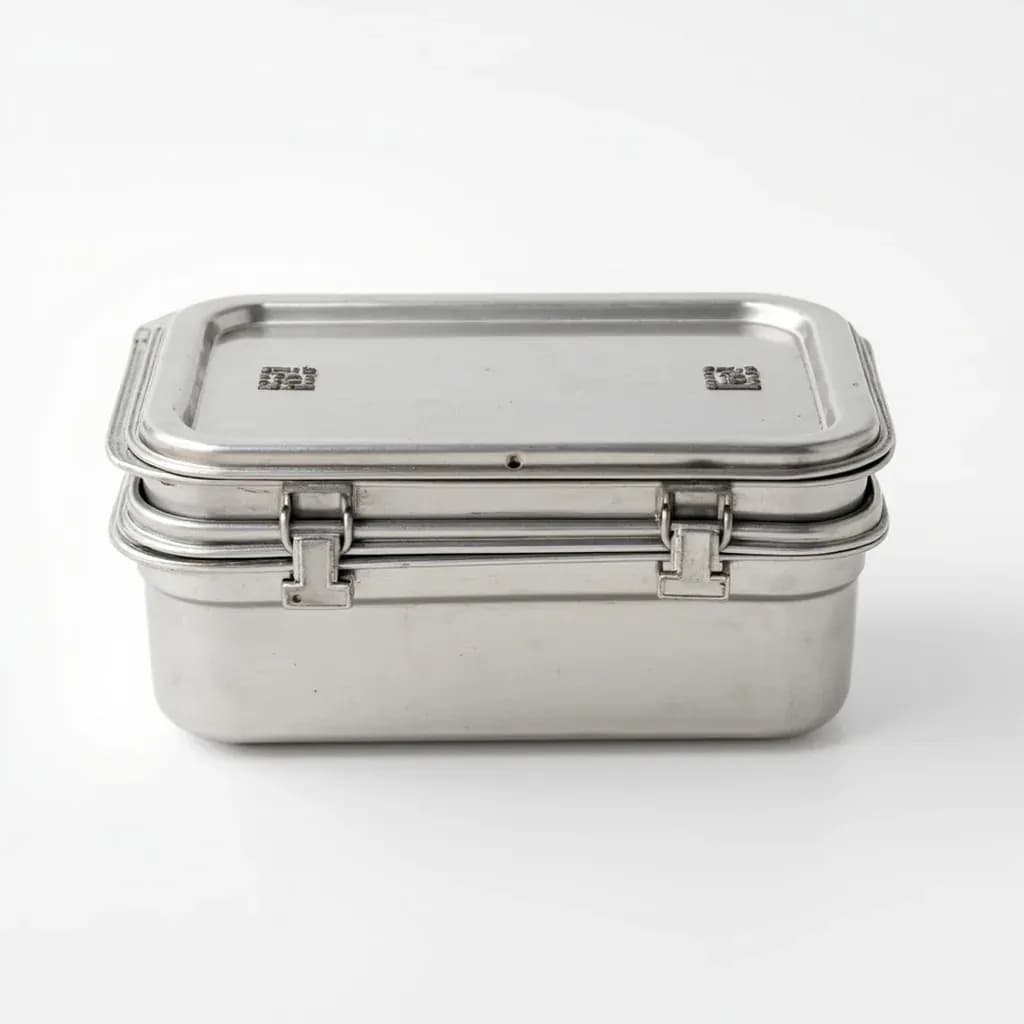
A stacked, clip-locked stainless lunch carrier that keeps several dishes separate for transport.
A steel tiffin is a set of stackable stainless containers held together by a side clamp and carrying handle, used to pack a multi-course meal, rice in one tier, curry in another, without mixing. It is the classic Indian and South Asian lunch carrier, famously delivered by Mumbai's dabbawalas. The tiers nest and lock so the whole stack travels as a single unit.
A steel tiffin is a stack of two to four (sometimes five) shallow, food-grade stainless steel containers that clip together with spring-loaded side clasps to form a single, tidy column for carrying. The form is the South Asian answer to a problem every packed-lunch cook knows: a rice, a sabzi, a roti, and a pickle want to live in four different worlds on the way to the table, and a single compartment smears them into one. The clips hold the stack rigid for carrying, and the rims seat firmly against each other to keep dry foods in their own tier, though liquids need an inner container because there is no gasket.
The format is not new. It grew out of 19th-century Indian practice of ferrying freshly cooked midday meals from home to workers, and the Mumbai dabbawala network has been moving roughly 175,000–200,000 such lunches a day by hand-cart, train, and bicycle since the 1880s, using a colour-and-symbol coding system studied as a Six Sigma logistics operation. In a Western kitchen the tiffin is best understood as a meal-prep and picnic tool rather than a thermos: stainless conducts heat quickly, so food cools to ambient within about an hour unless the set travels in an insulated sleeve.
For cooks who batch-cook or pack colourful, multi-component lunches, the tier system does something no single-chamber lunchbox can — it keeps textures honest. A damp roti stays dry, a wet dal stays in its own cup, a fried snack does not get crushed by the rice on top, and a pickle keeps its sharp edges away from the dal. The trade-off is real: no insulation, no leak-proof seal, and the obligation to think about loading order.
Alternatives
Types & varieties
The smallest practical set; one main and one side. Easiest to seal and carry, useful for a single diner with a drink or dessert in the second tier.
The traditional Mumbai dabba — one tier each for sabzi, roti/flatbread, and rice or dal, with a small inner cup often reserved for pickle or sweet.
Used for fuller thali-style meals with separate compartments for rice, dal, sabzi, and a dry side or sweet; heavier and more crowded than the 3-tier.
More common in Pakistani and Bangladeshi designs; the flat shape fits chapati and paratha without folding.
A single-tier small steel box used for paratha rolls, sandwiches, or sweets; often sold as part of a larger set.
Loading order: what goes where
The tiers of a tiffin are not interchangeable. Because there is no gasket, anything that can slosh sits at the bottom of the stack, where the clip pressure is highest, and anything dry or fragile sits at the top, where it is least likely to be crushed.
- Bottom tier: the wettest dish — dal, rasam, kadhi, curries. Liquids belong here, ideally in a small inner steel bowl or jar, so a tilted carry does not pool between tiers.
- Middle tier: rice, biryani, khichdi, or any grain that wants to stay fluffy and separate from the wet dishes.
- Top tier (under the lid): rotis, parathas, theplas, or fried snacks. Lay them flat on a small steel plate or a clean cloth napkin to catch condensation from the lid.
- Inner cup: pickle, chutney, raita, or dessert. The cup travels in whichever tier has space; in the traditional Mumbai dabba, the small bowl sits on top of the rice in the rice tier.
- Lid: keep it dry. Wipe it before clipping shut so a drop of water does not drip down onto the rotis.
Tiffin and bento: a comparison
A steel tiffin and a Japanese bento box solve the same problem — a multi-compartment lunch that travels well — with different material vocabularies and eating etiquette. The bento is built around lacquer, plastic, or wood, with internal dividers in a single box, and it is designed to be opened and eaten from the same container. The tiffin is a vertical stack of separate small boxes, opened tier by tier and plated (or eaten) from each one in turn. The bento stays warm longer because the closed box traps steam; the tiffin cools fast because steel conducts heat. Modern 'bento-style' marketing in the West sometimes uses the words interchangeably, but the form, the food, and the way the meal is eaten are distinct.
Common uses
Tips & pitfalls
- Grease the rim of each tier lightly with oil before clipping shut — it helps the rims seat, slows stale-air exchange, and keeps the seal tighter on a long carry.
- Always wrap liquids, dals, and rasam in a separate small jar or steel bowl inside the relevant tier; stacked tiffins are not designed to be leak-proof on their own.
- Load the heaviest, most liquid food in the bottom tier so it bears less jostling pressure and the top tier stays dry and unbruised.
- Keep rotis and fried items in the top tier under a small steel plate or a cloth napkin to retain warmth and stop steam from the lid dripping back into them.
- Carry the set inside an insulated cloth sleeve if you need the food to stay warm for more than 30–45 minutes — bare steel cools quickly.
- Check the side clips before each trip; the small springs weaken over time, and a loose clip will pop open if the carrier is tilted in a bag.
- Air-dry every tier completely with lids removed after washing — trapped moisture between rims causes a metallic, stale smell on the next use.
- Avoid carrying strong-smelling foods (raw mango pickle, strong garlic) without an inner container — steel does not absorb odours, but a residual film can transfer to the next meal.
- Don't microwave any tier directly — transfer food to a microwave-safe dish first. Stainless steel in a microwave is an arcing hazard.
- Replace the set if you see warping or bent rims; a warped tier will never clip tightly and leaks no matter what you do.
Good to know
- Origin
- South Asia, especially India and Pakistan; the word 'tiffin' (a light midday meal) entered British colonial usage in the 19th century
- Material
- Food-grade stainless steel, typically 18/8 or 18/10 grade
- Construction
- Two to four (sometimes five) tiers that stack and lock together with side clips and a folding top handle
- Capacity
- Each tier holds roughly 300–500 ml; a 3-tier set totals about 1–1.5 L
- Sizes
- Small (2-tier), medium (3-tier), large (4-tier); tier diameters commonly 12–16 cm
- Seal
- Tight rim-fit and clip pressure only — no gasket, so the carrier is not leak-proof for liquids without an inner container
- Weight (empty 3-tier)
- Approximately 500–900 g
- Dishwasher
- Top-rack safe on most models
- Microwave
- No — stainless steel must never go in a microwave; transfer food to a microwave-safe dish first
- Tradition
- The Mumbai dabbawala system has used these stacked carriers to deliver home-cooked lunches to office workers since the late 1800s
Also called
Tiffin Carrier · Dabba · Lunch Box · Tiffin
Related

Peeler
Swift blade for stripping skin off fruit and vegetables

Grater
Sharp-toothed surface for shredding cheese and vegetables

Microplane
Ultra-fine rasp for citrus zest, garlic, and hard cheese

Mixing Bowl
All-purpose bowl for combining, whisking, and tossing

Whisk
Looped wires that beat air into eggs, cream, and sauces

Spatula
Flat blade for flipping, lifting, and scraping

Slotted Spoon
Pierced spoon that lifts solids and drains the liquid behind

Wooden Spoon
Gentle, heat-friendly spoon for stirring anything