Cookware
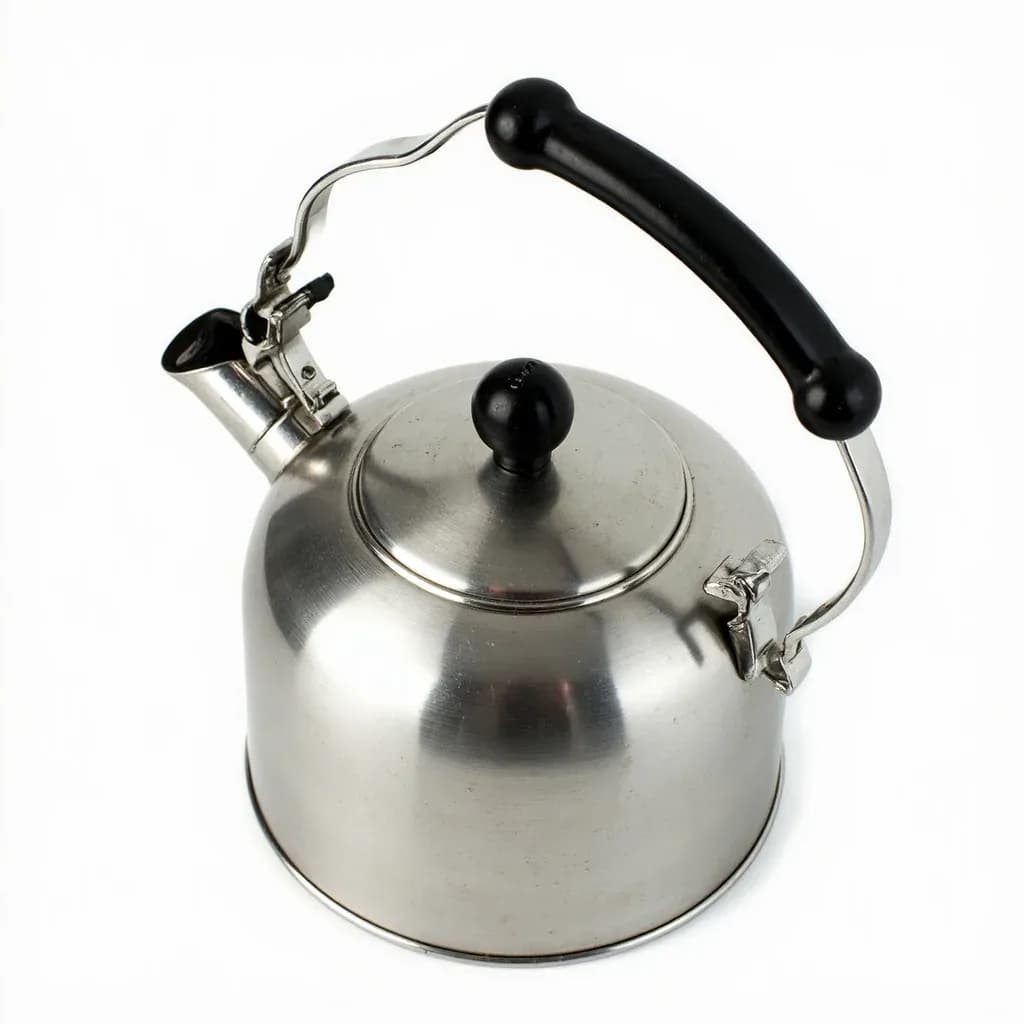
Stovetop Kettle
Burner-heated kettle for boiling water, often with a whistle to signal it's ready.
A metal kettle heated on a stovetop burner to boil water for tea, coffee, and cooking. Many have a whistling spout that signals when the water reaches a boil. It's a simple, electricity-free way to heat water and a fixture in kitchens worldwide for pour-over coffee and quick boiling.
A stovetop kettle is a purpose-built water-boiling vessel, set apart from a saucepan by its wide base and dedicated pouring spout — proportions that let it heat a quart of water noticeably faster than a covered pot. Most models carry a steam-activated whistle on the spout that sounds the moment the contents reach a rolling boil, freeing the cook to step away. Because the kettle is dedicated to water, it never picks up the flavors or starch residue that would compromise tea, coffee, or any recipe where water purity matters.
Materials shape the experience more than the silhouette does. Copper and aluminum conduct heat fastest, so a two-quart pot reaches a whistle in roughly four to six minutes on a high-output gas burner. Cast iron is slow to heat but holds temperature longer, which is why the Japanese tetsubin tradition favors it for keeping water hot through several pours. Stainless steel is the slowest of the common metals, but it wins on durability and induction compatibility. The whistle itself is a two-piece cap with a small aperture: when steam pressure builds, the cap vibrates and produces a tone at roughly 100 °C — so a silent kettle is almost always a scaled-up kettle, not a broken one.
For a cook choosing one, the practical questions are cooktop compatibility (induction requires a magnetic base), capacity (2 to 2.5 quarts suits most households), and how the handle behaves when the body is hot. A phenolic or wood grip stays comfortable; an all-metal swing handle is elegant but demands a mitt or a folded towel.
Alternatives
Types & varieties
Cylindrical body, side handle, and a flip-up whistle on the spout. The dominant American style since the early 20th century (e.g., Revere Ware, and later All-Clad).
Usually without a whistle, with a short arched handle and a slightly downturned spout. Unlined or enameled interior; prized for boiling water for green tea.
Long, narrow curved spout for precise pouring speed and placement; a modern, typically non-whistling variety designed for pour-over coffee.
European style with a single pivoting arched metal handle; common in copper, tin-lined copper, or polished stainless. Most do not whistle.
Classic enameled or stainless body with a heat-resistant knob and handle, e.g., Le Creuset Classic (introduced in the 1960s).
Dial thermometer on the lid; favored for pour-over coffee and specific tea steeping temps (green tea ~80 °C, black tea ~95 °C).
Ornamental textured surface, often enameled steel; functional but often bought as much for looks as for use.
Stainless model with a flat magnetic-clad base that works on induction cooktops; a plain copper or aluminum kettle will not.
How the Whistle Works (and Why It Stops)
The whistle is not a defect-prone part — it is a tiny steam-pressure system. A two-piece cap sits over the spout, with the top piece carrying a narrow slot. As water approaches a rolling boil, steam pushes up through that slot; the pressure differential across the cap causes it to vibrate and produce the familiar tone, typically at or just above 100 °C. Most 'the whistle stopped working' complaints are scale issues, not mechanical ones. Hard-water minerals precipitate fastest right at the spout opening, where the water is shallowest and the temperature highest. A quick fix is to remove the cap, soak it in warm white vinegar for 20–30 minutes, then clear the small hole with a pin or a bamboo skewer. If the whistle sounds but at a much lower pitch, the cap has loosened; reseat it and the tone returns. Replacement whistle caps are usually available from the manufacturer and cost far less than a new kettle.
Matching Material to Your Cooktop
Material dictates how fast a kettle heats, how long it holds temperature, and which cooktops it will work on. For most kitchens, the choice comes down to three families.
- Stainless steel — the workhorse. Durable, induction-ready (with a clad disc base), indifferent to a hard water supply, and easy to clean. Heats more slowly than copper but is the most forgiving daily driver.
- Copper (usually tin-lined inside, brass handle) — the fastest conductor. A 2-quart copper kettle can whistle in roughly four minutes on a high-Btu burner. The trade-off is exterior upkeep (polish, or accept the patina) and the need for a separate induction interface on an induction range.
- Cast iron — slow to heat, slow to cool. Best when you want water to hold its temperature for several minutes, as in Japanese green tea preparation. Heavy, and naturally induction-compatible (iron is ferromagnetic), though the slow heat-up makes it less practical for that use.
- Enameled steel — lighter than cast iron, prettier than raw steel, and the standard for hobnail and decorative kettles. Drop one and the enamel can chip, exposing the steel beneath to rust.
Common uses
Tips & pitfalls
- Fill only what you need; an under-filled kettle takes disproportionately long to whistle and wastes energy, while an over-filled one can spit boiling water from the spout.
- Use medium heat rather than high — water reaches a rolling boil almost as fast, with less noise and less disturbance of mineral scale on the base.
- Kill the heat the instant the whistle sounds; leaving the kettle whistling boils off water, scorches the whistle gasket, and on enameled models can discolor the finish.
- Descale monthly in hard-water areas: simmer a 1:1 white-vinegar-to-water solution, let stand 30 minutes, then scrub the interior with a non-scratch pad and rinse thoroughly.
- If the whistle is weak or silent, the spout cap is almost certainly clogged with mineral scale — soak it in vinegar and clear the small hole with a pin before assuming the kettle is broken.
- Match the base to your cooktop: induction requires a magnetic (ferrous) base, so plain copper or aluminum kettles will not heat on an induction range.
- Don't use a kettle to boil milk, stock, or anything sugary — residue burns onto the base and is very hard to remove, and it ruins the kettle for clean-tasting water.
- On gas, center the kettle and keep the flame under the base only; flame licking up the sides will discolor stainless and can crack or strip enameled finishes.
Good to know
- Category
- Cookware (water-heating vessel)
- Primary materials
- Stainless steel, copper, aluminum, cast iron (often enameled), enameled steel
- Typical capacity
- 1.5–3 quarts (1.4–2.8 L); 2–2.5 qt is the most common household size
- Heat source
- Gas, electric coil, electric glass-top, and (only with a magnetic base) induction
- Whistle mechanism
- Two-piece steam-activated cap on the spout that vibrates at ~100 °C / 212 °F
- Average time to boil
- 2 qt on high-Btu gas: 4–6 minutes; on electric coil: 6–9 minutes; cast iron is noticeably slower
- Care
- Hand-wash; descale with white vinegar or citric acid every 1–3 months in hard-water areas
- Not for
- Milk, oils, stock, or anything other than water — not a substitute for a saucepan or stockpot
Also called
Tea Kettle · Whistling Kettle
Related

Steamer
Gentle moist heat that keeps vegetables, fish, and dumplings tender

Frying Pan
Shallow sloped pan for frying, sautéing, and quick sears

Saucepan
Tall, straight-sided pot for sauces, grains, and small batches

Sauté Pan
Wide straight-sided pan with room to brown and braise

Dutch Oven
Heavy lidded pot that turns tough cuts tender over hours

Stock Pot
Tall, roomy pot for stocks, pasta, and big-batch cooking

Wok
High-sided bowl pan built for blistering-hot stir-fries

Griddle
Flat, broad surface for pancakes, smash burgers, and breakfast