Prep Tools
String Hopper Mat (Idiyappa Mat)
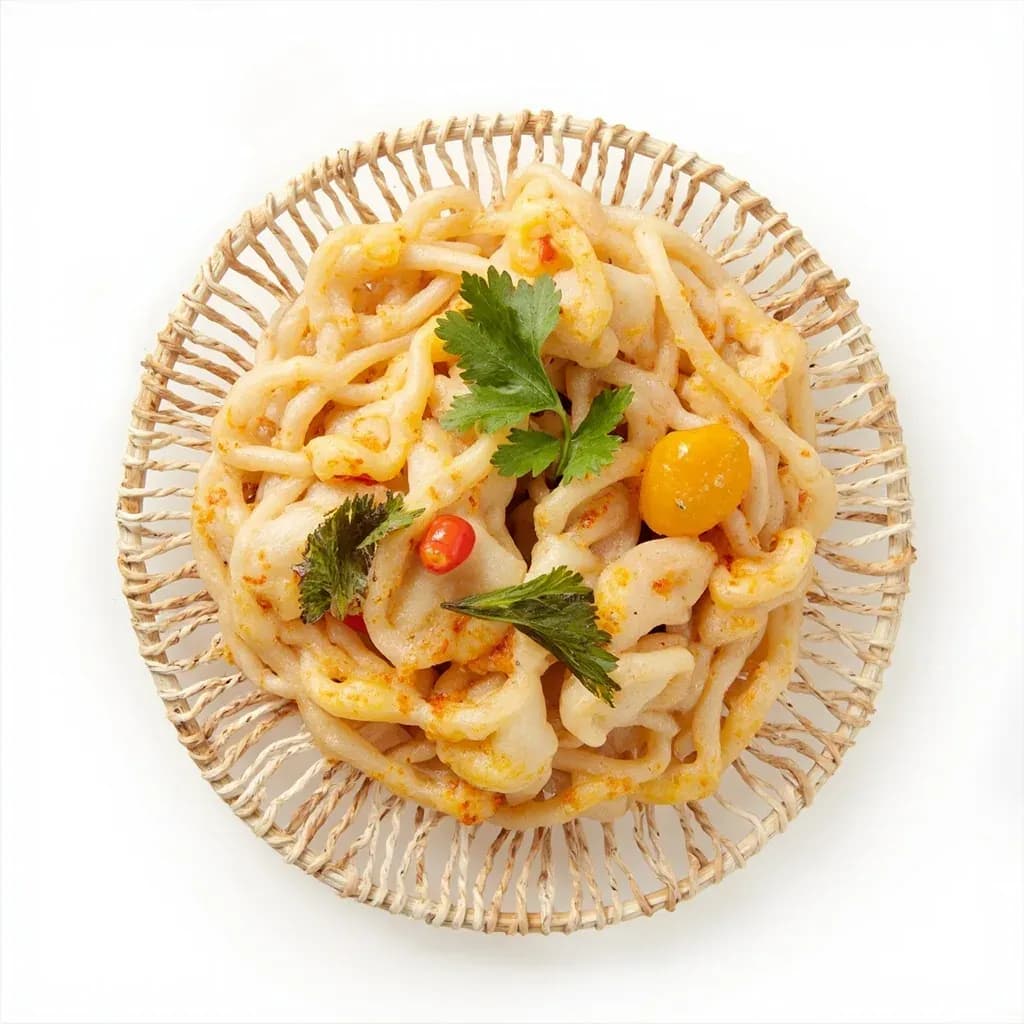
Small woven mat that holds pressed rice-flour noodles for steaming into string hoppers.
A small round mat, traditionally woven from cane or plastic, onto which fine rice-flour noodles are pressed in a swirl to form a string hopper. The loaded mats are stacked in a steamer to cook the delicate noodle nests, a staple breakfast in Sri Lanka and South India. The mat keeps each hopper intact and easy to lift after steaming.
The idiyappam mat is the receiving surface in a two-tool system that turns soft rice-flour dough into the lacy, separate-strand cakes known as idiyappam, nool appa, or string hoppers. It is a flat circular disc with raised woven ridges, traditionally hand-plaited from thin bamboo splints in Kerala and Tamil Nadu. A string hopper press (the sevai nazhi, a chakli press fitted with a fine-hole disc) extrudes the dough directly onto the mat, which is then lowered into a steamer pot for eight to ten minutes.
The mat is not interchangeable with a flat plate. Its ridges lift the noodles off a solid base, letting steam circulate from below and giving the finished cake its light, open, stringy texture instead of a gummy pancake. Without that raised surface the rice flour fuses into a dense disc. The same mat is used in Sri Lankan kitchens for the closely related nool appa, and the breakfast set — mat, press, steamer — is often sold as a unit in markets across South India and in Tamil diaspora shops abroad.
Most home mats are 18–25 cm in diameter and yield two to four servings per batch. Bamboo is the traditional material because it imparts a faint, pleasant aroma and dries quickly; food-grade silicone mats have become a popular low-maintenance alternative for cooks who want a dishwasher-safe option.
Alternatives
Types & varieties
The traditional form; lightweight, gives a faint bamboo aroma, needs oiling and thorough drying.
Modern, non-stick, flexible, dishwasher-safe; slightly more even heat but lacks the bamboo's character.
Durable, restaurant-grade; sits on a trivet in the steamer, perforations allow steam to pass.
Hollow cone-shaped variant used in parts of Tamil Nadu and Sri Lanka to produce tall, nest-shaped string hoppers.
Smaller 12–15 cm versions for single-serving portions or bite-sized rice cakes.
Bamboo vs silicone: choosing your mat
The choice comes down to care tolerance and what you want from the finished cake. Bamboo, as used in Kerala and Sri Lanka, releases a trace of aroma into the noodles, but it demands attention: oil before each use, rinse without soap, and sun-dry fully or it will mildew. Silicone is genuinely low-maintenance — no oiling, dishwasher-safe, no mildew risk — but it does not breathe the way bamboo does, and very wet dough can sit on the surface rather than gripping it. Warped silicone mats, which can develop over time with repeated high-heat use, will give unevenly steamed cakes with raw spots at the dips, so replace them as soon as you notice the wobble. For occasional cooks silicone wins on convenience. For frequent home use, a well-cared-for bamboo mat produces the most characterful result.
Common uses
Tips & pitfalls
- Lightly brush the mat with coconut oil or ghee before pressing noodles — this is the single most important step to stop the rice cake from sticking and tearing on lift-off.
- Press the noodles in slow concentric circles, keeping the lattice thin and even; thick patches turn gummy at the center while thin patches dry out.
- Leave small gaps in the lattice so steam can rise through and cook the underside — a tightly packed mat steams unevenly and the bottom strands stay raw.
- Keep the steamer's water level below the rack holding the mat; splashing boiling water makes the noodles soggy and waterlogged.
- Steam only over a rolling boil, and start the timer the moment the lid goes on — 8–10 minutes is usually enough; over-steaming makes idiyappam rubbery.
- Lift the whole mat out of the steamer the instant it's done and let the noodle cake rest 30–60 seconds before peeling — it firms up just enough to slide off cleanly in one piece.
- Rinse bamboo mats under running water only (no soaking), towel-dry, then sun-dry fully before storage; trapped moisture causes mildew and a sour smell that taints the next batch.
- Never use soap on a bamboo mat — the fragrance soaks into the bamboo and migrates into the rice noodles next time you steam.
Good to know
- Also called
- Idiyappam thattu (Tamil), nool appa mat, idiappam plate, string hopper mat
- Origin
- South India (Kerala, Tamil Nadu) and Sri Lanka, evolving alongside the rice noodle dish idiyappam
- Primary material
- Hand-woven bamboo splints; modern versions in food-grade silicone or stainless steel
- Typical diameter
- 18–25 cm (7–10 in) for home use; 30 cm versions exist for commercial kitchens
- Used with
- A string hopper press (sevai nazhi) and a steamer pot or idli cooker
- Steam time
- 8–10 minutes over rapidly boiling water once noodles are pressed on
- Yield per mat
- 2–4 servings of idiyappam depending on diameter
- Care
- Bamboo must be rinsed, towel-dried, and sun-dried to prevent mildew; never use soap, which flavors the next batch
Also called
Idiyappam Mat · Idiyappa Mat · String Hopper Tray
Related

Peeler
Swift blade for stripping skin off fruit and vegetables

Grater
Sharp-toothed surface for shredding cheese and vegetables

Microplane
Ultra-fine rasp for citrus zest, garlic, and hard cheese

Mixing Bowl
All-purpose bowl for combining, whisking, and tossing

Whisk
Looped wires that beat air into eggs, cream, and sauces

Spatula
Flat blade for flipping, lifting, and scraping

Slotted Spoon
Pierced spoon that lifts solids and drains the liquid behind

Wooden Spoon
Gentle, heat-friendly spoon for stirring anything