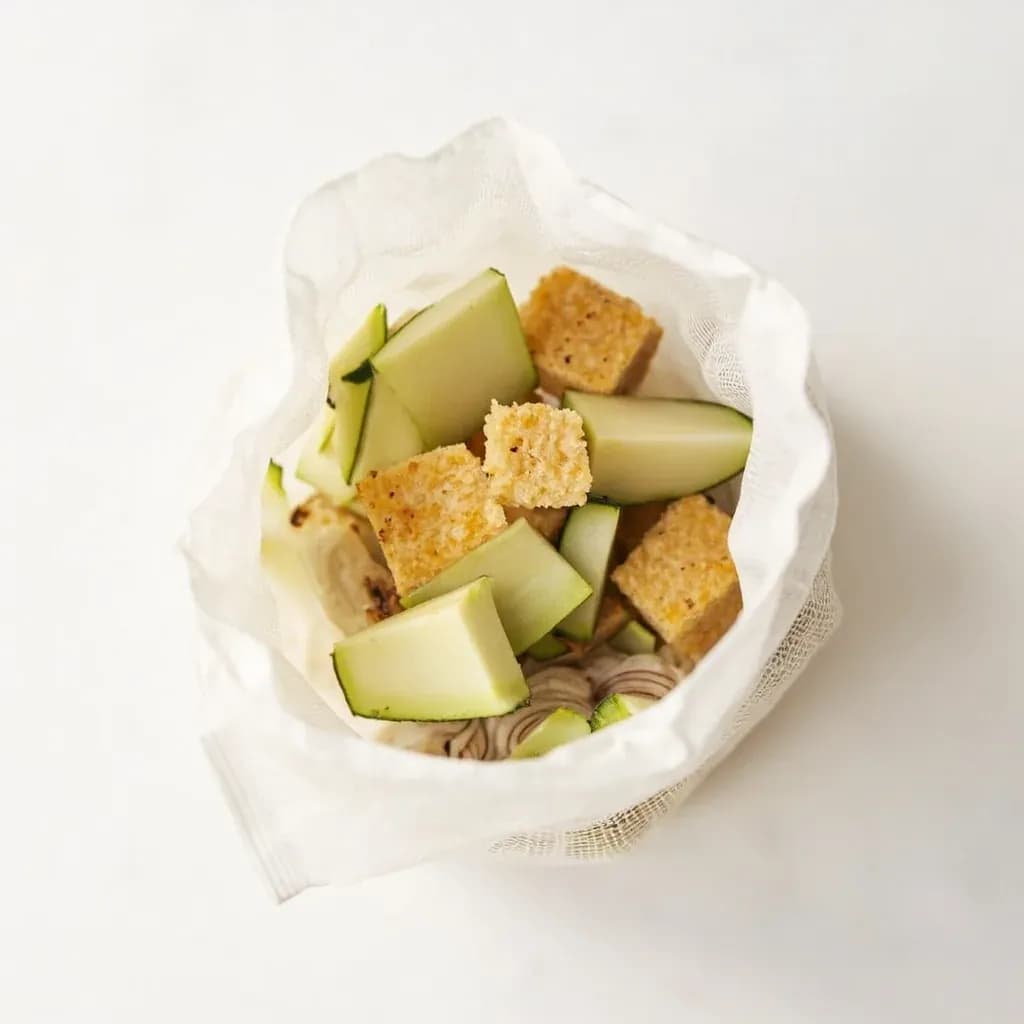
Prep Tools
Superbag (Fine Filter)
Reusable ultra-fine mesh straining bag for crystal-clear stocks, juices, and purees.
The Superbag is a reusable fine-mesh straining bag, made in graded micron sizes, used to filter liquids to remarkable clarity. Chefs use it to clarify stocks and consommé, strain fruit and vegetable juices, and produce silky purees and infusions. Its tight, durable weave catches far finer particles than cheesecloth and rinses clean for reuse.
The Superbag is a reusable, ultra-fine mesh straining bag made from food-grade nylon monofilament, with a reinforced cuff that lets it drape over a pot or stockpot like a deep, permeable pouch. The flagship Fine version filters at roughly 200 microns — tight enough to catch the small particles of herb, pulp, and protein that cloud a stock, open enough that liquid flows through steadily under gravity alone. It is, in essence, the modern professional's answer to a problem cooks have wrestled with for centuries: how to clarify a liquid without single-use cheesecloth or an hour at a chinois.
The bag's innovation is not the nylon itself but the combination of fine gauge, monofilament weave (which does not shed lint), a stiffened rim that holds the bag open, and reusability. Used correctly — hung from a ladle or pot rim, never wrung, and rinsed the moment the run is done — it delivers a level of clarity that previously required multiple chinois passes, and for many stock applications rivals the polish once reserved for egg-white fining. Squeezing, by contrast, forces fine solids back through the mesh and undoes the clarifying effect, which is why the bag's reputation rests as much on technique as on hardware.
For the home cook, it is one of the most useful upgrades to a stock-clarifying setup, offering a finer filter and far greater capacity than a fine-mesh sieve, and a more practical alternative to cheesecloth for dairy work — yogurt, ricotta, paneer — where the old standby shed lint and demanded four to six layers to do the same job.
Alternatives
Types & varieties
The ~200-micron original and most-cited model. Used for crystal-clear stocks, nut milks, juices, and purées.
Coarser weave, roughly 400+ microns, for faster draining of coulis, thicker purées, or stock where ultimate clarity is not the goal.
Largest openings; primarily for containing whole spices, herbs, tea leaves, or peppercorns during simmering rather than for fine straining.
Cylindrical versions designed to line a chinois or stand in a pot, useful for very large-batch straining.
Bag vs. Cheesecloth, Chinois, and Nut-Milk Bags
The Superbag is not the only fine-straining tool in a kitchen, but it sits in a useful middle ground that makes the others feel specialized. Most cooks end up reaching for it more often than they expect.
- Vs. cheesecloth: faster (one rigid layer rather than four to six loose), no lint shedding, reusable. Cheesecloth still wins for ultra-fine drying of herbs or for wrapping a terrine where shape matters.
- Vs. chinois: the Superbag filters finer but is slower. Many kitchens use both in sequence — chinois first to remove coarse solids, Superbag second to polish to a glaze.
- Vs. traditional nut-milk bag: the Superbag's tighter weave yields a noticeably smoother milk. The trade-off is slower flow, so for very large batches some cooks press the first pass through a nut-milk bag and finish with a Superbag.
- Vs. fine-mesh sieve: a sieve cannot hold enough volume to clarify a stock in one pass; the Superbag's deep pouch is what makes the difference.
Care and Lifespan
Treat the bag the way you treat a good towel: rinse it the moment you are done, wash it properly, and let it dry flat. With reasonable care, a Superbag will run hundreds of cycles before the mesh begins to soften or the cuff loses stiffness.
- Rinse immediately after every use — dried stock solids or nut-milk residue can permanently clog the mesh if left to set.
- Wash by turning the bag inside out under hot running water with a little dish soap, or run it through a commercial dishwasher.
- Periodically boil the bag in a pot of water with a splash of baking soda to release trapped fat and protein, then rinse clean.
- Avoid chlorine bleach, which degrades nylon over time; oxygen-based cleaners are safer if you need to brighten a stained bag.
- Store fully dry and folded flat — never put away wet, which invites mildew and lingering odor.
- Replace the bag when the mesh begins to pill, the weave stretches, or the cuff no longer holds its shape on the pot rim.
Common uses
Tips & pitfalls
- Pre-wet the bag with hot water before first use to flush any residual sizing or loose filament from the monofilament.
- Hang the bag from a ladle, bench scraper, or the rim of a tall stockpot so it acts as a gravity filter — the weight of the liquid does the work, and the result is far clearer than any squeezing.
- Never wring the bag. Squeezing forces fine solids back through the mesh and undoes the clarifying effect. To speed a slow drip, gently lift and lower the bag to 'pulse' the liquid through.
- For a stock that must gleam, do a second pass through a rinsed bag — the first run catches most solids, the second delivers a polish.
- Rinse the bag the moment you are done; dried-on residue is the single most common cause of a permanently clogged Superbag.
- Keep a dedicated 'dairy' bag and a dedicated 'savory/stock' bag to avoid flavor cross-contamination, the way professional kitchens treat cutting boards.
- The Fine bag is the right choice for clarity work; reach for the Coarse only when you want a spice sachet or a quick first-pass drain, not a polish.
- Remember that the bag filters particulates, not fat or dissolved protein — skim first, and for consommé-grade polish consider a separate clarification step.
Good to know
- Brand / Maker
- Chef Rubber (Culinary USA), the company that popularized the reusable ultra-fine nylon straining bag in professional kitchens.
- Country of Origin
- Designed and sewn in the USA; mesh sometimes imported.
- First Popularized
- Entered U.S. professional kitchens broadly in the early-to-mid 2010s as a 'cheesecloth replacement'; the Superbag name has been marketed by Chef Rubber since then.
- Material
- Food-grade nylon monofilament mesh, sewn with nylon thread and a reinforced polyester or nylon cuff.
- Mesh Rating (Fine version)
- Approximately 200 microns (≈ 74 mesh) — fine enough to catch fine pulp, herbs, and stock cloudiness, coarse enough to let liquid through under gravity.
- Typical Sizes
- Square bags roughly 9"×9", 12"×12", and 18"×18"; round/drum versions also sold. The bag hangs by its cuff over a pot rim.
- Heat Tolerance
- Rated to roughly 200–220 °F (95–105 °C); suitable for hot stocks but not for direct flame or deep-fry temperatures.
- Reusability
- Designed to be washed and reused hundreds of times; does not shed fibers the way cheesecloth does.
- Cleaning
- Rinse immediately after use; turn inside out, wash with hot soapy water or run through a commercial dishwasher, then air-dry.
- Cost Range
- Roughly $15–$45 USD per bag depending on size, sold through culinary supply and direct from the maker.
Also called
Super Bag · Fine Filter Bag · Straining Bag
Related

Peeler
Swift blade for stripping skin off fruit and vegetables

Grater
Sharp-toothed surface for shredding cheese and vegetables

Microplane
Ultra-fine rasp for citrus zest, garlic, and hard cheese

Mixing Bowl
All-purpose bowl for combining, whisking, and tossing

Whisk
Looped wires that beat air into eggs, cream, and sauces

Spatula
Flat blade for flipping, lifting, and scraping

Slotted Spoon
Pierced spoon that lifts solids and drains the liquid behind

Wooden Spoon
Gentle, heat-friendly spoon for stirring anything