Prep Tools
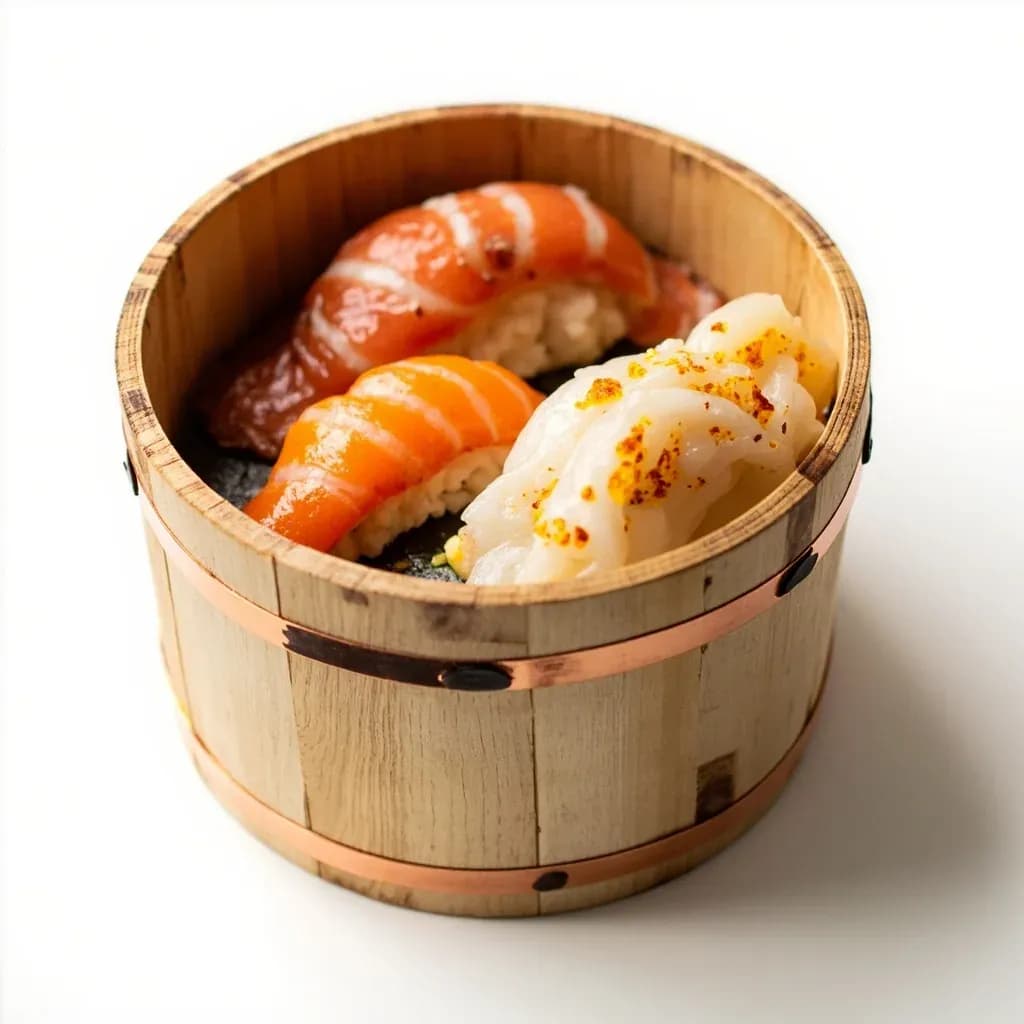
Wooden Serving Box (Sushi Oke)
Flat-bottomed cypress tub used to cool, season and present sushi rice.
A sushi oke, or hangiri, is a round flat-bottomed wooden tub traditionally made of hinoki cypress bound with copper hoops. Sushi cooks spread hot rice across it and fold in seasoned vinegar while fanning, the broad surface and absorbent wood helping the rice cool to the right gloss and texture. It also doubles as a serving vessel for finished sushi.
A sushi-oke is a flat-bottomed wooden tub, most often coopered from hinoki (Japanese cypress), in which the sushi chef mixes, seasons, cools, and sometimes serves shari — the vinegared short-grain rice that forms the foundation of nigiri and maki. The defining feature is not the shape but the wood: a properly made oke is unfinished and porous, and that porosity is the whole point. As the hot, freshly steamed rice is folded with sushi vinegar, the cypress staves wick surface moisture away from each grain far faster than metal, glass, or plastic could. The result is rice that dries to the right degree on the outside while staying tender within, and that takes on the faintly lustrous sheen prized in edomae-style sushi.
In practice the terms sushi-oke, hangiri, and handai are used almost interchangeably. Some retailers reserve "hangiri" or "handai" for the working tub kept behind the cutting board and "sushi-oke" for a slightly more decorative vessel used at the bar or for service, but the construction is the same: wooden staves bound by metal hoops, a flat base, and a wide, shallow profile that lets the chef fan and cut through the rice in a single motion. Diameters range from roughly 27 cm for home use up to 54 cm in regular professional kitchens, with larger commercial sizes reaching about 75 cm — sized to the volume of rice the cook needs to handle at one stretch.
Wooden sushi tubs are high-maintenance compared with a plastic bowl, which is exactly why serious sushi chefs still insist on them. Hinoki is mildly antimicrobial, but it is also absorbent; it must be rinsed with water only, never soaped, and left to air-dry upright. A well-used oke develops a pale patina and a faint vinegar scent, and is considered better seasoned — and better for the rice — than a brand-new one.
Alternatives
Types & varieties
The premium choice and the standard in serious sushi kitchens. Pale, fragrant, mildly antimicrobial, and highly absorbent — it draws excess moisture from the rice for a glossy finish.
More affordable and widely available than hinoki. Lighter in color with a stronger resinous scent and somewhat less absorbent; a good entry-level option.
Naturally antibacterial with a pronounced camphor aroma. Traditional in some regional kitchens, though the strong scent is a notable consideration when seasoning delicate rice.
Occasionally used for serving or presentation oke, deepening to a warm reddish tone with age. Not the standard for active mixing.
Urushi-lacquered versions are display pieces; plastic-lined modern oke exist for institutional use but are not favored by traditional chefs because the lining defeats the wood's wicking action.
Why wood, and why hinoki
A sushi-oke is essentially a wide, shallow wooden bowl, and the wood does the work. When hot, freshly steamed rice is seasoned with sushi vinegar, the surface of each grain is wet and sticky. In a metal or plastic tub, that surface moisture has nowhere to go and the rice turns gummy as it cools. Hinoki — a soft, pale, straight-grained cypress — is absorbent without being dense. It pulls a thin film of water off the rice as the chef folds and fans, leaving each grain distinct and faintly glossy. The same porosity is why an oke must never see soap: the wood will hold the scent and taint the next batch of rice. Hinoki also has mild natural antimicrobial oils that help the tub stay serviceable with nothing more than a water rinse and a wipe.
- Soft, straight-grained cypress wicks moisture from the surface of the rice without leaching flavor.
- Mildly antimicrobial; safe with nothing more than a clear-water rinse.
- Wears in rather than out — a patina of use is a sign the tub is well seasoned.
Seasoning and care
A new oke needs a brief conditioning before its first use, and ongoing care is light but non-negotiable. The two enemies are soap and trapped moisture. If soap gets into the grain, it will outgas into every batch of rice from then on; if water sits in the tub, the staves will blacken with mold and eventually warp. Used correctly, an oke will outlast every nonstick pan in the kitchen.
- Before first use, fill with cloudy rice water (yu) or a dilute vinegar rinse and let stand for a few hours to tighten the staves and season the wood.
- After each use, rinse briefly under cool water, wipe with a clean cloth, and stand the tub on its side or upright to air-dry fully.
- Rub the inside occasionally with a cloth dampened in diluted rice vinegar to sanitize and refresh the surface.
- Re-seat loose hoops with a light tap of a mallet; do not over-tighten, since the staves swell naturally when wet.
- Store in a well-ventilated spot — never sealed in a cabinet — to prevent mustiness.
Common uses
Tips & pitfalls
- Never wash the oke with soap or detergent — hinoki is porous and will absorb the scent and taint future batches of rice for the life of the tub.
- Always mix rice with a wooden shamoji; metal scoops will score the soft cypress and leave metallic off-flavors in the shari.
- Fold the rice with a cutting motion and fan continuously while mixing — the wood's breathability helps the grains dry to the right texture only if air moves over them.
- Avoid sudden temperature swings; do not bring a cold oke into a hot steaming environment, as the staves can crack.
- If a stave lifts and the tub leaks, soak it briefly in water to swell the wood back into the hoops rather than reaching for glue.
- Reserve a separate, older oke for strongly flavored work (pickles, marinades) and keep the prized hinoki tub exclusively for shari.
- Expect the wood to darken with use; a uniform pale patina after a few seasons of vinegar and rice water is normal and desirable.
- When buying, run a hand across the inside of the staves — rough or splintery surfaces will shed wood into the rice and should be sanded smooth or passed over.
Good to know
- Japanese name
- Sushi-oke (寿司桶); often used interchangeably with hangiri (飯切り) and handai (半台)
- Traditional material
- Hinoki (Japanese cypress); also available in sugi (cedar), camphor wood, and occasionally cherry
- Construction
- Wooden staves bound with copper, brass, or stainless steel hoops; flat bottom
- Typical diameters
- 27, 30, 33, 36, 42, 48, and 54 cm for home and pro use; commercial sizes run to roughly 75 cm
- Capacity reference
- A 36 cm oke holds about 4–5 kg of cooked rice (roughly 10 go of uncooked rice)
- Surface treatment
- Unfinished, food-grade wood; never sealed with varnish, lacquer, or oil
- Care
- Rinse with clear water only, wipe, and air-dry upright; never soap or submerge
- Origin
- Japan; established part of edomae sushi preparation since the Edo period (1603–1868)
Also called
Sushi Oke · hangiri · sushi rice tub
Related

Peeler
Swift blade for stripping skin off fruit and vegetables

Grater
Sharp-toothed surface for shredding cheese and vegetables

Microplane
Ultra-fine rasp for citrus zest, garlic, and hard cheese

Mixing Bowl
All-purpose bowl for combining, whisking, and tossing

Whisk
Looped wires that beat air into eggs, cream, and sauces

Spatula
Flat blade for flipping, lifting, and scraping

Slotted Spoon
Pierced spoon that lifts solids and drains the liquid behind

Wooden Spoon
Gentle, heat-friendly spoon for stirring anything