Prep Tools
Swing-Top Bottle
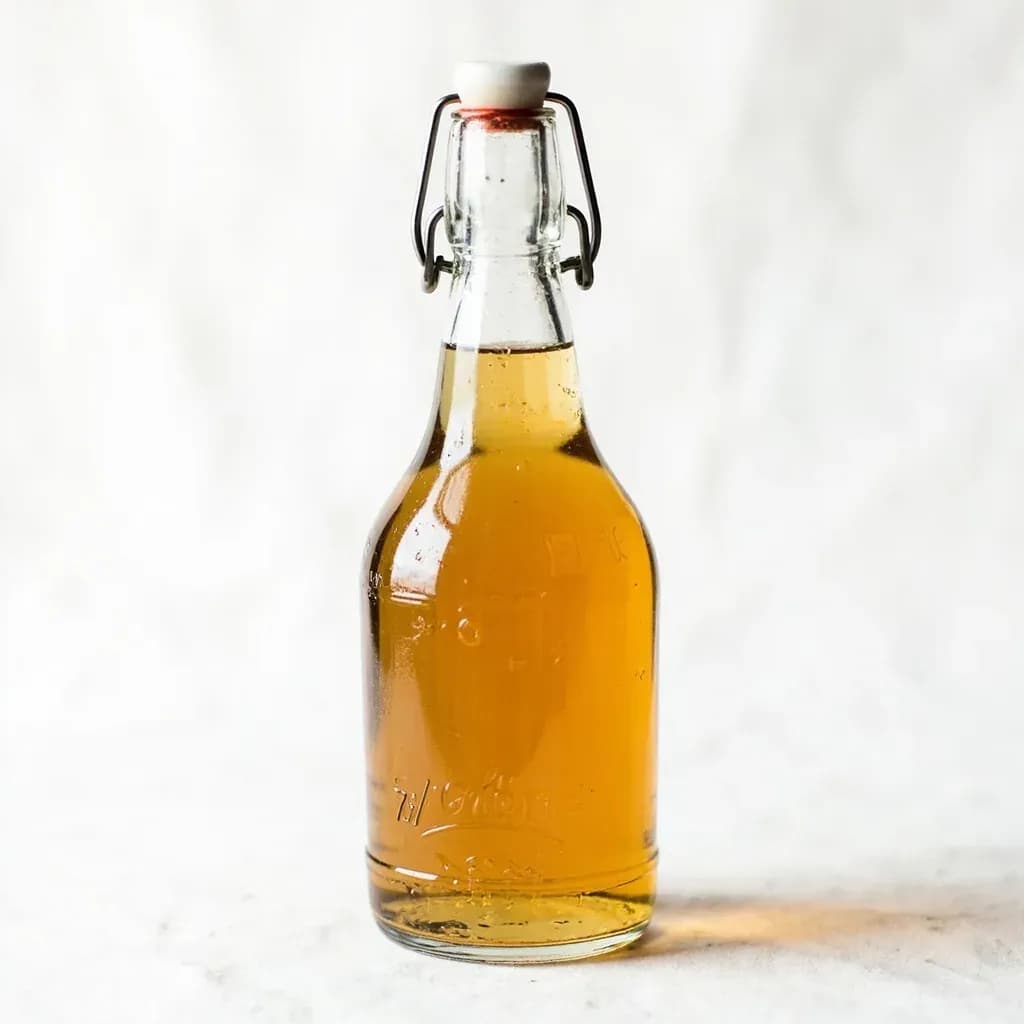
A bottle with a hinged ceramic stopper and gasket that reseals airtight for fermenting and storing drinks.
A swing-top bottle uses a wire-bail lever to clamp a gasketed ceramic or plastic stopper down, giving a reusable, pressure-tight seal. Home brewers and fermenters favor it for kombucha, ginger beer, water kefir and homemade sodas because it holds carbonation. The flip-top reseals instantly without a separate cap or capper.
The swing-top bottle is a reusable glass vessel closed by a ceramic or porcelain stopper held down by a hinged stainless-steel bail, with a rubber or silicone gasket creating the seal. Where most household bottles rely on disposable caps or corks, the swing-top delivers a genuinely airtight, pressure-tolerant closure that can be opened and resealed indefinitely without any extra equipment. That combination — resealability, reusability, and the ability to hold carbonation pressure — is what made the design a fixture of European brewing in the late 19th century, and what keeps it relevant in modern kitchens for fermentation, infusions, and short-term storage of pressure-sensitive liquids.
In practical use, a swing-top behaves as both a storage bottle and a small fermentation vessel. The bail pulls the stopper down with enough force to hold several atmospheres of internal pressure, which means the bottle can bottle-condition beer, carbonate kombucha during a secondary ferment, or fizz up homemade soda without a capper or crown caps. The trade-off is fragility under thermal shock and the need to maintain the gasket — small habits that, once learned, make the bottle a workhorse for any cook who works with ferments, syrups, or infused vinegars.
Alternatives
Types & varieties
Heavy glazed ceramic body with thick glass liner; classic amber and green tints; prized for traditional homebrew and longer aging.
Lightweight all-glass body with porcelain stopper; widely sold for kombucha, water kefir, and home soda.
UV-protective tint suited to light-sensitive ferments, tinctures, and herbal liqueurs.
Used for batch kombucha secondary fermentation, continuous-brewed water kefir, and bulk cold-brew coffee or tea.
Often repurposed from commercial German mineral waters like Gerolsteiner; handy for single-serving ferments or tasting flights.
Choosing the right bottle for the job
Most home cooks only need one or two sizes. A 500 mL clear bottle is the most versatile all-rounder — large enough to carbonate a single bottle of kombucha or soda, small enough to handle, and inexpensive to buy in cases. If you brew beer or cider at home, the same size works for bottle-conditioning, though serious brewers often prefer heavier ceramic-bodied Grolsch-style bottles because the thicker walls tolerate pressure spikes better and age beer more gracefully. Amber glass earns its keep the moment you start making anything light-sensitive: herbal tinctures, saffron or chamomile infusions, and any ferment you intend to keep on a shelf for weeks rather than days. Large 1–2 L formats are useful for bulk continuous-brewed water kefir, secondary kombucha batches, or storing cold-brew coffee, but they are heavy when full and harder to chill quickly.
- 500 mL clear glass: the everyday workhorse for kombucha, soda, and small ferments.
- Amber glass: for light-sensitive infusions and longer storage.
- 1–2 L formats: for bulk ferments, continuous kefir, and cold brew.
- Mini 200–250 mL: for samples, single servings, and tasting flights.
Gasket care and replacement
The rubber gasket is the only part of a swing-top that meaningfully wears out, and it is the single most common cause of leaks, off-flavors, and lost carbonation. A healthy gasket is supple, sits flat in its groove, and shows no cracking when you flex it. Hardening, shiny surfaces, or any visible splits mean it is time to replace it. Keep a small bag of spare gaskets on hand — they are inexpensive and sold in standard sizes matching the bottle diameter, not the bottle volume. When installing a new gasket, wet it lightly with water or sanitizer so it seats evenly, then press the stopper home and cycle the bail a few times to settle it.
Safety with pressure
A swing-top will hold carbonation, but it is not indestructible. Treat it like any pressurized glass vessel: respect the headspace, respect the temperature, and respect the seal. Overfilled bottles and warm storage are the two most common ways home users push a swing-top past its limit. If a bottle feels rock-hard when squeezed, or if the stopper hisses aggressively on opening, the ferment has over-carbonated and the contents should be vented slowly with the bail held open and a towel over the stopper. Never use a swing-top for liquids that will be force-carbonated with a CO2 tank at high pressure unless the bottle is rated for it — most household swing-tops are not.
Common uses
Tips & pitfalls
- Always leave 3–5 cm (about 1.5–2 inches) of headspace for carbonating ferments; under-filling risks bottle failure from pressure build-up.
- Inspect rubber gaskets every few uses and replace at the first sign of cracking, hardening, or loss of elasticity, since flavor and seal both suffer.
- Sanitize bottles and stoppers separately with a no-rinse brewing sanitizer before any ferment that will sit more than a day.
- Never pour boiling or very hot liquid into a cold swing-top — thermal shock can shatter the glass or crack the ceramic stopper. Let liquids cool below about 40 °C / 100 °F first.
- When opening after carbonation, open the bail slowly while keeping a thumb or towel over the stopper to release pressure gradually and avoid geysering or stopper-popping.
- Periodically disassemble the bail and clean under the hinge; residue trapped there is a common source of off-flavors and slow leaks.
- For bottle-conditioning, store bottles in a dark place at a stable temperature and burp them daily for the first 48 hours to gauge carbonation and prevent over-pressurization.
- If a stopper leaks, check that the gasket is seated flat and that the bail is fully closed — most leaks are seating issues, not bottle defects.
Good to know
- Also called
- Flip-top bottle, Grolsch-style bottle, Bügelverschlussflasche (German)
- Origin
- Bail-closure design popularized by Dutch brewery Grolsch beginning in 1897, with similar stoppered bottles appearing in 19th-century European brewing earlier
- Body material
- Soda-lime or borosilicate glass in clear, amber, green, and occasionally blue or cobalt tints
- Stopper material
- Glazed porcelain or stoneware
- Closure mechanism
- Stainless steel or nickel-plated wire bail hinged to a ceramic or porcelain stopper
- Seal
- Food-grade rubber or silicone gasket seated around the stopper rim
- Common capacities
- 250 mL, 500 mL, 1 L, and 2 L; 500 mL is the most widely produced
- Typical pressure rating
- Roughly 2–4 bar (about 30–60 psi), suitable for bottle-conditioning and lightly carbonated ferments
- Reusability
- Fully reusable indefinitely; gaskets are the only replaceable wear item
- Cleaning
- Hand-wash recommended; generally not dishwasher-safe due to gasket and bail wear
Also called
Flip-Top Bottle · Grolsch Bottle · Bail-Top Bottle
Related

Peeler
Swift blade for stripping skin off fruit and vegetables

Grater
Sharp-toothed surface for shredding cheese and vegetables

Microplane
Ultra-fine rasp for citrus zest, garlic, and hard cheese

Mixing Bowl
All-purpose bowl for combining, whisking, and tossing

Whisk
Looped wires that beat air into eggs, cream, and sauces

Spatula
Flat blade for flipping, lifting, and scraping

Slotted Spoon
Pierced spoon that lifts solids and drains the liquid behind

Wooden Spoon
Gentle, heat-friendly spoon for stirring anything