Prep Tools
Swivel (Straight) Peeler
A blade in line with the handle that pivots over curves, peeled by drawing toward you; better than a Y-peeler for long passes down carrots, cucumbers, and asparagus.
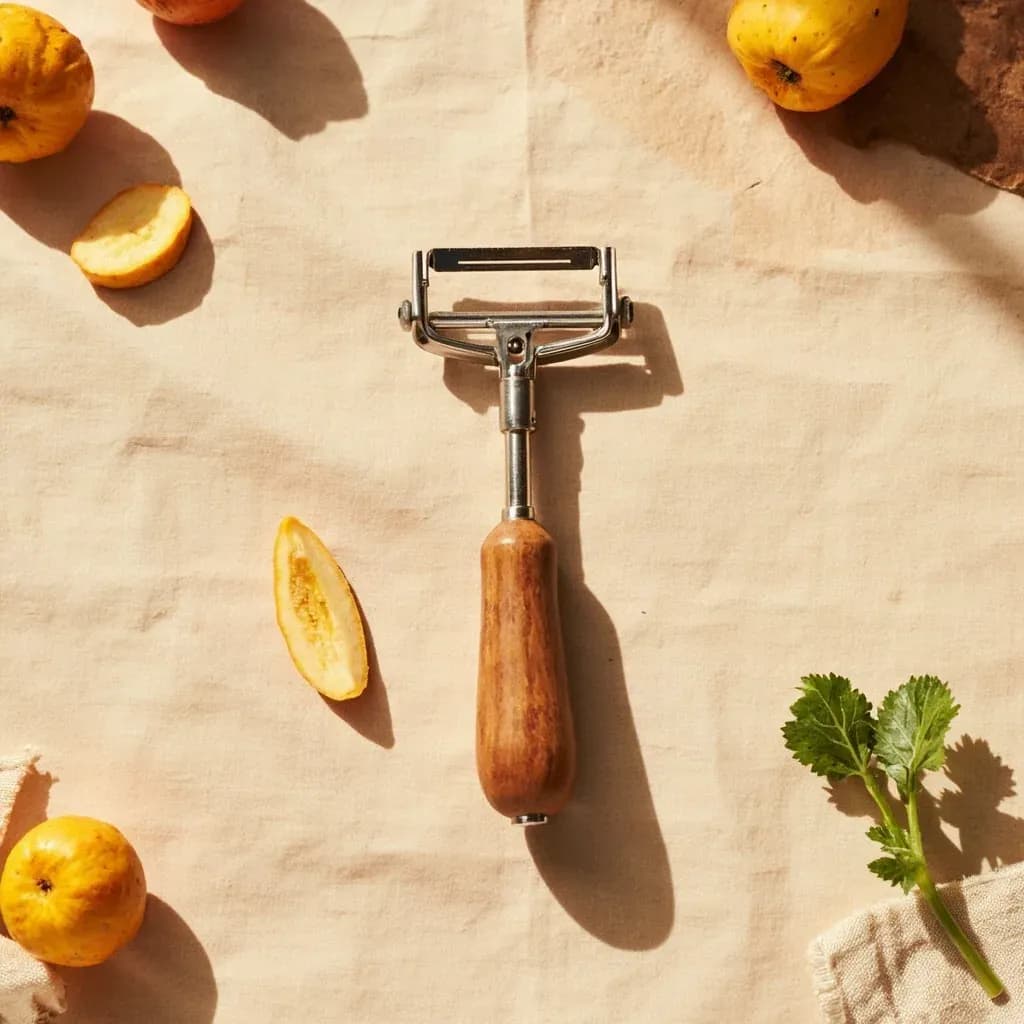
The swivel peeler is the default vegetable peeler in most kitchens, recognizable by its straight handle running in line with a short blade mounted on a central pivot pin. That pivot is the whole point: as you draw the tool along a curved potato or carrot, the blade swivels to stay flush with the surface, removing a thin, even strip without gouging. The handle length and grip orientation let the cook's hand sit naturally above the produce on a cutting board, with the blade between hand and food, pulled toward the body. This geometry favors long, continuous strokes down the length of cylindrical vegetables, where a Y-peeler would need to be reset every few inches.
A well-made swivel peeler is one of the cheapest, lightest, and most-used tools in any kitchen, yet its design has been refined over decades. The breakthrough was OXO's 1990 Good Grips peeler, designed by Smart Design for founder Sam Farber, which introduced the soft, oversized Santoprene-style handle that reduced hand strain and made the tool genuinely comfortable for people with arthritis or reduced grip strength. Modern versions vary mostly in handle material, blade steel, and whether the pivot rivet is replaceable — the rivet is almost always the first thing to fail, and a wobbly blade behaves like a dull one.
The swivel peeler's main rival is the Y-peeler, whose blade sits perpendicular to the handle and rides flat over rounds like apples and potatoes. Many serious cooks keep both: the swivel for long passes on carrots, cucumbers, zucchini, and asparagus, and the Y-peeler for quick work on round produce. For delicate skins — tomatoes, peaches, nectarines, plums, apricots, kiwis — the serrated swivel variant is essentially non-negotiable, since a straight blade tears through the soft flesh underneath.
Alternatives
Types & varieties
Plain straight edge; the everyday workhorse for potatoes, carrots, apples, and cucumbers
Toothed blade that scores and slices thin, delicate skins of tomatoes, peaches, nectarines, plums, apricots, and kiwis without tearing the flesh
Straight-handle peeler with a julienne blade that produces thin matchstick strips; a different tool from the standard peeler despite the similar silhouette
Mirror-image blade orientation so left-handed cooks don't have the blade dig in away from them
Built-in container behind the blade to collect peels; reduces counter mess for jobs like apples and potatoes
Traditional European style with a round disc-shaped handle rotated parallel to the blade
Detachable blade that can be swapped; common in professional kitchens from makers like Messermeister and Kai
Smaller version suited to shallots, garlic scapes, small radishes, and detail work
Swivel vs. Y-peeler: choosing the right tool
The two designs are not interchangeable. The swivel peeler's in-line blade and long handle are tuned for long, straight strokes down cylindrical vegetables: carrots, parsnips, cucumbers, zucchini, asparagus stalks. The Y-peeler's perpendicular blade sits flat on the surface and rides over rounds — apples, potatoes, onions — with a short, flicking motion that many cooks find faster once the rhythm is learned.
- Reach for the swivel peeler on carrots, parsnips, cucumbers, zucchini, asparagus, and other long produce where one continuous pass is possible.
- Reach for the Y-peeler on apples, potatoes, onions, and other round produce where you want speed and a flat, broad stroke.
- The swivel peeler gives more control for knobby roots like celeriac, kohlrabi, and ginger; the Y-peeler tends to skip over the bumps.
- For butternut or kabocha squash, the swivel's short blade and precise angle are safer than the broad Y-blade on a hard, curved surface.
When to reach for the serrated blade
The serrated swivel peeler is a different tool from the standard one and lives on the same hook for a reason: it is the only safe choice for soft-skinned produce. The teeth score the skin before the blade slices it, so the flesh underneath stays intact. Use the straight blade on a ripe tomato or peach and you will pull a strip of flesh away with the peel.
- Use it for tomatoes, peaches, nectarines, plums, apricots, and ripe pears.
- Use it for kiwis and other fruit with thin, fragile skin.
- Reserve the straight blade for firmer skins — potatoes, carrots, apples, squash — where the serrations would be wasted.
Common uses
Tips & pitfalls
- Pull the peeler toward you with the produce resting on a cutting board; pushing away reduces control and risks slipping off the food.
- Keep the thumb of your holding hand tucked behind the blade, not in front of it — most swivel-peeler injuries come from the thumb straying into the cutting path.
- Maintain a light, even pressure; pressing hard wastes flesh, shortens blade life, and increases the chance of the blade digging in.
- Replace or sharpen the blade as soon as it starts to skip or require force — a dull peeler is the single most common cause of both waste and accidents.
- Use the serrated version for tomatoes, stone fruit, and ripe pears; a straight blade will bite into the flesh and tear it.
- Choose a Y-peeler for round produce like apples and potatoes if speed matters more than stroke length; the swivel excels at long, continuous passes.
- Store the peeler with the blade covered, in a drawer guard, or in a dedicated slot — an exposed swivel blade damages other utensils and fingers in the drawer.
- Hand-dry after washing to prevent rust spots forming around the pivot pin, especially on cheaper stainless models.
Good to know
- Tool type
- Hand-held peeler with a straight blade that pivots on a pin to track curved surfaces
- Blade orientation
- In line (parallel) with the handle, distinguishing it from the Y-peeler whose blade is perpendicular
- Overall length
- Roughly 15–18 cm (6–7 in) standard; mini versions around 10–12 cm
- Blade width
- Cutting edge typically 6–8 cm (2.5–3 in) wide, kept short for control
- Blade material
- Stainless steel on most models; professional versions use hardened or carbon steel; ceramic blades stay sharp longer but chip if dropped
- Handle material
- Plastic or rubber over a core; soft Santoprene-style grips popularized by OXO Good Grips in 1990
- Notable milestone
- OXO Good Grips peeler introduced 1990, designed by Smart Design for Sam Farber; widely credited with popularizing ergonomic handles for cooks with arthritis
- Failure point
- The pivot rivet — it should move smoothly without wobble; on better models it is replaceable
Also called
straight peeler · swivel-blade peeler · European peeler
