Prep Tools
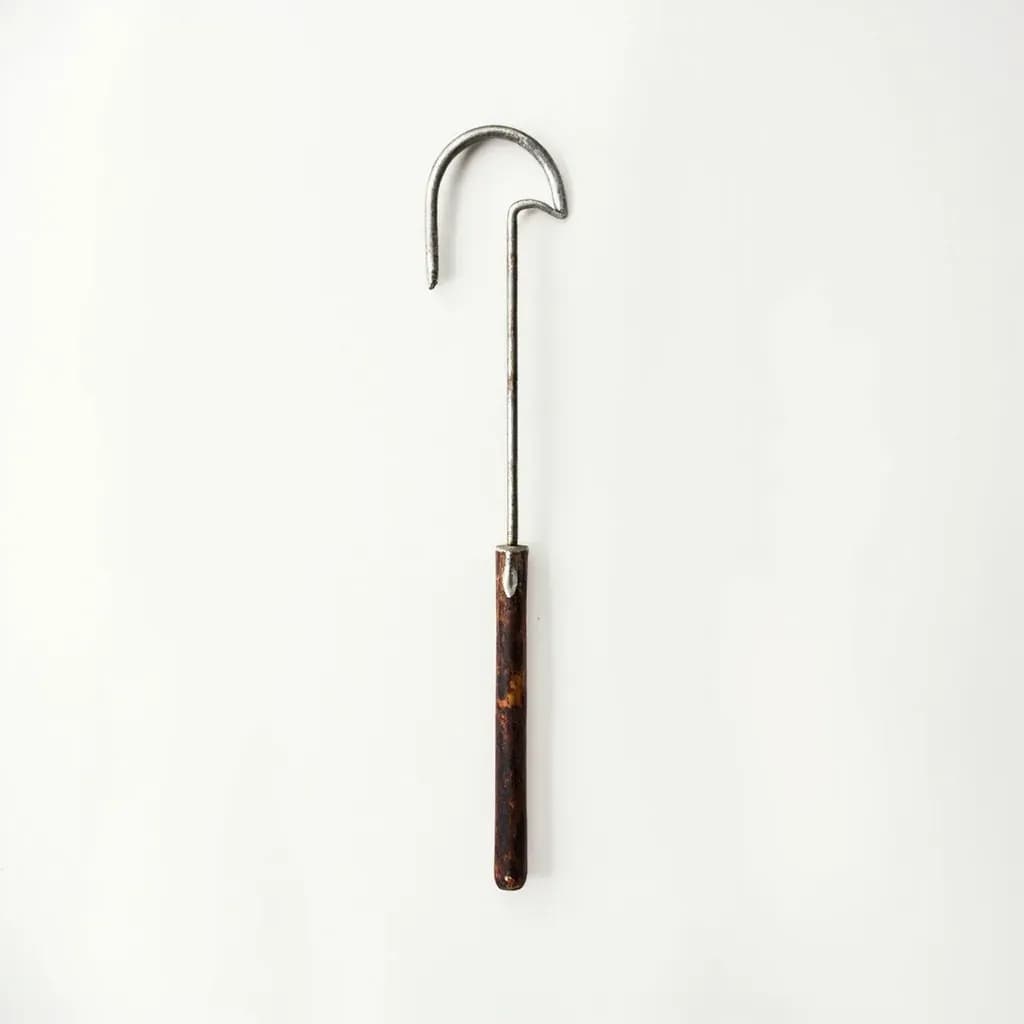
Tandoor Skewer Hook (Salaakh)
Long hook used to lower, turn, and retrieve skewers and bread from a deep tandoor oven.
A long metal hook, known as a salaakh, used to maneuver inside the deep, intensely hot tandoor clay oven. Cooks use it to place and lift heavy skewers of kebabs and tikka, and to retrieve naan from the oven walls without reaching into the flames. Its length keeps the cook's hands clear of the searing heat.
The salaakh is the long iron hook that lets a cook work inside a clay tandoor running at 450–480 °C (840–900 °F) without ever putting a hand past the lip. With one in hand, a practiced line cook can juggle a dozen skewers in motion, swapping finished tikka for raw seekh in a single sweep. The form is deceptively simple — a forged bar 60–90 cm long tipped with a small, carefully shaped hook — but the angle of that hook, the thickness of the shaft, and where the balance point falls are matters of personal preference that often outlast a cook's career.
Mechanically, the salaakh works by catching a protruding end or edge and transferring vertical force. For skewers, the hook slides under the bare metal end of the shaft and the cook lifts, drops, or rotates with a flick of the wrist. For naan, the working end is flattened into a short chisel or angled blade that gets behind the dough where it has welded itself to the clay wall and pries the bread off in one piece. Because the oven is a near-vertical chamber with the heat source at the bottom, almost every manipulation in a tandoor is a question of geometry — and the salaakh is that geometry made into a tool.
The salaakh is distinct from, and complementary to, the chimta (tandoor tongs). The chimta grips with a scissor action and is the right tool for whole chickens, small seekh, or moving hot coals. The salaakh hooks and lifts. In a busy tandoor station the two sit side by side, and most line cooks develop a strong, almost tribal preference for which is which.
Alternatives
Types & varieties
Long shaft with a small forged hook at the tip; the standard tool for catching the bare end of a metal or wooden skewer, lifting it, and rotating it inside the tandoor.
Hook end flattened into a short angled blade or chisel; used to prise naan or roti off the clay wall and lift it out by the edge or by piercing the dough.
Two opposing hooks or a fork-like tip; lets the cook catch a skewer from either side, useful in narrow or unusually deep ovens.
Modern commercial version in food-grade stainless, usually with a longer handle and a heavier forged head built for high-volume service.
Shorter (40–60 cm) version made for countertop or charcoal-cylinder tandoors where the cook stands close to the opening.
Anatomy of a good salaakh
A well-made salaakh is almost always forged from a single bar, not welded, because the eye where the bar bends into the hook is the structural weak point and the usual place for the tool to fail under a heavy load. Four details separate a serviceable salaakh from a great one:
- Hook angle — a shallow, almost flat hook catches a skewer shaft cleanly and releases it; a steep, deep hook traps the shaft and makes fast turning harder.
- Shaft thickness — heavy enough not to flex when lifting a loaded chicken or a tray of tikka, light enough to flick for the catch-and-turn motion on small seekh.
- Balance point — sits in the lower part of the shaft, close to the hand; a tip-heavy salaakh tires the wrist, a butt-heavy one feels clumsy at the bottom of a deep oven.
- Handle treatment — bare iron is traditional and conducts heat; a wrapped or wooden grip costs some tactile feedback but protects the hand during long service.
Salaakh vs. chimta: when to reach for which
The two tools look like cousins but do different jobs, and using the wrong one slows service and risks dropping food. A rough rule of thumb from working tandoor stations:
- Long metal skewers (seekh, tikka, boti, reshmi) — salaakh. The hook slides under the bare end of the shaft and the cook can lift and rotate in one motion.
- Whole chicken, small seekh, or any item needing a pinch grip — chimta. The scissor action is more secure than a single hook for an irregular, heavy load.
- Naan and roti — naan-type salaakh with a flat blade to prise the bread off the wall, or chimta for soft, just-stuck breads where a pinch grip is gentler than a pry.
- Moving or breaking up hot coals — chimta. The salaakh is for food, not the charcoal bed.
Common uses
Tips & pitfalls
- Match the length of the salaakh to your oven — the hook should reach the bottom with the cook's hand safely above the lip of the tandoor, never inside it.
- Always hook the skewer at its bare (unguarded) end so the hook never touches the food; this also keeps the meat from spinning off the shaft mid-turn.
- For naan, work the flat blade of a naan-type salaakh down from the top edge. Yanking from the centre of the bread tears it and leaves dough stuck to the wall.
- Heat the salaakh over the charcoal for a minute before first use; a cold tool drags moisture into the oven and can dull the blistering crust of fresh naan.
- Wipe the hook between batches — tar, char, and bits of dough build up on the working end and will flake onto the next skewer of tikka if left uncleaned.
- Never use a bent, cracked, or sprung salaakh for heavy loads (whole chicken, large tikka trays). The hook can open under the weight and drop the food straight into the coals.
- Hang the tool vertically after washing so water drains from the forged eye; trapped moisture in the bend is what causes the hook to split along the grain over time.
- Oil a bare-iron salaakh very lightly between shifts to slow rust. Stainless versions can simply drip-dry.
- Practice the 'catch and turn' motion with an empty skewer held over a bucket before going near a live oven — tandoor service speed comes from a confident single-flick rotation, not from strength.
Good to know
- Also called
- Salakh, salak, salaak (alternate romanizations); tandoor prong
- Type
- Long-handled retrieval and turning tool for tandoor ovens
- Material
- Wrought iron or mild steel traditionally; stainless steel in modern versions
- Handle material
- Often bare metal; some versions have a wooden grip or wrapped handle for heat protection
- Typical length
- 60–90 cm (2–3 ft); up to ~120 cm for deep commercial tandoors; ~40–60 cm for small home units
- Working end
- Forged hook for skewers, or flattened/angled blade for prising naan off the clay wall
- Origin
- Indian subcontinent — from Persian/Urdu/Hindi 'salakh', meaning a piece split off or a hook
- Used in
- North Indian, Pakistani, Afghan, and Central Asian tandoor kitchens
- Heat tolerance
- Designed for sustained radiant heat up to ~480 °C (900 °F)
- Skill required
- Low for basic retrieval; moderate for turning skewers evenly at speed
- Related tool
- Chimta (tandoor tongs) — grips with a scissor action; sits alongside the salaakh in a full tandoor kit
Also called
Salaakh · Tandoor Hook · Skewer Hook
Related

Peeler
Swift blade for stripping skin off fruit and vegetables

Grater
Sharp-toothed surface for shredding cheese and vegetables

Microplane
Ultra-fine rasp for citrus zest, garlic, and hard cheese

Mixing Bowl
All-purpose bowl for combining, whisking, and tossing

Whisk
Looped wires that beat air into eggs, cream, and sauces

Spatula
Flat blade for flipping, lifting, and scraping

Slotted Spoon
Pierced spoon that lifts solids and drains the liquid behind

Wooden Spoon
Gentle, heat-friendly spoon for stirring anything