Prep Tools
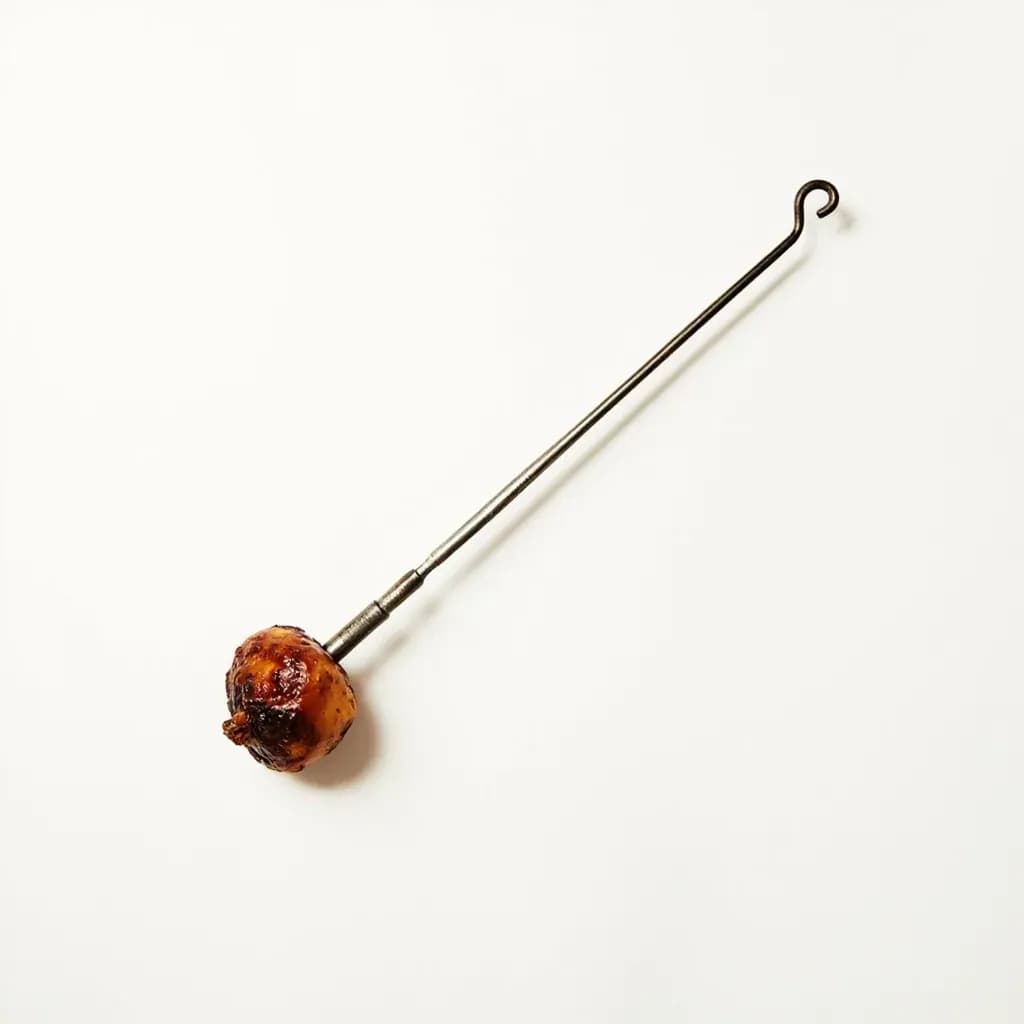
Round Tandoor Skewer
A long thick metal rod for threading kebabs and lowering them into a tandoor oven.
A round tandoor skewer is a long, heavy stainless or iron rod, often a meter or more, used to hold marinated meat, paneer, or vegetables over a tandoor's intense charcoal heat. Its length keeps the cook's hands clear of the fierce clay-oven heat, and the substantial gauge supports heavy kebabs without bending. The rounded shaft is standard for chunky tikka and seekh kebabs.
A round tandoor skewer is a long, heavy-gauge metal rod — typically 4–8 mm in diameter and 18–36 inches long — used to thread cubes of meat, fish, or vegetables for cooking in a tandoor oven or over an open grill. Stainless steel is the standard material because it tolerates the 480–900°F interior of a clay tandoor without warping and washes clean in a dishwasher. Most have a turned wooden grip or a hooked end so the cook can lower the loaded skewer deep into a vertical oven or hang it from the rim.
A point worth clarifying: in traditional South Asian cookery, the word "tandoor skewer" almost always refers to a FLAT steel blade, not a round one. The flat profile grips the food by shear and keeps it from spinning when the cook turns the skewer. A true round tandoor skewer is closer in lineage to the shish kebab and shashlik rods of the Caucasus, Iran, and the Levant — cylindrical pins designed for horizontal grills (mangal) or spits, and only secondarily used inside a tandoor. Western cookware catalogs routinely conflate the two, but their cooking behavior is genuinely different.
The practical consequence is that round skewers let threaded food rotate freely. Pieces must be packed firmly, scored across the grain, or notched into the metal so a cube of chicken or lamb doesn't spin loosely and cook on only one side. Done well, the round profile is excellent for shish kebab-style cookery where you want to roll the skewer between palms to crust all sides evenly.
Alternatives
Types & varieties
The form covered here — a cylindrical rod. Used for shish kebab and shashlik traditions; meat must be packed firmly or scored to prevent spinning.
The classic South Asian tandoor skewer, a 1–2.5 cm wide flat blade. Prevents rotation, ideal for chicken tikka and boti kebab.
Two parallel flat blades joined at one end. Used for mince-based kebabs (seekh kebab) that are molded along the bars.
Bent tip that hooks over the rim of a tandoor so the loaded skewer hangs vertically without a rack.
Steel rod with a turned wooden grip at the top to shield the hand from radiant heat when reaching into a hot tandoor.
A restaurant shortcut for oven-broiled "tandoori" style. Will ignite above roughly 400°F (200°C) and is not safe in a real tandoor.
Flat vs. round: why it matters
The choice of cross-section changes how you cook. Flat blades hold food by shear — cubes of chicken tikka or boti kebab grip the wide face and stay put when you turn the skewer, so the cook can confidently rotate to char a second side. Round rods offer no such purchase; threaded food spins loosely unless you pack it shoulder-to-shoulder, score each piece across the grain so the muscle fibers bite into the metal, or carve a shallow notch where a piece sits. The trade-off: round skewers release cleanly in any direction, which suits shish kebab traditions where the cook rolls the rod to sear all sides evenly.
Loading technique
How you thread determines how the food cooks.
- Oil the rod lightly before threading — food releases cleanly when cooked.
- Pack pieces tightly, leaving no air gaps; loose threading causes spinning and uneven browning.
- Leave 1–2 cm of bare metal at each end so you can grip and turn the skewer without burning your fingers.
- For a tandoor, hook the tip over the rim and slide the food down the inside wall — the radiant heat from the clay is what gives the characteristic char.
- For a grill, rest the skewer across the bars with the handle hanging off the edge so the cook can rotate it without tongs.
Common uses
Tips & pitfalls
- Score each cube of meat across the grain before threading — the fibers bite into the metal and stop rotation.
- Marinate in yogurt-based mixtures for several hours; the lactic acid tenderizes the meat and the marinade solids form a coating that helps it grip the rod.
- For mince-based kebabs, chill the mixture thoroughly and mold it onto a flat or double-pronged skewer — round rods release minced mixtures too easily.
- Clean while still warm with a scrubber and hot soapy water; burnt-on residue lifts with a baking-soda soak or a few hours in a vinegar bath.
- Never use thin disposable bamboo sticks in a real tandoor — they ignite above roughly 400°F (200°C) and are a genuine fire hazard.
Good to know
- Origin
- Caucasus, Iran, and the Levant; the round rod is associated with shish kebab and shashlik cookery, while South Asian tandoor cookery traditionally uses flat blades
- Cross-section
- Round; 4–8 mm diameter. Distinct from the flat-bladed skewer traditionally used for tikka and seekh
- Length
- 18–36 in (45–90 cm); longer than grilling skewers because a tandoor is a deep vertical oven
- Material
- Stainless steel is standard; heavy-gauge iron and nickel-plated steel are also common
- Handle / tip
- Turned wooden grip or hooked (S- or loop-shaped) end so the skewer can hang from the rim of the tandoor
- Working temperature
- Withstands tandoor interior temperatures of 480–900°F (250–480°C)
- Also called
- Shish kebab skewer, shashlik skewer, tandoor pin, tandoori skewer (in Western catalogs)
- Care
- Dishwasher-safe for stainless steel; wooden-handled versions need hand washing
Also called
tandoori skewer · kebab skewer · seekh skewer · tandoor rod
Related

Peeler
Swift blade for stripping skin off fruit and vegetables

Grater
Sharp-toothed surface for shredding cheese and vegetables

Microplane
Ultra-fine rasp for citrus zest, garlic, and hard cheese

Mixing Bowl
All-purpose bowl for combining, whisking, and tossing

Whisk
Looped wires that beat air into eggs, cream, and sauces

Spatula
Flat blade for flipping, lifting, and scraping

Slotted Spoon
Pierced spoon that lifts solids and drains the liquid behind

Wooden Spoon
Gentle, heat-friendly spoon for stirring anything