Prep Tools
Tastevin (Tasting Cup)
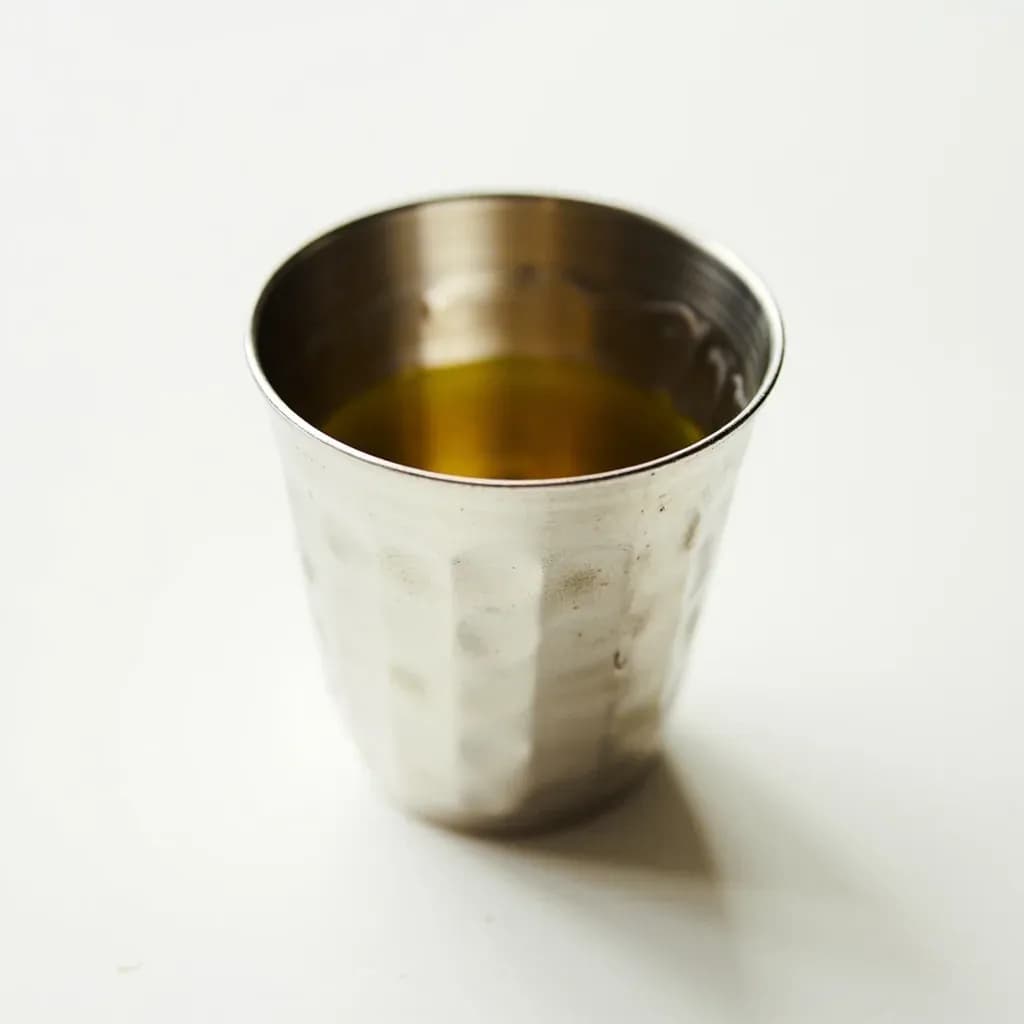
A shallow dimpled silver cup sommeliers use to judge wine color and clarity.
A tastevin is a small, shallow silver or metal tasting cup, traditionally used by sommeliers and vintners to assess a wine's color, clarity, and aroma in low cellar light. Its faceted, dimpled bottom catches and reflects light to reveal the wine's hue and any sediment. Today it is as much a sommelier's emblem as a working tool.
A tastevin is a small, shallow, silver bowl covered in concentric ridges and bumps (the godrons that give it its characteristic sparkle), designed for the quick visual and aromatic inspection of wine at the table or in the cellar. Unlike a stemmed tasting glass, it sits in the palm or on the fingertips, holds only a few milliliters, and is shaped so that light passes up through the wine toward the taster's eyes rather than being blocked by a foot or stem. The interior dimpling is functional, not decorative: it catches candlelight and bounces it back through the wine, breaks the surface tension during a swirl, and gives the taster something to feel against the pads of the fingers while the wine is held.
In practical use the tastevin behaves like a small mirror for the wine. A few milliliters are poured in, the cup is tilted, and the taster reads hue, rim variation, sediment, and clarity against a white surface or candle flame. Because the bowl is so shallow, the wine spreads into a thin film, accelerating the release of volatile aromatics when the cup is rotated — useful when assessing a young Burgundy straight from barrel, or when a sommelier is checking a dozen bottles in quick succession during inventory. The wide, open rim means aromas dissipate almost immediately, which is a deliberate trade-off: the tastevin privileges sight over nose.
Today the cup survives in two overlapping worlds. In old-style Burgundian cellars and at formal service it remains a working tool of sommeliers and cellarmen, especially the members of the Confrérie des Chevaliers du Tastevin, founded in 1934, whose chapter meetings at the Château du Clos de Vougeot keep the form culturally alive. As an object, it is also a ceremonial emblem — presented at inductions, engraved with guild insignia, and handed down as a professional heirloom.
Alternatives
Types & varieties
Traditional premium form; tarnishes and needs regular polishing but patinas handsomely and is heirloom-quality.
Most common modern production; affordable and visually identical until the plating wears through at the high points of the godrons.
Practical choice for blind tastings and busy cellars; neutral flavor and dishwasher-safe, though it lacks the light-catching warmth of polished silver.
Iconic French silversmith's version with deeply hand-hammered ribs; a benchmark for working tastevins.
Deeper, rounder bowl with a pronounced central boss; the historical form associated with monastic cellarmen.
Especially shallow and broad, designed to spread sparkling wine into a thin film so effervescence and bead can be read at a glance.
How to hold and read a tastevin
Grip is the first thing to learn. The cup is meant to be balanced, not clutched.
- Cradle the cup on the tips of the index, middle, and ring fingers of your non-dominant hand, with the thumb resting lightly on the rim. The bowl should sit above your hand, not in it.
- Pour only enough wine to cover the bottom — a few milliliters, no more than a shallow film a few millimeters deep. Overfilling defeats the shallow design and the wine will slosh.
- Hold the cup at chest height and tilt it toward a white napkin, tablecloth, or candle flame. Read the rim first: the outermost edge tells you about age (tawny for older wines, violet for young) and oxidation.
- Tip back to look through the deep part of the bowl to check clarity and sediment. Hold it briefly against a dark background to spot floaties and tartrate crystals.
- Rotate the cup gently with a small wrist motion. The dimples grip the wine and pull it into a thin film, releasing aromatics faster than a smooth bowl would.
Why the dimples matter
The godrons are the tastevin's defining engineering feature and they do three jobs at once.
- They reflect ambient light — including the warm flicker of a candle — back through the wine, so the taster can read color in dim cellars and dining rooms without electric light.
- They roughen the surface of the wine during a swirl, increasing air-to-wine contact and lifting volatile aromatics in a fraction of a second.
- They give the fingers purchase on the bowl, so a wet or cold hand can still rotate the cup without slipping.
Common uses
Tips & pitfalls
- Don't grip it like a mug — the proper hold is loose and elevated so light passes through the wine toward your eyes.
- Use the dimples: a few milliliters swirled over the godrons release volatiles faster than the same pour in a smooth bowl, so don't skip the wrist rotation.
- Read the rim, not the center — the outermost edge of the wine shows age and oxidation most clearly, especially on older reds.
- Smell quickly. The wide, open rim lets aromas escape almost at once, so nose the wine in the second after swirling, not after a pause.
- Polish silver with a non-abrasive cloth and never put a tastevin in the dishwasher; the heat and detergents strip plating and accelerate tarnish, especially in the recessed grooves of the godrons.
- Reach for stainless steel for blind or highly acidic wines — very low-pH whites can pick up faint metallic notes from silver contact that bias a tasting.
- Overfilling is the most common mistake. A tastevin is a judging tool, not a drinking vessel; if you need more than a mouthful, pour it into a proper glass.
- Avoid gripping the cup by the rim with the whole hand — body heat warms the wine in seconds and throws off color and aromatic readings.
Good to know
- Origin
- France; documented in Burgundy and Champagne from the 16th–17th centuries, with monastic cellarmen among the earliest regular users.
- Material
- Traditionally sterling or coin silver; modern versions include silver-plate and stainless steel.
- Dimensions
- Typically 8–10 cm (3–4 in) in diameter and only 2–3 cm deep — a fraction of the volume of a tasting glass.
- Interior finish
- Dimpled (godronné) — concentric ridges and small bumps covering the bowl to catch light and agitate the wine.
- Weight
- Roughly 80–200 g depending on silver thickness; heavy enough to feel substantial, light enough to hang from a neck chain.
- How it's carried
- Worn on a chain, ribbon, or belt clip so the cup stays accessible without occupying a hand or pocket.
- Cultural association
- The emblem of the Confrérie des Chevaliers du Tastevin (founded 1934, Burgundy) and other wine fraternities.
- Notable makers
- Historically the silversmiths of Dijon, Paris, and Troyes; today Ercuis, Christofle, and Puiforcat produce working and ceremonial examples.
- Cost range
- Plain silver-plated examples from about $30; sterling antique pieces typically $200–$2,000+ depending on maker, age, and weight.
Also called
tasting cup · wine taster cup
Related

Peeler
Swift blade for stripping skin off fruit and vegetables

Grater
Sharp-toothed surface for shredding cheese and vegetables

Microplane
Ultra-fine rasp for citrus zest, garlic, and hard cheese

Mixing Bowl
All-purpose bowl for combining, whisking, and tossing

Whisk
Looped wires that beat air into eggs, cream, and sauces

Spatula
Flat blade for flipping, lifting, and scraping

Slotted Spoon
Pierced spoon that lifts solids and drains the liquid behind

Wooden Spoon
Gentle, heat-friendly spoon for stirring anything