Prep Tools
Tea Glass
A small heat-tolerant glass for serving hot tea, common across the Middle East, Caucasus, and South Asia.
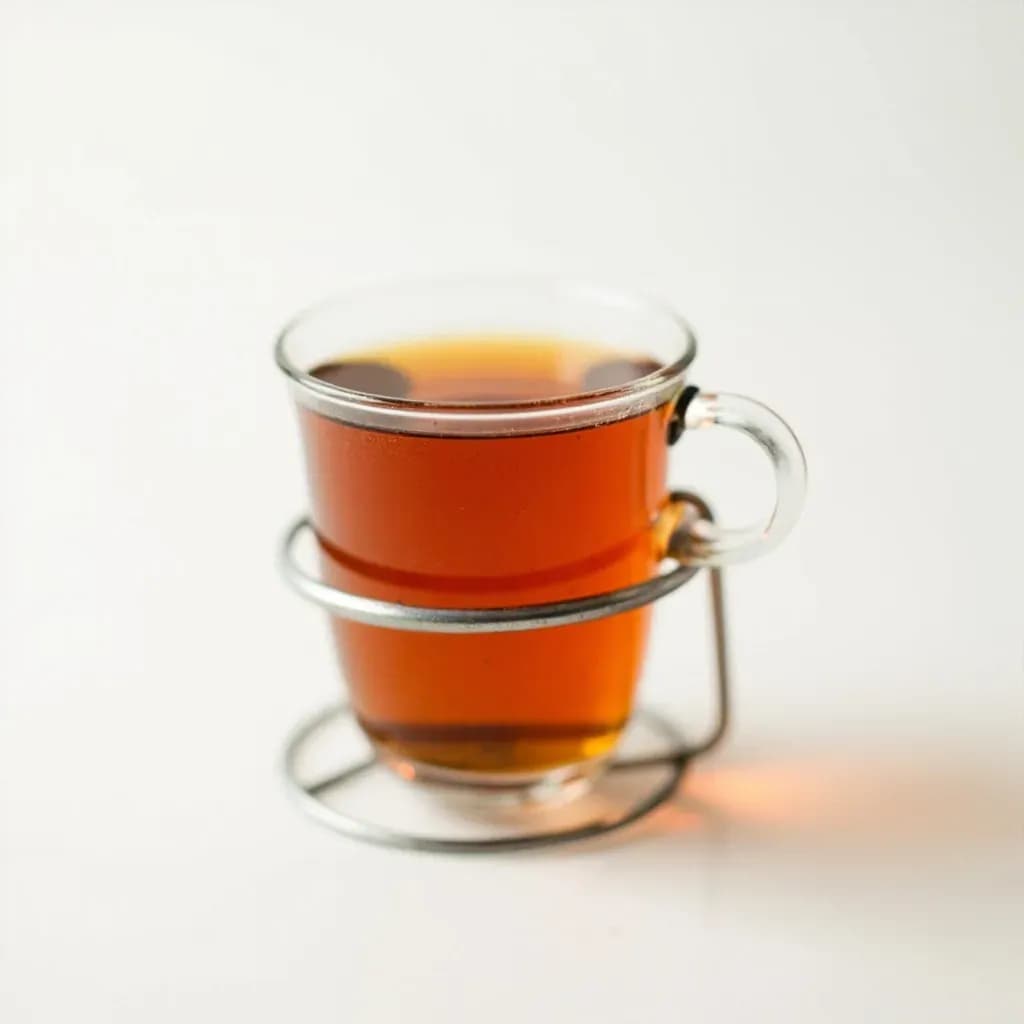
A tea glass is a small, often waisted or tulip-shaped glass used to serve and sip hot tea, showcasing its color while staying comfortable to hold. Estakans in the Caucasus and Iran sit in metal holders, and small glasses serve sweet mint or chai elsewhere. The thin glass and small volume keep tea hot and encourage refilling little and often during long social gatherings.
The tea glass is a small, heat-tolerant drinking vessel — typically 60 to 120 ml — designed for hot black tea brewed strong and served dark. Across Turkey, the Caucasus, Iran, the Levant, and parts of South Asia and North Africa, this little glass has largely displaced the porcelain cup for a practical reason: clear glass shows the tea's color, and a properly brewed black tea is supposed to look like deep mahogany or amber. When the liquor is right, the brewer can read it through the wall the way a winemaker reads wine against a white tablecloth, and adjust strength by sight alone.
The defining shape is a tulip or pear: rounded bowl, pinched waist, gently flared rim. The silhouette is functional, not decorative. The narrow waist concentrates rising steam and volatile aroma compounds at the rim, the flare cools the liquid a few degrees just before it reaches the lips, and the thin walls conduct heat so quickly that the bowl becomes uncomfortable to hold — which is exactly why drinkers pinch the waist or grip the rim instead. Most are made from tempered or borosilicate glass that tolerates near-boiling pours; finer sets come with matching saucers, and in some traditions a metal holder or filigree cage.
It is a serving vessel, not a brewing vessel, and most of what matters lives in the rituals around it: pre-warming the glass before pouring, leaving a thumb's width of headspace for aroma to collect, holding it by the rim or pinched waist rather than the bowl, and pairing it with the right accompaniments — sugar cubes, saffron-tinged rock candy, lokum, or fresh mint — depending on the region.
Alternatives
Types & varieties
The defining form: rounded bowl tapering to a narrow waist then flaring to a slightly wider rim; usually 90–110 ml, sold in sets of 6 or 12 with matching saucers.
Slightly squatter pear silhouette with a more pronounced waist; 80–100 ml; the pinched middle is the trademark of Caucasus tea service.
Smaller (60–80 ml) with a tighter waist and shorter stem-like flare; typically paired with a sugar bowl and saffron-tinged rock candy (nabat).
Sturdier, often straight-sided or lightly curved tumbler in plain clear glass; 150–200 ml; built for milky, spiced masala or cutting chai rather than clear black tea.
Colorful hand-blown glass set into an engraved silver or pewter filigree cage with a solid base; used for atay (gunpowder green tea with fresh mint).
A straight, thick-walled glass that sits inside an ornate silver or nickel-plated holder with a handle; used on long-distance trains and at home samovar service.
Wider at the top than the bottom, with a ring base; used for fruit and herbal infusions in Germany, the Czech lands, and parts of Poland.
Why the shape matters
Every curve of a tea glass is doing work. The thin wall conducts heat so quickly that the bowl becomes too hot to hold, so the drinker is encouraged to pinch the waist or grip the rim — and that grip alone slows the sip, cooling the liquid slightly. The narrow waist funnels rising vapor into a tight column, which is where the volatile top notes of a strong black tea (the bright, almost metallic edge of a fresh Turkish çay, the caramel notes of a well-made Georgian leaf) collect. The flared rim spreads the liquid into a thin film across the lips, dropping the perceived temperature another degree or two. The clear wall, finally, lets the drinker see the color — and a properly brewed black tea should read as a translucent, glowing mahogany; if it looks black, it has been over-leafed or over-steeped.
- The pinched waist is the trademark feature — it concentrates aroma at the rim and gives the drinker a natural place to hold the glass without burning the fingers.
- The flared rim cools the tea slightly at the moment of contact with the lips, which is why the same brew feels hotter in a straight-sided cup than in a tulip glass.
- Clear glass is a quality-control tool: brew too long and the color darkens past mahogany to a flat brown-black; the cook sees this instantly and adjusts next time.
Regional rituals and accompaniments
A tea glass arrives with an etiquette as specific as its shape. In Turkey and Azerbaijan it is filled about three-quarters full, set on a saucer, and often served alongside a small curved spoon for stirring sugar. In Iran, a glass is rarely offered without a dish of nabat — crystallized sugar, sometimes saffron-yellow — that the guest helps themselves to. In Morocco, the glass lives inside a silver cage and the tea is poured from roughly 30 cm (12 in) above the rim to aerate the mint and build a pale foam on top. In Russia, the glass is a plain insert whose identity comes from the holder; on the Trans-Siberian railway it is a near-mandatory part of the journey.
- Turkey / Azerbaijan: saucer, small spoon, optional sugar cube or two; tea brewed in a stacked çaydanlık (lower pot for water, upper pot for leaves).
- Iran: glass set on a saucer with a separate sugar dish holding nabat (rock candy), often saffron-flavored.
- Morocco: silver-caged glass, fresh mint sprigs, and a high pour from a long-spouted teapot; atay is traditionally sweetened generously.
- Russia: straight glass seated in a podstakannik, the metal holder doubling as a handle on moving trains.
- South Asia: straight-sided chai glass for milky, spiced masala chai; sometimes a saucer, more often just a glass.
Common uses
Tips & pitfalls
- Pre-warm the glass with a splash of hot water before pouring; this prevents the thin glass from cracking under a sudden thermal hit and keeps the tea at drinking temperature longer.
- Hold the glass by the upper rim or pinch the waist, never the bowl — the thin wall conducts heat quickly and the bowl becomes uncomfortable to hold within a few sips.
- Pour slowly down the inside wall rather than dropping tea from height into the glass; a hard impact from a full kettle can craze or crack thin glass.
- Use the saucer. Turkish and Iranian etiquette expects it, and it catches drips when the glass is set down between sips; it also gives the hot glass somewhere safe to rest.
- Don't fill to the brim — leave roughly a thumb's width of headspace so aroma collects under the flared rim rather than scalding the nose on the first sip.
- Avoid stacking too high in storage. The thin pressed rims chip easily, and a chip can propagate into a crack the next time boiling tea is poured in.
- Hand-wash painted, gilded, or silver-caged glasses; dishwasher detergent and high heat strip metallic decoration and cloud hand-painted rims.
- To spot a well-made Turkish or Moroccan set, look for a small pour spout subtly pressed into the rim — it makes pouring from a low-sided teapot far cleaner and is a sign of a thoughtful mold.
- Don't try to brew tea in a tea glass; it is a serving vessel, not a brewing vessel, and the thin glass over a heat source will shatter.
Good to know
- Typical capacity
- 60–120 ml (about 2–4 fl oz); full-sized Turkish çay bardakları are commonly 100–120 ml, Iranian estekāns 60–80 ml
- Material
- Thin, clear tempered or borosilicate glass, sometimes paired with a metal holder, silver filigree cage, or porcelain saucer
- Distinctive shape
- Tulip or pear silhouette — rounded bowl, pinched waist, gently flared rim
- Heat tolerance
- Designed for boiling-hot tea (70–95 °C / 160–205 °F); thin tempered or borosilicate glass tolerates thermal shock far better than an ordinary tumbler
- Serving temperature
- Best at 70–80 °C for Turkish- and Caucasus-style black tea; cool enough to sip, hot enough to read the deep amber color through the wall
- Also called
- çay bardağı (Turkish), armudu (Azerbaijani, 'pear-shaped'), estekān (Iranian), chai glass (South Asia), stakan (Russian glass insert)
- Origin
- Form evolved in the late Ottoman period and was standardized in the 20th century alongside black-tea drinking habits in Turkey, the Caucasus, and Iran
- Care
- Dishwasher safe if plain tempered glass; hand-wash sets with hand-painted rims, gilding, or silver cages
Also called
Estakan · Small Tea Glasses · Tea Glasses · Small Tea Glass · Shot Glasses · Steel Tumbler
Related

Peeler
Swift blade for stripping skin off fruit and vegetables

Grater
Sharp-toothed surface for shredding cheese and vegetables

Microplane
Ultra-fine rasp for citrus zest, garlic, and hard cheese

Mixing Bowl
All-purpose bowl for combining, whisking, and tossing

Whisk
Looped wires that beat air into eggs, cream, and sauces

Spatula
Flat blade for flipping, lifting, and scraping

Slotted Spoon
Pierced spoon that lifts solids and drains the liquid behind

Wooden Spoon
Gentle, heat-friendly spoon for stirring anything