Prep Tools
Tea Tray (Cha Pan)
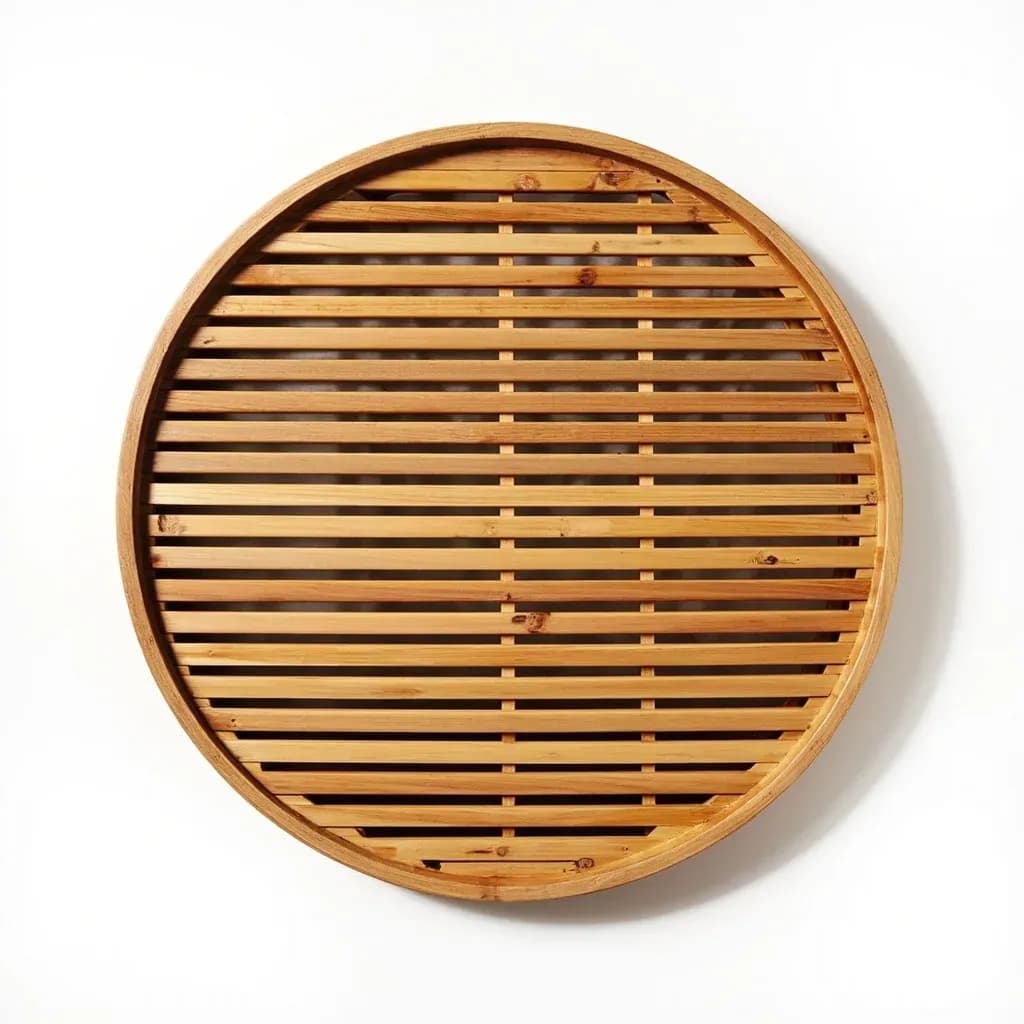
A grated draining tray that catches spilled water during Chinese gongfu tea service.
A tea tray, or cha pan, is a slatted serving board used in Chinese gongfu tea ceremony that catches the water poured over teapots and cups for warming and rinsing, draining it into a hidden reservoir or tube. It keeps the brewing area dry while allowing the free pouring that the ritual demands. Trays are made of bamboo, wood, or stone.
The chá pán, or tea tray, is the work surface of a Chinese gōngfū chá setup: a flat upper deck pierced with slots, slats, or a carved grate, sitting over a shallow reservoir that catches every drop of rinse water, overflow, and pour-off. Gongfu brewing is a high-water, high-motion ritual — the teapot and pitcher are rinsed with hot water, the first steepings of leaf are discarded, and water is constantly lifted and poured — so a place for all that liquid to go is not optional. The tray turns what would be a soggy tablecloth into a clean, contained station where the brewer can move quickly between vessels without ever mopping up.
Beyond drainage, the tray provides a stable, level platform for arranging the teapot, fairness pitcher (gōng dào bēi), tasting cups, tea towel, and accessories like the tea needle. It is functionally silent — it does no brewing, steeping, or measuring — but it is what makes the rapid, repeated rinses and short flash-steepings of gongfu service actually practical. Material and style range from everyday bamboo to dense hardwoods and carved stone, but every well-made tray shares the same basic geometry: a draining top, a watertight lower pan, and enough surface area to keep every pour over the grate rather than on the table.
Alternatives
Types & varieties
Lightweight, affordable, and the everyday workhorse; the most forgiving material but needs occasional oiling to prevent drying and cracking.
Dense, durable, and prized for a patina that deepens with years of use; sensitive to standing water and worth wiping dry after every session.
Slate, marble, or carved stone tops are non-absorbent and easy to wipe clean, and pair visually with darker oolongs and aged sheng puer; vulnerable to thermal shock.
Traditional and decorative, often paired with a removable perforated insert rather than a fixed grate; heavier and more fragile than bamboo.
A flat grated top set over a separate catch basin; the basin lifts out for emptying, which is the easiest design to keep dry.
An integrated lower pan beneath a fixed grate; sleeker and more furniture-like, but harder to dry fully and prone to hidden mold if neglected.
Compact trays with a small reservoir for solo brewing at a desk or on the road; usually bamboo or thin hardwood.
Choosing a Material
Material is mostly a question of use, weight, and how you like a tray to age. Bamboo is the practical default: light enough to move, cheap enough to replace, and gentle on teaware. Hardwoods — huali, hóng mù, wenge, ebony — are the heirloom choice; they darken and burnish with handling, and a well-cared-for hardwood tray will outlast several generations of teapots. Stone is the easy-care option: it will not stain, will not absorb odors, and wipes clean in seconds, though it is heavy and can crack if boiling water is poured onto a cold slab. Ceramic sits between stone and bamboo in feel — decorative, traditional, and usually finished with a separate drain insert.
- Pick bamboo for daily use and travel; pick hardwood if the tray will live in one place for years.
- Pick stone if you brew a lot of dark, tannic teas (aged sheng, ripe shu, rock oolong) and want a wipe-clean surface.
- Check that the grate sits flat and that drain holes actually line up over the reservoir — misalignment is the most common defect in cheaper trays.
Setting Up the Tray
A tray is most useful when its working area is laid out intentionally, with all pour points over the grate and the dry tools (towel, needle, tea pets) on the solid edge or a small side tray.
- Position the teapot and pitcher so their spouts and rims sit over the slotted area, not the frame.
- Keep the tea towel, tea needle, and tea pets on the unslated rim or a side tray where they stay dry.
- Leave a small clear zone for the spent-leaves container or chá hé.
Common uses
Tips & pitfalls
- Empty and rinse the reservoir between sessions; even a few hours of stagnant water breeds odor and mildew, especially in the closed double-layer design.
- Oil bamboo trays every few weeks with a light coat of food-safe mineral oil or walnut oil to keep the slats from drying out, splitting, and leaking.
- Wipe wood trays dry after use and never let pooled water sit overnight — standing water darkens the grain, warps the slats, and eventually rots the joints.
- Avoid pouring boiling water directly onto a cold stone slab; warm the tray with a little hot water first to prevent thermal cracking.
- Always aim the teapot spout over the slotted grate rather than the solid wooden frame, or rinse water will pool on the edge and run off onto the table.
- Match tray size to your teapot: when pouring from pot to pitcher, the spout should fall well within the grated area, with room to spare on the far side.
- Rotate a wood tray periodically so that sun, humidity, and use are distributed evenly, which helps the patina develop uniformly rather than blotchily.
- Lift the grate and air-dry the underside every few sessions; the space between grate and reservoir is where mold starts in neglected trays.
Good to know
- Chinese Name
- Chá pán (茶盘); also called chá chuán (茶船, "tea boat") in older usage
- Used In
- Gōngfū chá (Chinese concentrated leaf tea service)
- Function
- Slatted or grated top drains overflow water into a reservoir pan below
- Common Materials
- Bamboo, hardwoods (huali/hóng mù, wenge, ebony), stone (slate, marble, carved stone), ceramic, occasionally metal or resin
- Typical Sizes
- Personal trays ~20–30 cm; medium 35–45 cm; tea-table trays 50 cm and up
- Reservoir Capacity
- Roughly 300 mL on small trays; 1–2 L or more on larger models
- Origin
- Standardized through southern Chinese tea cultures (Fujian, Guangdong, Chaoshan) over the Ming and Qing dynasties
- Care
- Empty and rinse reservoir after each session; oil bamboo and wood periodically; never let wood trays stand in pooled water
Also called
Cha Pan · gongfu tea tray · tea boat
Related

Peeler
Swift blade for stripping skin off fruit and vegetables

Grater
Sharp-toothed surface for shredding cheese and vegetables

Microplane
Ultra-fine rasp for citrus zest, garlic, and hard cheese

Mixing Bowl
All-purpose bowl for combining, whisking, and tossing

Whisk
Looped wires that beat air into eggs, cream, and sauces

Spatula
Flat blade for flipping, lifting, and scraping

Slotted Spoon
Pierced spoon that lifts solids and drains the liquid behind

Wooden Spoon
Gentle, heat-friendly spoon for stirring anything