Prep Tools
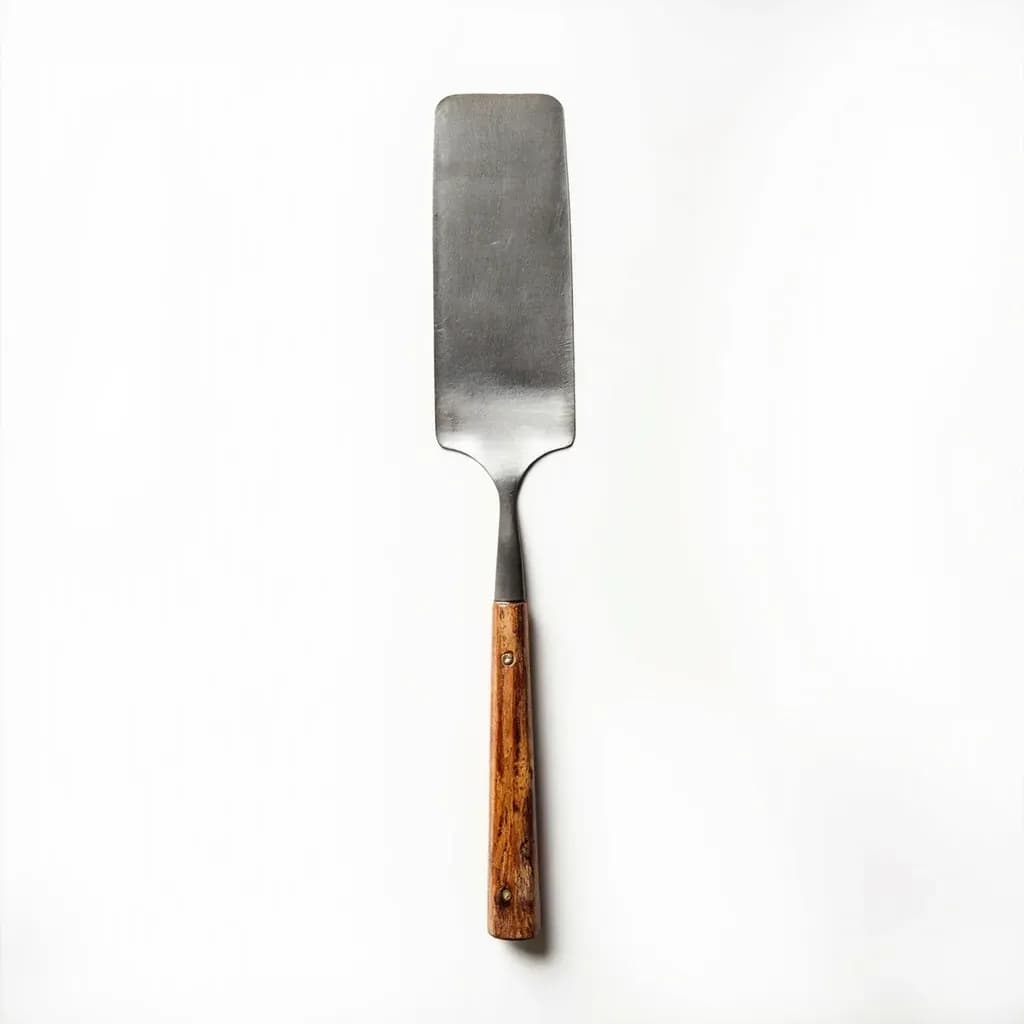
Teppanyaki Spatula (Long Turner)
Long-handled flat turner for flipping, chopping, and moving food across a teppan griddle.
A wide, long-handled metal spatula used at the teppanyaki griddle to flip, chop, scrape, and gather food across the hot flat surface. Chefs use a pair of them to dice, toss, and serve with speed and flair. The long handle keeps the cook back from the searing heat while covering the broad cooking surface.
The teppanyaki spatula — known in Japan as the hamba or hera, and sometimes the hibachi turner in the West — is the defining tool of the teppan grill. Unlike a Western fish spatula or pancake turner, it carries a long, slim shaft that keeps the hand well back from a roughly 250°C steel surface, and a flat, broad rectangular blade that sits flush against the griddle. Teppanyaki chefs almost always work with two of them, one in each hand, using a coordinated flip-and-toss rhythm that a single short turner cannot reproduce. The blade is thin enough to slide under a fragile scallop yet stiff enough to chop aromatics on the hot steel when its front edge is sharpened.
Beyond flipping, the tool's defining role is as a chopping and arranging instrument. On a teppan, garlic, scallions, cabbage, and even thin noodles are diced directly on the griddle with a rocking motion; the spatula replaces both knife and bench scraper in that workflow. The rear edge stays deliberately dull so it can serve as a pusher, scraper, and plating guide without scoring the steel. This dual personality — sharp front, blunt rear — is what separates a true hamba from the flat stamped turners sold for home griddles.
Materials matter. Most commercial versions are stainless steel end to end, making them tough, sanitary, and dishwasher-tolerant, at the cost of weight and heat conduction near the head. Wood-handled versions are lighter and cooler in the grip, but less durable. Carbon-steel blades take the finest edge and stay thinner, though they demand the same drying and oiling care as a carbon-steel pan.
Alternatives
Types & varieties
Flat, broad shovel-shaped blade; the classic teppanyaki turner used for flipping, lifting, and transferring food.
Smaller, heavier head with a sharpened front edge, used like a bench scraper or cleaver to chop vegetables and garlic directly on the teppan. Pairs with the hamba.
Standard professional model roughly 45 cm long; the chef holds one in each hand.
Shorter (25–30 cm) version used for tabletop teppan service where the diner sits at the grill.
Traditional wooden handle (often magnolia) instead of all-metal; lighter and cooler in the grip, suited to tabletop or lower-heat cooking.
Preferred by some chefs for a thinner, sharper edge; requires immediate drying and a light oil to prevent rust.
The Two-Spatula Technique
The defining habit of working with a teppan spatula is that you almost never use just one. The dominant hand holds the larger hamba for flipping and plating, while the off-hand holds either a second hamba or the smaller hera for steadying, chopping, and clearing. This pairing lets you turn a piece of fish cleanly with both blades at once — one slides under, the other guides the top into place — which a single spatula cannot do. It also lets you dice aromatics by rocking the sharpened hera through a pile of garlic or scallion while the hamba scoops the cut pieces into oil. The rhythm is closer to drumming than to Western sautéing, and the chef learns to read the sizzle of food sliding against steel the way a line cook reads the sound of a knife on a board.
Material and Care
Stainless-steel hambas are the workhorse of commercial teppan stations: tough, sanitary, and indifferent to the dishwasher. The trade-off is weight and heat conduction — an all-steel handle grows hot near the head, and a long all-metal spatula is heavier than most home cooks expect, which is why pros grip near the balance point rather than at the end. Carbon-steel versions sharpen to a finer edge and stay lighter in the hand, but rust if left wet, so they must be towel-dried and lightly oiled exactly like a carbon-steel pan. Wood-handled versions (traditionally magnolia) are the lightest and coolest to grip, but the wood can scorch if rested near open flame or a very hot griddle; they are best suited to tabletop teppan service or moderate-heat cooking rather than standing over a blazing surface.
Common uses
Tips & pitfalls
- Always work with two spatulas — one in each hand — for control and to mimic the two-spatula technique used by teppanyaki chefs.
- Hold the sharpened hera edge down at a shallow angle and use a rocking, chopping motion; bearing straight down like a cleaver can dent the steel surface of the teppan.
- When flipping, keep the flat blade in full contact with the griddle, not the tip — slide it completely under the food before lifting, or the edge will tear delicate items like scallops.
- Reserve one spatula for raw proteins and the other for vegetables to avoid cross-flavoring, especially with raw seafood.
- Never use these on non-stick or ceramic-coated griddles; the metal edge will score the coating within a few passes.
- Wipe the blade between cuts when chopping aromatics — residual juice makes the steel slippery and the garlic will skate instead of slicing.
- For neat plating, hold the spatula flat and use the back (dull) edge as a guide to slide food onto the plate in a single clean motion.
- Dry stainless spatulas immediately after washing to prevent water-spot staining; towel-dry and lightly oil carbon-steel versions to prevent rust.
- Rest the spatula blade-down on a heatproof surface, not on the handle, to avoid bending the shaft or scorching nearby grips.
- If the front edge dulls from chopping, re-sharpen it on a whetstone — many teppan chefs keep a small stone at the station for daily touch-ups.
Good to know
- Origin
- Japan
- Also called
- Teppan spatula, hamba (hamber), hera, hibachi turner, Japanese griddle spatula
- Material
- Stainless steel (most common); carbon steel and wood-handled versions also used
- Typical length
- 40–50 cm (16–20 in) overall; blade 10–15 cm (4–6 in)
- Blade width
- 7–10 cm (3–4 in) on standard hamba style
- Weight
- Roughly 200–400 g per spatula
- Edge type
- Sharpened front edge on professional versions for chopping; dull rear edge for pushing and plating
- Compatible surfaces
- Carbon steel or stainless steel teppan, cast iron; not for non-stick or enameled coatings
- Cleaning
- Hand wash and dry immediately; stainless needs no seasoning; carbon steel must be towel-dried and lightly oiled
Also called
Teppan Turner · Griddle Spatula · Hibachi Spatula
Related

Peeler
Swift blade for stripping skin off fruit and vegetables

Grater
Sharp-toothed surface for shredding cheese and vegetables

Microplane
Ultra-fine rasp for citrus zest, garlic, and hard cheese

Mixing Bowl
All-purpose bowl for combining, whisking, and tossing

Whisk
Looped wires that beat air into eggs, cream, and sauces

Spatula
Flat blade for flipping, lifting, and scraping

Slotted Spoon
Pierced spoon that lifts solids and drains the liquid behind

Wooden Spoon
Gentle, heat-friendly spoon for stirring anything