Prep Tools
Steel Thali Plate
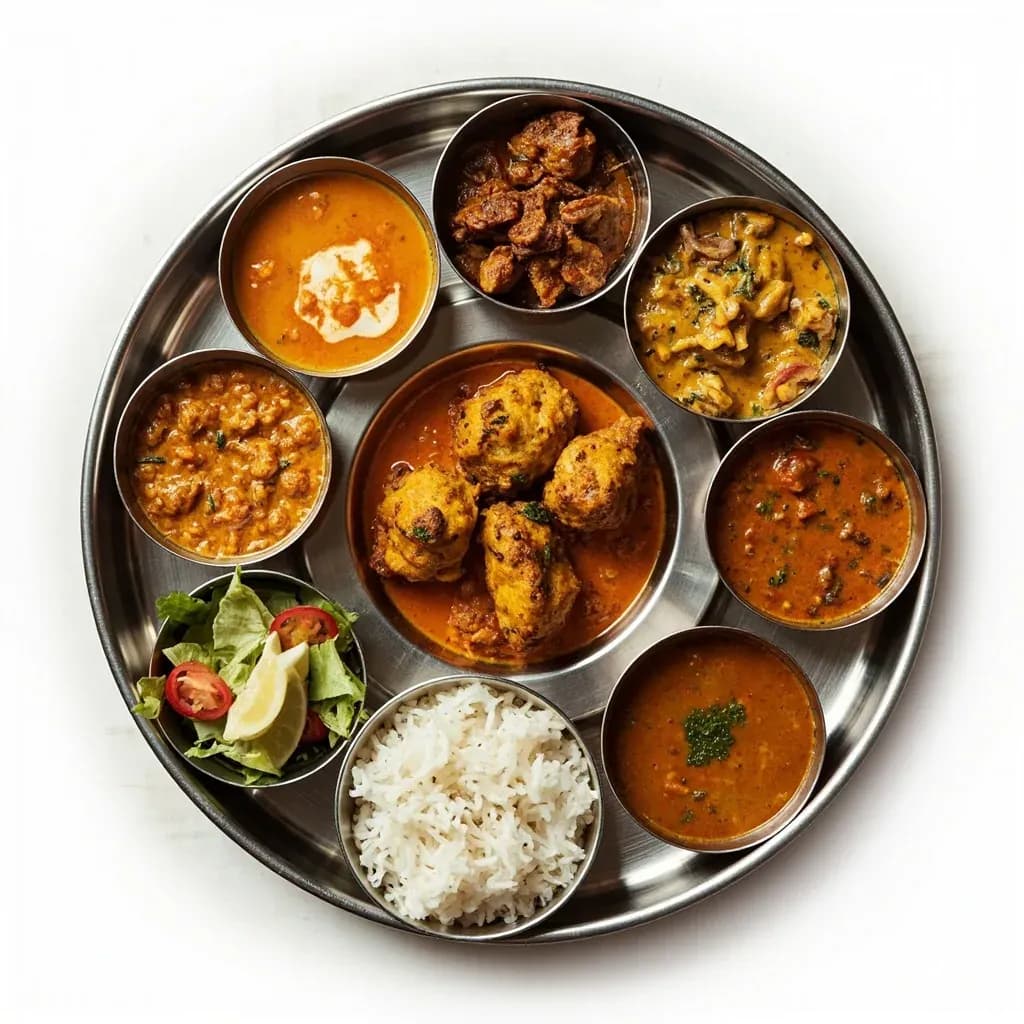
A round metal platter used to serve an Indian meal of many small dishes at once.
A thali is a round stainless steel plate, often with a raised rim or small bowls (katoris), used to serve a complete Indian meal of rice, breads, curries, dal, pickle and sweet together. The compartments or bowls keep the dishes separate while the diner combines them. Light and durable, steel thalis are everyday tableware across the subcontinent and in temples and canteens.
The thali is not a single utensil but a serving system: a flat round platter, almost always paired with a cluster of small bowls called katoris that hold curries, dals, and raitas. Together they let a cook assemble a complete meal — a grain, a lentil, a vegetable, a yogurt, a pickle, a sweet — in a single round arrangement the diner can see and taste at a glance. This layout mirrors the Ayurvedic idea of a balanced plate and is the visual grammar of eating across the subcontinent, from the Gujarati and Rajasthani restaurant 'unlimited thali' to the home dinner in Tamil Nadu and Andhra Pradesh.
Modern thalis are overwhelmingly made of stainless steel, thin-gauge (about 0.7–1.2 mm) and light enough to pass around the table but rigid enough to hold a full meal without flexing. Traditional variants in brass, copper, and the copper-tin alloy called kansa remain prized for religious offerings and Ayurvedic eating, where the metal is believed to interact mildly with food. The thali absorbs and holds heat well — useful for keeping dal and sabzi hot through a long meal — but it is not microwave-safe, and pouring ice-cold water onto a freshly heated one risks warping and burn splatter.
Standard dinner thalis run 10–14 inches across, with 12 inches being the most common size for a full multi-dish meal. Care is straightforward for stainless steel: wash soon after serving (tannin-rich pickle and tamarind chutney can leave marks if left overnight), towel-dry to avoid water spots, and stack with a cloth between pieces. Brass and kansa want gentler treatment — tamarind pulp or lemon-and-salt, never steel wool — and reward that care with a soft, warm patina that improves with use.
Alternatives
Types & varieties
Everyday workhorse; mirror or matte finish; cheapest and most common since the 1960s
Copper-tin alloy; claimed in Ayurveda to balance pitta; develops a soft golden patina
Used for festive meals, pujas, and wedding rituals; needs regular polishing with tamarind or brass cleaner
Ceremonial and wedding use; very expensive; common for serving Prasad
Traditional in parts of North India; food surface is tin-lined; uncommon today
Pressed or welded wells (2–6) keep curries, rice, and sweet separated without katoris
Stainless-steel sets with 2–4 welded small bowls — the restaurant standard
Smooth flat disc; preferred in South India and for banana-leaf-style presentations
Building a Balanced Thali at Home
A well-composed thali follows a loose Ayurvedic template — one item from each flavor and food group, arranged so the eye reads the meal before the fork does. The layout is intuitive: the grain (rice or roti) anchors one side, the wet dishes fill the katoris or wells, and the dry accents — pickle, papad, salad — sit along the rim.
- Anchor: rice (steamed or pulao) or 2–4 rotis/phulkas, placed at the center or one side.
- Dal: a thin lentil (toor, moong, or chana) in the largest katori — the thali's backbone.
- Sabzi: one dry or semi-dry vegetable (aloo gobi, bhindi masala) for texture contrast with the dal.
- Wet curry or kadhi: a saucy dish if the sabzi is dry — never two runny curries competing in the same thali.
- Dairy: raita, plain curd, or a small portion of butter, balancing heat and richness.
- Salad or kachumber: sliced raw onion, cucumber, or tomato to cut richness.
- Condiments: a teaspoon each of pickle (achar) and fresh chutney — small but essential.
- Crunch: a roasted papad or a few fryums.
- Sweet/farsan: a single laddu, a spoonful of shrikhand, or a savory snack like chivda to close the meal.
Regional Differences
The shape of a thali tells you where it is from. Gujarati and Rajasthani thalis tend to be larger, more compartmentalized, and surrounded by four or five katoris. South Indian thalis are usually plain flat discs — the banana leaf's metal descendant — with separate katoris set alongside for sambar, rasam, and curd. Bengali and Odia thalis are smaller and used more for rice and a single main; elaborate plating happens on a separate steel or brass tray.
- Gujarat / Rajasthan: large, 12–14 inch, heavy compartmentalization, four to five katoris.
- Maharashtra: medium thali, two attached katoris, bhakri or puri as the grain.
- South India (Tamil Nadu, Karnataka, Andhra): plain 11–12 inch disc, three to five loose katoris for sambar, rasam, kootu, curd.
- Punjab / North India: medium thali with one or two attached katoris; often paired with a separate parat for rotis.
- Bengal: smaller thali used primarily for rice, with accompaniments in a separate tray or bowls.
Common uses
Tips & pitfalls
- Wash the thali soon after serving — pickle, tamarind chutney, and turmeric-heavy dals can stain steel if left overnight.
- Towel-dry stainless steel with a soft cotton cloth; air-drying leaves visible water marks on polished surfaces.
- Never use steel wool on brass or kansa — rub with tamarind pulp, a paste of lemon and salt, or a dedicated brass cleaner instead.
- Stack thalis with a layer of tissue paper or thin cotton cloth between them to prevent ring scratches on the polished face.
- Do not pour ice-cold water onto a freshly heated thali; the thermal shock can warp the steel and send hot liquid scalding.
- Choose compartmented sets for restaurants where dishes must stay visually separate; plain thalis work better for saucy dals and runnier curries that need a wider pool.
- Keep one dedicated brass or kansa thali for festive and religious use, and use stainless steel for the daily meal — mixed use wears the alloys faster.
- When eating from a thali by hand, use the right hand only; this is consistent etiquette across the subcontinent and is a sign of respect in shared meals.
- Resist overcrowding: five to seven well-chosen items read better than a dozen spoonfuls crammed in, and the diner can taste each dish clearly.
- Warm the thali briefly over a flame or with a splash of hot water before ladling in hot food — a pre-warmed plate keeps dal and sabzi at serving temperature through the meal.
Good to know
- Origin
- South Asia — India, Nepal, Pakistan, Bangladesh, Sri Lanka
- Material
- Stainless steel (modern standard); traditional variants in brass, kansa (copper-tin alloy), copper, and silver
- Standard diameter
- 10–14 inches (25–35 cm); 12 inches for a full dinner thali
- Typical steel thickness
- 0.7–1.2 mm for everyday plates
- Weight
- Roughly 300–600 g for a stainless-steel dinner thali
- Standard meal components
- 5–9 small dishes: dal, sabzi, roti or rice, raita, salad/kachumber, pickle, papad, and a sweet or farsan
- Companion piece
- Small steel bowls called katoris; sold as welded sets or as separate loose bowls
- Lifespan
- Decades for stainless steel; brass and kansa tarnish and need periodic polishing
- Temperature tolerance
- Tolerates hot foods and reheating on flame; vulnerable to thermal shock from cold liquids
- Dishwasher safe
- Yes for stainless steel; not recommended for brass or kansa
- Microwave safe
- No — metal
Also called
thali-plate · thali-steel · Thali · Steel Plate
Related

Peeler
Swift blade for stripping skin off fruit and vegetables

Grater
Sharp-toothed surface for shredding cheese and vegetables

Microplane
Ultra-fine rasp for citrus zest, garlic, and hard cheese

Mixing Bowl
All-purpose bowl for combining, whisking, and tossing

Whisk
Looped wires that beat air into eggs, cream, and sauces

Spatula
Flat blade for flipping, lifting, and scraping

Slotted Spoon
Pierced spoon that lifts solids and drains the liquid behind

Wooden Spoon
Gentle, heat-friendly spoon for stirring anything