Prep Tools
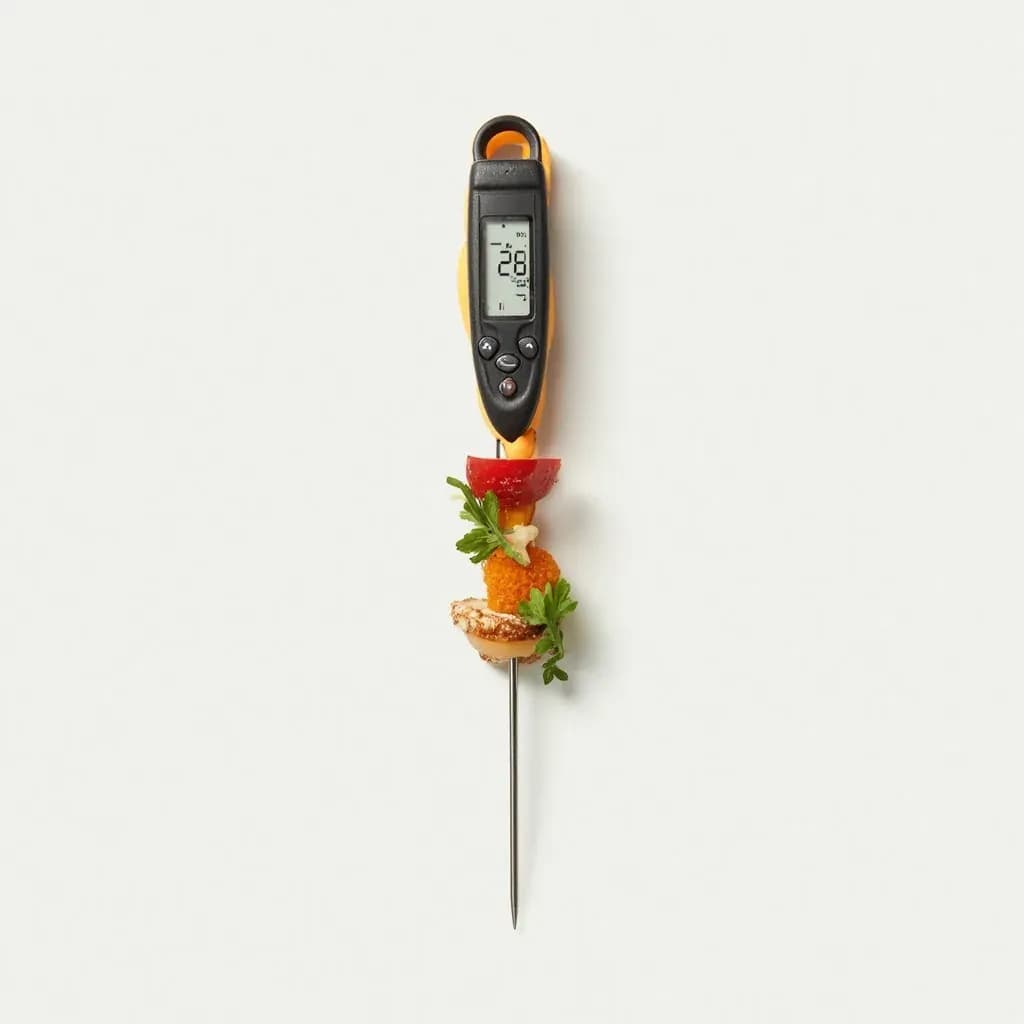
Thermocouple Probe Thermometer
Fast, thin metal probe that reads cooking temperatures almost instantly via a thermocouple junction.
A thermocouple probe thermometer uses two joined dissimilar metals to generate a tiny voltage that maps to temperature, giving very fast and accurate readings. Cooks use the thin needle-like probe to check the doneness of meat, the temperature of frying oil, or the core of bread without leaving a large hole. Its quick response and slim tip make it the preferred tool for precise, repeated spot checks.
A thermocouple probe thermometer is built around a small junction of two dissimilar metals welded at the very tip of a thin stainless shaft. When that junction heats up, it generates a tiny voltage (the Seebeck effect) that the meter's circuitry translates into a temperature reading in 1–3 seconds. That mechanism is what gives the tool its signature speed: the sensor is physically tiny and sits right where the metal meets the food, so it has almost no mass to warm up before it reports a number.
In the kitchen, that speed changes the way you cook. On a hot grill or sear, a thermistor-based instant-read can take 4–6 seconds or more to settle, and during that time carryover heat may have already pushed the center past your target. A thermocouple reads before the tip has time to overshoot, which is why chefs and serious grillers reach for one when every degree matters. The trade-off is fragility: the reduced-tip shaft is slim (around 1.5 mm) and bends more easily than a chunky thermistor probe, and the body of the meter is electronics, not a leave-in tool.
Thermocouples are read-and-remove instruments, not continuous monitors. They are not designed to sit in an oven or a smoker for an hour; for that role, pair the thermocouple with a leave-in thermistor probe or an oven-rated wired thermocouple. Used as intended — quick, decisive pokes into thick roasts, thin fish fillets, bread crumb, hot oil, or steaming milk — the thermocouple probe is the fastest, least-destructive option a home cook can buy.
Alternatives
Types & varieties
Straight-shaft, pistol- or wand-grip body in the original commercial form (e.g., Cooper-Atkins 93600–style). Affordable, fast, and durable; no rotating head.
Sealed or watertight bodies, longer probes, larger displays; common in restaurant kitchens and butcheries where the tool lives near heat and liquids.
Adjustable display angle so the readout can be read from multiple positions; the form factor most associated with the original Thermapen-class thermocouple designs.
Use a removable Type K probe that can be swapped or replaced; the meter doubles as a general-purpose instrument capable of very high temperatures (1100°F+) with the right probe.
A thin thermocouple wire runs from a separate meter/display, useful for ovens, sous vide baths, or smokers where the cook stays at a distance.
Docking stations that accept both instant-read thermocouple probes and leave-in thermistor probes; common in commercial kitchens that want one base station for both jobs.
Thermocouple vs. Thermistor Instant-Read
Both types are sold as 'instant-read' thermometers, but they measure temperature in fundamentally different ways. A thermistor changes its electrical resistance with temperature; a thermocouple generates a small voltage at the junction of two dissimilar metals. In practice this means:
• The thermocouple tip is smaller and thinner, so it pierces food with a smaller hole and reads faster (1–3 s vs. 4–6 s or more for a typical consumer thermistor). • A quality thermistor probe is often slightly more accurate and stable over years of use, and its thicker shaft is harder to bend. • Thermocouples handle higher temperatures more easily, which is why Type K meters are sold as general-purpose instruments for grills, kilns, and labs.
For a home cook, the practical takeaway is simple: pick a thermocouple when speed and minimal puncture are paramount (grilling, fish, bread crumb checks), and reach for a quality thermistor when long-term stability and a more robust probe matter more. Note that the current Thermapen branded line is thermistor-based, so 'thermocouple' identifies a sensor technology, not a specific brand family.
Reading the Number Correctly
The fastest thermometer in the drawer is still wrong if you read it wrong. A few rules apply specifically to thermocouples because of how quickly the tip responds:
- Hold the probe steady once inserted. Sawing it in and out pulls ambient air into the puncture and gives an unreliable reading.
- Wait for the number to settle, even if it settles fast. In dense, frozen, or bone-chilled food, give it a full 2–3 seconds.
- Read the lowest stable number, not the highest. A quick spike usually means the tip brushed a hot spot (a piece of fat, a bone, the pan wall), not that the food is at that temperature.
- Account for carryover: pull meat 5°F below target for steaks, 10°F for large roasts and whole birds, because internal temperature will keep climbing off-heat.
Common uses
Tips & pitfalls
- For an accurate read on a roast or steak, aim for the thickest part and avoid touching bone, fat pockets, or the pan or bowl wall.
- Insert at an angle into thin cuts (burgers, fish fillets) so the tip crosses the centerline without poking out the other side.
- Keep the reduced tip clean. Baked-on carbon insulates the junction and noticeably slows response.
- For frying oil, lower the probe slowly and at an angle to avoid splashing and let any bubbles clear before reading.
- Do not leave a thermocouple in a hot oven or over an open flame unless the specific model is rated for it — the handle electronics and battery are not oven-safe.
- Don't submerge the body of the meter. Only the stainless shaft is rated for food contact and liquids.
- Common mistake: waiting 5+ seconds the way you would with a thermistor probe. Thermocouples stabilize in 1–3 seconds; lingering only makes the tip overshoot in hot food.
- Common mistake: pulling the probe out before the reading settles. Even fast thermometers need a second or two in dense, cold, or frozen food — patience in those cases prevents under-reading.
Good to know
- Sensor type
- Thermocouple junction (two dissimilar metals welded at the tip; voltage generated is proportional to temperature, per the Seebeck effect)
- Typical response time
- 1–3 seconds — markedly faster than thermistor-based instant-read thermometers
- Probe diameter
- About 1/16 in (~1.5 mm) at the reduced tip, versus ~1/8 in (~3 mm) for typical thermistor probes
- Temperature range
- Commonly -40°F to 700°F+ (-40°C to 370°C+), model dependent
- Accuracy
- Roughly ±0.5°F to ±2°F at cooking temperatures, model dependent
- Calibration
- User-calibratable to an ice bath (32°F / 0°C) or boiling-water reference on most units
- Power
- Battery (9V, AAA, or coin cell depending on model); auto-off common
- Hazard note
- Not a leave-in tool — only the stainless shaft is food-safe; the handle contains electronics and is not oven- or flame-rated
Also called
thermocouple thermometer · needle probe thermometer · instant-read thermocouple
Related

Peeler
Swift blade for stripping skin off fruit and vegetables

Grater
Sharp-toothed surface for shredding cheese and vegetables

Microplane
Ultra-fine rasp for citrus zest, garlic, and hard cheese

Mixing Bowl
All-purpose bowl for combining, whisking, and tossing

Whisk
Looped wires that beat air into eggs, cream, and sauces

Spatula
Flat blade for flipping, lifting, and scraping

Slotted Spoon
Pierced spoon that lifts solids and drains the liquid behind

Wooden Spoon
Gentle, heat-friendly spoon for stirring anything