Prep Tools
Thermocouple Thermometer
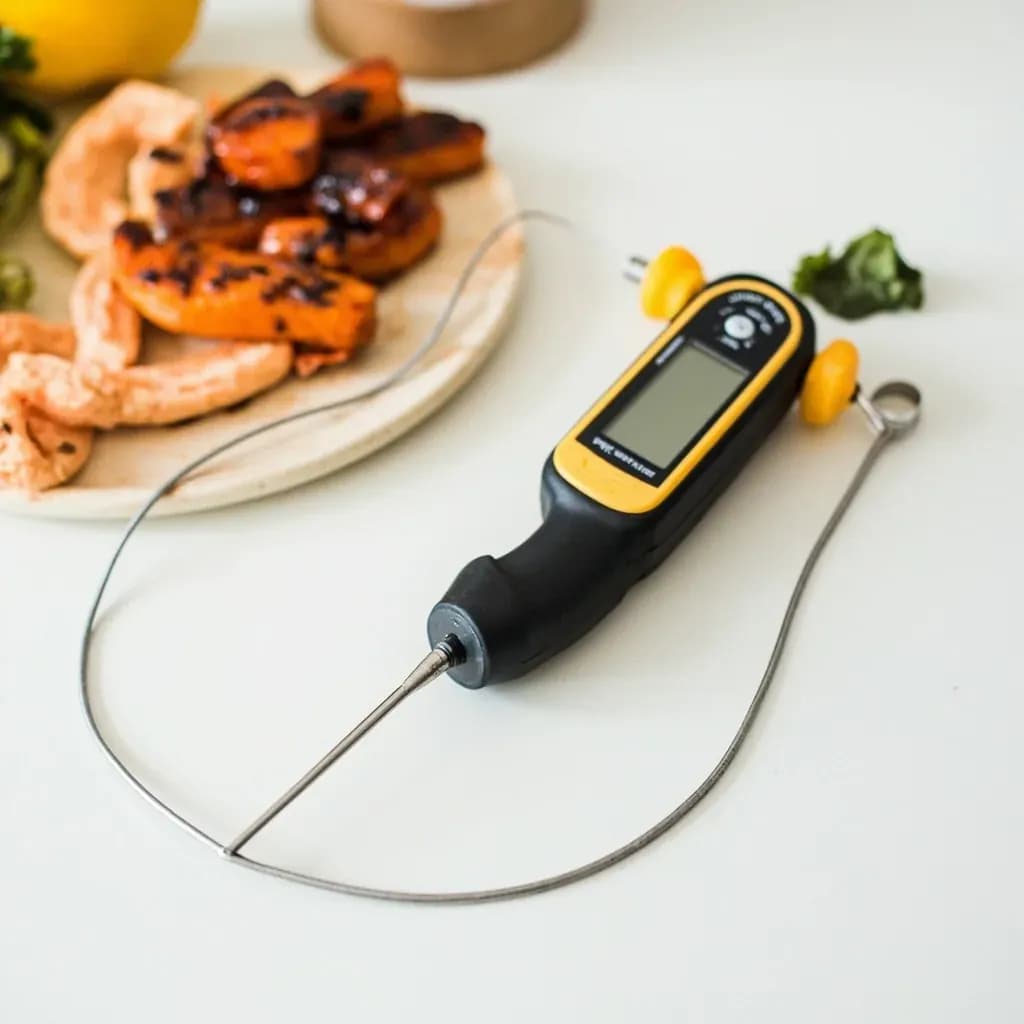
Digital thermometer that takes rapid, accurate readings using a thermocouple sensor.
A thermocouple thermometer pairs a handheld digital readout with one or more thermocouple probes to measure temperature quickly and precisely. It is favored in professional kitchens for checking oil, sugar, meat and ambient temperatures where speed and accuracy matter. Many models accept interchangeable probes for surface, penetration or air measurements.
A thermocouple thermometer is a digital probe thermometer built around a sensor made of two dissimilar metals welded together at the tip. The junction produces a tiny voltage that varies with temperature — the Seebeck effect, identified in 1821 — and the handle's circuitry translates that voltage into a reading in about a second or two. That tiny thermal mass at the junction is the whole reason cooks care: the sensor has very little metal to warm up, so it equilibrates with food far faster than the larger bead of a thermistor probe or the coiled strip of a dial thermometer.
In practical terms, this is the tool for moments when the pan, grill, or fryer is moving faster than you can think. A 1–3 second read lets you pull a steak at 130°F as the crust is still sizzling, or catch oil at 350°F before it climbs past smoke point. The trade-off, compared with a thermistor instant-read, is a small step down in precision (the gap is usually well under a degree at cooking temperatures) and a thinner, more delicate probe wire — a fair exchange for most working cooks, who would rather have speed than a third decimal place.
It is worth knowing where it sits in the thermometer family. Cheap bi-metal dial probes are slow and low-resolution but nearly indestructible and oven-safe; thermistor instant-reads (the older Thermapen Classic style) are slightly more accurate at the table but a beat slower. A thermocouple thermometer is the right default for the hot end of cooking — searing, frying, grilling, candy — while long, slow oven and smoker work is better handled by a leave-in probe or a thermistor.
Alternatives
Types & varieties
The classic kitchen form factor: a slim folding or pivoting probe in a pocket-sized handle. The right tool for spot-checking meat, oil, and liquids at the stove or grill.
A heat-resistant cable meant to stay in the oven or smoker while the display sits on the counter, logging internal temperature over hours. Used for roasts, large birds, and long smokes.
Probe transmits to a separate display or smartphone via Bluetooth or RF, so you can monitor from another room.
Two or more probes feeding one base unit — the standard kit for competition and backyard BBQ, where you track meat and pit temperature at once.
Combines a thermocouple needle probe with a non-contact IR sensor for reading griddle and pan surface temperatures.
Lower-cost, thinner units that trade speed and durability for portability and price.
How a thermocouple actually works
Inside the tip of the probe, two different metal wires are welded into a single junction. Because the metals respond differently to heat, that junction generates a small but measurable voltage, and the voltage scales predictably with temperature. The handle contains circuitry that converts that voltage into a digital reading.
The reason this design is fast is mechanical, not magical. The junction is tiny, so it has very little thermal mass to warm up; it reaches equilibrium with the food in a fraction of the time a larger bead or coil needs. The same small mass is also the reason the probe wire is thin and the tip is delicate — that fragility is the price of speed.
Thermocouple vs. thermistor
A thermistor instant-read (the older Thermapen Classic style, and many entry-level digital probes) uses a semiconductor bead whose resistance changes with temperature. The bead is slightly more accurate at a given target temperature and the probe body is usually tougher, but the larger thermal mass means a reading that takes one to three seconds longer.
For most stovetop and grill work, the thermocouple wins on speed. For long, slow oven cooks and for tasks where you are reading the same spot repeatedly (candy, chocolate, yogurt incubation), the thermistor's extra precision and ruggedness can be worth the extra second. Many serious cooks end up owning one of each.
Common uses
Tips & pitfalls
- Insert from the side into the thickest part of the cut, so the tip rests in the geometric center without touching bone or a fat pocket — both conduct heat faster than muscle and will give a falsely high reading.
- Wait a full 2–3 seconds for the reading to stabilize; even a fast thermocouple needs a moment to equilibrate with the food.
- For thin items like burger patties or fish fillets, slide the probe in horizontally rather than from the top, so the tip travels through more mass and gives a representative reading.
- Wipe the probe between raw proteins — an alcohol swipe or a clean damp cloth is the standard habit, and it also keeps fats from insulating the next reading.
- Never leave a handheld thermocouple in a hot oven. Only leave-in probes with oven-rated cables and a separate display are designed for that, and even then the display unit stays on the counter.
- Use the ice-bath test once a year: stir crushed ice with a little water, plunge the tip in, and confirm 32°F / 0°C. If it reads off by more than a degree or two, replace the unit — most consumer thermocouples are factory-sealed and not user-calibratable.
- Hold the probe tip mid-depth in oil, not against the pot wall or resting on the bottom — those surfaces run several degrees hotter than the oil bulk and will mislead you.
- Check more than one spot on a roast or whole bird; a thermocouple reads a single point, not the whole piece, and large cuts can vary by 10°F or more from end to end.
Good to know
- Sensor type
- Thermocouple: two dissimilar metals joined at the tip, producing a voltage proportional to temperature (the Seebeck effect, 1821).
- Response time
- 2–5 seconds for most models; flagship units such as the Thermapen ONE read in roughly 1 second.
- Accuracy
- About ±0.5–1°F (±0.3–0.5°C) in the cooking range — slightly less precise than a thermistor, but much faster.
- Temperature range
- Roughly -58°F to 600°F (-50°C to 315°C) for most kitchen models; some industrial probes reach 700°F and beyond.
- Probe style
- Thin needle probe (often under 2 mm diameter) — rigid and folding on handheld instant-reads, or on a thin lead wire on leave-in and wireless models, all feeding a pocket-sized display.
- Power
- Most run on a single AAA battery; a few low-cost models use coin cells.
- Care
- Wipe the probe between uses; never submerge the handle or the probe-to-cable junction, and never put a handheld unit in the oven.
- Field check
- An ice-bath test — crushed ice plus a little water — should read 32°F / 0°C within a degree or two. Annual checks are usually enough.
Also called
thermocouple probe thermometer · digital thermocouple
Related

Peeler
Swift blade for stripping skin off fruit and vegetables

Grater
Sharp-toothed surface for shredding cheese and vegetables

Microplane
Ultra-fine rasp for citrus zest, garlic, and hard cheese

Mixing Bowl
All-purpose bowl for combining, whisking, and tossing

Whisk
Looped wires that beat air into eggs, cream, and sauces

Spatula
Flat blade for flipping, lifting, and scraping

Slotted Spoon
Pierced spoon that lifts solids and drains the liquid behind

Wooden Spoon
Gentle, heat-friendly spoon for stirring anything