Prep Tools
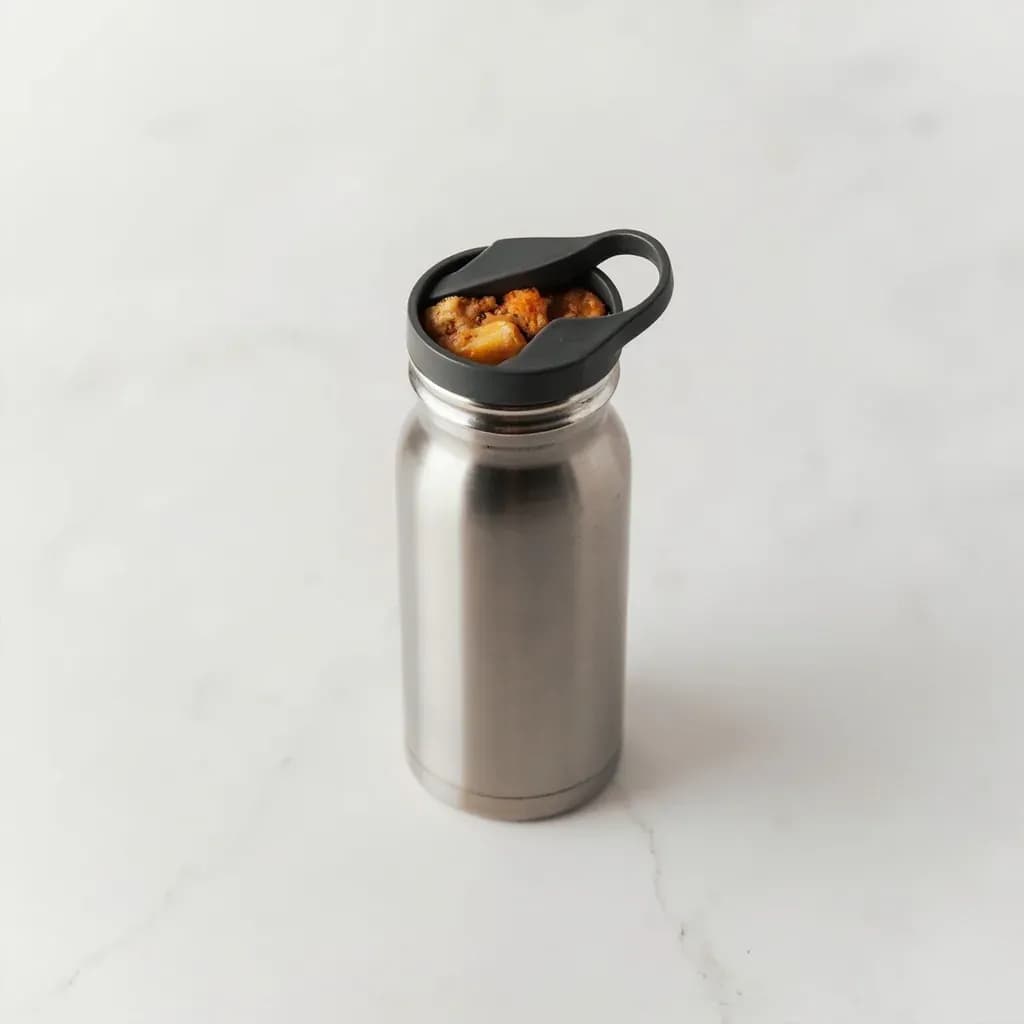
Thermos Flask
A vacuum-insulated flask that keeps drinks and liquids hot or cold for many hours.
A thermos flask is a double-walled vacuum-insulated bottle that slows heat transfer to keep contents hot or cold for hours. In the kitchen it carries hot tea, coffee, and broth, and can hold liquids at a steady warm temperature for slow infusions or holding a culture. Pre-rinsing with hot or ice water before filling improves how long it maintains temperature.
A vacuum flask is a double-walled vessel with the air between the walls pumped out, leaving a near-vacuum that blocks heat transfer by conduction and convection. A reflective coating on the glass or steel surfaces further reduces radiant heat loss, so a filled flask can hold tea at drinking temperature through a long commute or keep a pot of stock piping hot during a drive to a friend's kitchen. For cooks, it is less about clever physics than about timing: it lets you finish a stew at home and serve it two hours later close to the same temperature, or carry hot porridge to a child at school without resorting to a microwave.
The body is usually 18/8 stainless steel today, though glass-lined versions remain prized for tea, coffee, and anything sulfurous such as eggs, cabbage, and brassicas, where steel can lend a faint metallic note. A screw-down lid with a rubber or silicone gasket seals the top, and that gasket is the part most likely to fail, harbor odor, or grow mold. Quality varies sharply with wall thickness, gasket quality, and whether the inner wall carries an extra copper or aluminum reflective layer, which is why two flasks of the same capacity can perform very differently.
Alternatives
Types & varieties
Traditional double-wall glass construction; best flavor neutrality for tea and coffee but fragile and heavy
Modern default; durable, lightweight, often with a copper or aluminum reflective layer for extra performance
Short, wide profile designed for soups, stews, oatmeal, and curries rather than drinks
Tall, single-handle design with a flip or slide lid for commuting, usually 350–500 ml
Lever- or pump-dispensed vessel holding 1.9–3.8 L, used in cafés, buffets, and offices for hot water or coffee
Narrow, lightweight bottle intended primarily for cold water; typically shorter retention than food-grade flasks
Open-top scientific version with no handle or lid, used for cryogenic liquids; the ancestor of all consumer thermoses
Choosing the right size and shape
Capacity is the single biggest variable in real-world performance. A flask filled only a third full loses heat or cold far faster than the same flask filled to the neck, because the air gap inside is the weak point of the design. For drinks, a 500 ml model is the sweet spot for most adults: large enough to skip refills on a workday, small enough to finish in a few hours so retention matters less. For soups and stews, a 350–500 ml wide-mouth food jar is easier to eat from with a spoon and easier to clean.
- 350–500 ml: daily drink bottle, single portion of soup or porridge
- 750 ml–1 L: shared drinks, multiple portions for a child's lunch
- 1.5–2 L: batch transport of stock, mulled wine, or large-format cooking water
- Airpot (1.9–3.8 L): hot water or coffee service for a group
Pre-conditioning: the step most people skip
A flask that goes straight from the cupboard to a hot filling loses a chunk of its working time warming up its own walls. Pouring hot tap water into the flask, capping it, and waiting five minutes, then discarding that water before filling, recovers 20–30% of total retention time. The same principle in reverse applies to cold use: chill the interior with cold water and ice for a few minutes before adding iced tea or a chilled dessert.
When not to use one
Carbonated drinks are the classic hazard: dissolved CO2 outgasses in the sealed headspace and the lid can pop, leak, or vent scalding liquid. Vacuum flasks are also poor choices for storing dairy at lukewarm temperatures, where the long holding time creates a food-safety window for bacterial growth, and they are unsuitable for microwaves, dry ice, or anything that needs to actively cook. Pressure cookers and slow cookers exist for a reason.
Common uses
Tips & pitfalls
- Always pre-condition the flask with hot or cold water for five minutes before filling; this recovers 20–30% of lost performance.
- Fill to at least three-quarters full — air space is the enemy of retention, since the void loses heat quickly.
- Stopper and cap immediately after filling; every second with the lid off bleeds heat or cold.
- Let very hot liquids cool for a few minutes before sealing to avoid dangerous pressure buildup, especially with chunky soups that trap steam.
- Clean the lid gasket and threads weekly; trapped milk, coffee oils, or soup residue is the usual cause of off-flavors and mold.
- Avoid carbonated drinks; CO2 outgasses in the vacuum space and the lid can pop or leak.
- For very hot liquids, choose a glass-lined flask for taste but never dunk a cold glass liner into boiling water — thermal shock will crack it.
- Skip the dishwasher on budget and glass-lined models; hand-washing preserves the vacuum seal and prevents lid warping.
- If a flask stops holding temperature, the vacuum is likely compromised; a sweaty or frosted outer wall is a telltale sign it is no longer insulating.
Good to know
- Inventor
- Sir James Dewar, Scottish physicist and chemist at the Royal Institution, patented the vacuum flask in 1892
- Commercial launch
- Thermos GmbH, founded in Berlin in 1904 by Reinhold Burger, brought Dewar's design to market
- Operating principle
- Two walls separated by a vacuum suppress conduction and convection; reflective coatings on the inner surfaces minimize radiant heat loss
- Typical retention
- A good flask holds liquid within roughly 5–10°C of starting temperature for 12–24 hours, with performance dropping sharply when partially filled
- Standard sizes
- Common capacities are 350 ml, 500 ml, 750 ml, 1 L, and 1.5–2 L; food jars usually run 350–500 ml
- Temperature limits
- Most household units are rated for 0–100°C; very hot liquids should cool a few minutes before sealing to prevent pressure buildup
- Care
- Hand-wash only on most models; gaskets and lids need separate cleaning to prevent mold and trapped odors
- Dishwasher safe
- Generally no; high heat and detergent can degrade the vacuum seal on budget models and warp plastic lids
Also called
vacuum flask · insulated bottle · thermos
Related

Peeler
Swift blade for stripping skin off fruit and vegetables

Grater
Sharp-toothed surface for shredding cheese and vegetables

Microplane
Ultra-fine rasp for citrus zest, garlic, and hard cheese

Mixing Bowl
All-purpose bowl for combining, whisking, and tossing

Whisk
Looped wires that beat air into eggs, cream, and sauces

Spatula
Flat blade for flipping, lifting, and scraping

Slotted Spoon
Pierced spoon that lifts solids and drains the liquid behind

Wooden Spoon
Gentle, heat-friendly spoon for stirring anything