Prep Tools
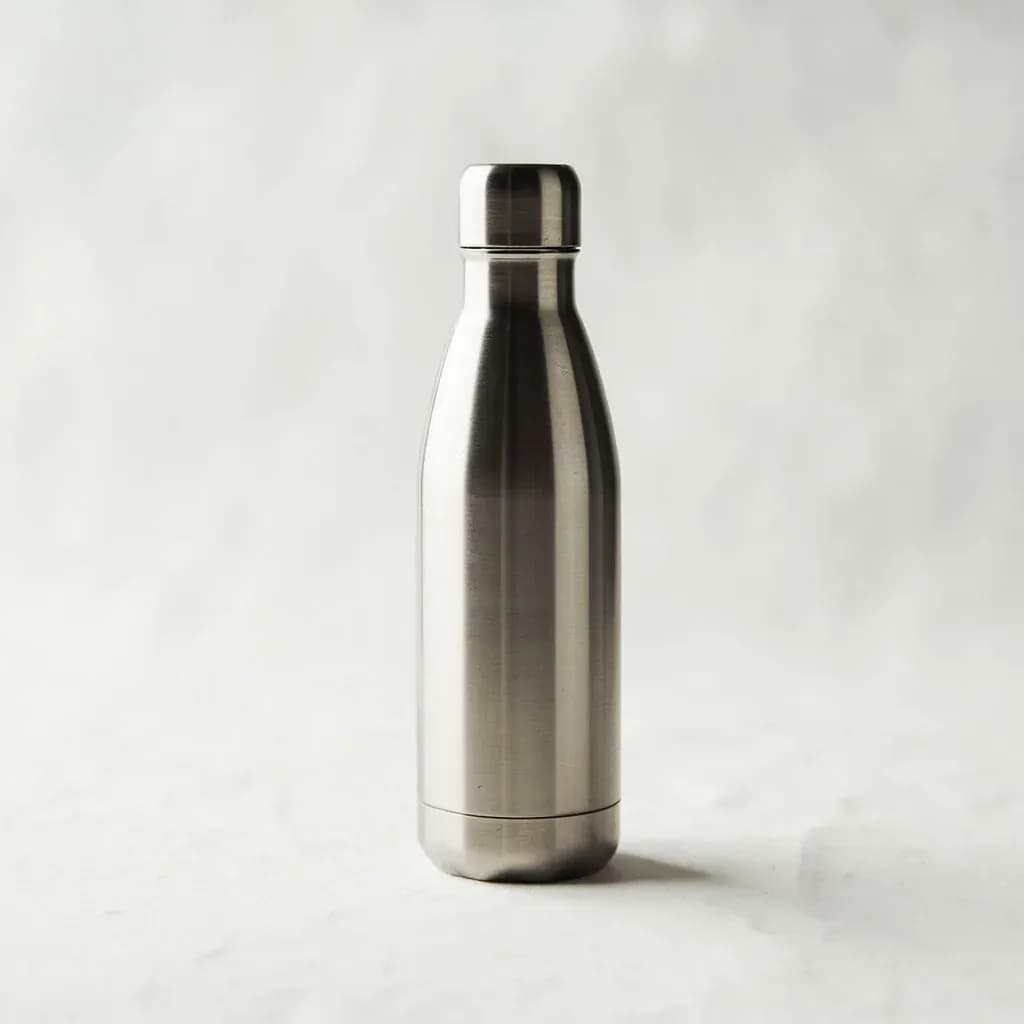
Vacuum Thermos Flask
A double-walled vacuum-insulated flask that keeps liquids hot or cold for hours.
A vacuum thermos flask is a double-walled container with the air evacuated between its walls, which dramatically slows heat transfer. Cooks use it to keep stocks, broths, tea, and coffee at temperature, and it can even serve as a low-tech sous-vide or low-temperature cooking vessel for eggs, yogurt, or grains. The vacuum gap, not the cap alone, is what gives it hours of insulation.
The vacuum thermos flask is one of the most useful non-powered tools a cook can own: a double-walled vessel with the air sucked out from between the walls, leaving a near-perfect vacuum that blocks conduction and convection between them. The inner wall is typically silvered to bounce radiant heat back where it came from, and the two walls are sealed at the neck. The result is a container that can hold a near-boiling stock at service temperature for many hours, or keep genuinely cold water cold through a long Saturday prep session, without any electricity.
In the kitchen it is best understood as a holding and transport tool rather than a cooking vessel. It will not simmer, reduce, or chill — it simply arrests change, which makes it ideal for moving finished liquids (soups, sauces, broths, fats, coffee) from one place to another while preserving their temperature and, in glass-lined models, their flavour. It is also a clever improvised proofer and a clean way to carry picnic or market-stall food that needs to arrive hot.
The two practical trade-offs are durability and weight. Stainless steel is the working cook's default; glass-lined flasks hold heat longer and taste cleaner, but the liner will shatter if dropped. Either way, the flask is a passive object — pre-condition it before use, fill it nearly to the top, and respect the food-safety clock on anything dairy- or protein-rich.
Alternatives
Types & varieties
Rugged, food-safe, the working cook's all-rounder for soups, stocks, fats, coffee, and tea.
Borosilicate glass liner inside a metal or plastic shell; the connoisseur's choice for tea, coffee, and delicate broths, with the cleanest flavour and longest heat retention, but the liner shatters on impact.
Wide-mouthed, screw-lid version built for solids as well as liquids — curries, congee, porridge, noodles, stews.
Large-volume (1.9–3 L+) dispenser with a press-down pump or lever; common on buffets, in coffee service, and in working kitchens for holding stock warm.
Table-style pour vessel for coffee or tea, usually with a glass inner, plastic or metal shell, and a push-button top.
Small, lidded, hand-held mug designed to keep a single serving of coffee or tea at temperature through a long prep session.
Care, cleaning, and food safety
A vacuum flask is sealed and passive, which means the food inside stays at roughly the same temperature for hours — including the temperature range where bacteria thrive. The flask pauses cooling and heating; it does not pause microbial growth. Treat anything dairy- or protein-rich with the same timing rules you would use for a covered pot on the counter.
- Hand-wash with warm water, mild detergent, and a long-handled bottle brush; rinse very thoroughly to keep fat and coffee oils from tainting the next batch.
- Pull the silicone or rubber gasket out and wash it separately every few uses — a smelly gasket is the most common cause of off flavours.
- Air-dry completely with the lid off before storing, or the seal and interior will pick up mildew and stale odours.
- Carry milk, cream, custards, and cream-based sauces no longer than 2–3 hours even when kept cold in the flask; the temperature is held, but the bacteria are not paused.
- Glass-lined flasks are vulnerable to thermal shock — never pour boiling liquid into a liner straight from the fridge, and never rinse a hot liner with cold water.
Common uses
Tips & pitfalls
- Always pre-condition the flask: fill with boiling water (or ice water for cold service) and let it stand 5 minutes, then empty, before adding the actual food. Skipping this drops performance noticeably.
- Fill to roughly 90–95% capacity. A small air gap prevents pressure build-up with very hot liquids and reduces the chance of the stopper popping off in a bag.
- With very hot liquids, let the food rest a minute or two off the heat before sealing, or crack the stopper open briefly after closing to release trapped steam — otherwise internal pressure can lift the lid.
- Never use a vacuum flask for carbonated or fermenting drinks. CO₂ pressure can blow the stopper or damage the seal.
- For the cleanest flavour in tea and coffee, choose a glass-lined flask; for anything that might be dropped, knocked, or carried in a busy kitchen, choose stainless steel.
- To proof dough, pre-warm the flask with boiling water, pour out, towel-dry, then set the covered dough inside — the residual warmth holds a steady ~30 °C for roughly 30–40 minutes.
Good to know
- Inventor
- Sir James Dewar, 1892, originally a laboratory vessel for holding liquefied gases.
- Commercial origin
- Glass vacuum flasks produced in Germany by Reinhold Burger from 1903; the 'Thermos' trademark was registered in Berlin in 1904 (from Greek therme, heat).
- Construction
- Inner and outer walls separated by a near-perfect vacuum; the inner wall is typically silvered to reflect radiant heat; sealed at the neck.
- Common materials
- Stainless steel (kitchen workhorse); borosilicate glass liner inside a metal or plastic shell (best flavour, fragile); all-plastic (lightweight, lower performance).
- Typical capacities
- 350 ml, 500 ml, 750 ml, 1 L, 1.5 L, 2 L for flasks; pump pots and airpots 1.9–3 L.
- Heat retention
- Quality stainless flasks keep liquids above ~60 °C for 6–12 hours and below ~10 °C for 12–24 hours; glass-lined flasks generally hold temperature longer.
- Care
- Hand-wash recommended for glass-lined and most double-wall steel flasks; never microwave — the metal and sealed vacuum make it unsafe.
- Empty weight
- A 500 ml stainless flask weighs roughly 300–400 g; a 1 L version around 500–700 g.
Also called
保温杯 · Vacuum Thermos · Vacuum Flask · Insulated Bottle
Related

Peeler
Swift blade for stripping skin off fruit and vegetables

Grater
Sharp-toothed surface for shredding cheese and vegetables

Microplane
Ultra-fine rasp for citrus zest, garlic, and hard cheese

Mixing Bowl
All-purpose bowl for combining, whisking, and tossing

Whisk
Looped wires that beat air into eggs, cream, and sauces

Spatula
Flat blade for flipping, lifting, and scraping

Slotted Spoon
Pierced spoon that lifts solids and drains the liquid behind

Wooden Spoon
Gentle, heat-friendly spoon for stirring anything