Prep Tools
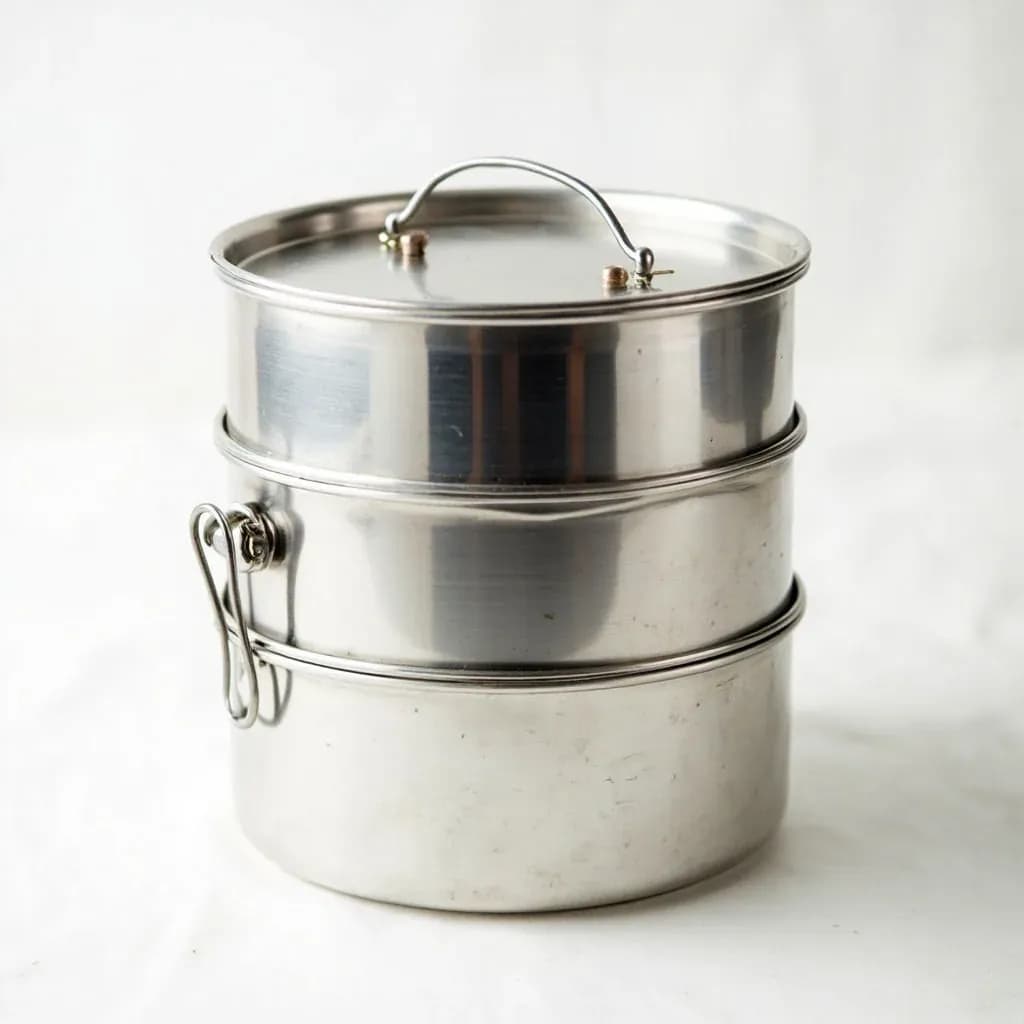
Tiffin Carrier (Sa Bwe)
Stacked metal lunch tins clamped together for carrying multiple dishes hot.
A tiffin carrier is a set of round, stackable metal containers locked together by a side clamp and shared handle, used across South and Southeast Asia to transport a full meal. Each tier holds a separate component such as rice, curry and vegetables, keeping them apart until serving. It is a reusable, insulating way to pack home-cooked food for work, travel or delivery.
The tiffin carrier is a stack of shallow, lidded food tins that lock together under a single handle, built to move a whole meal — rice, dal, vegetable, pickle, bread, sweet — in one upright column without the dishes touching or sloshing. It is one of the oldest mass food-delivery systems in the world, and the form matters as much as the food inside: shallow tiers cool quickly, stack compactly, and seal with metal-on-metal or rubber gaskets that hold against the jostling of a bicycle, a train, or a long morning commute.
The most familiar versions come from two traditions. In the Indian subcontinent, the stainless-steel dabba of Mumbai (with its side-clip latches) and the lighter spun-aluminum mess tiffin of South India (with a top bail handle) carry roughly 200,000 home-cooked lunches a day through the dabbawala network. In Myanmar, the Sa Bwe — bamboo or wood turned and coated in thitsi lacquer — serves the same function, but is also pressed into religious life, used to carry alms and temple offerings on morning merit rounds.
For the home cook, a tiffin is less about nostalgia than about geometry. The vertical stack keeps each dish at its own humidity: a wet curry cannot soak a chapati sitting above it, a pickle cannot perfume the rice, and a fried snack stays crisp because the lid above it never touches it. That separation, more than any insulation, is what makes the format work from a packed lunch in a rickshaw to a picnic in a field.
Alternatives
Types & varieties
Bamboo or wood body with thitsi lacquer, often black with red or gold banding; 3–5 tiers; prized as a heritage craft from the Bagan region.
Cylindrical tiers with side-clip latches rather than a top handle; the classic dabbawala style; thinner walls, very durable.
Spun aluminum tiers with a top bail handle; lighter and cheaper than steel; the standard 'tiffin carrier' sold across Tamil Nadu and Kerala.
Stainless or enameled stack with a tall loop handle; often 3 tiers; used for catering and home delivery.
Smaller, often 2–3 tier aluminum version sold for office and school lunches.
Plastic tiers with foam walls and snap-lid; designed to keep food hot or cold longer; lacks the metal-on-metal seal.
How the seal actually works
A tiffin is a stack of shallow cups, each with its own lid, pressed together by a single handle on the top tier. When you swing the handle down, it pulls the top lid into the rim of the tier below it, and that tier's lid is in turn pressed into the next, and so on. The food stays in because the lids are loaded in compression, not because of any clip or latch (except on the Mumbai dabba, which uses side clips instead). That is why an overfilled tier or a bent rim is the most common failure point: compression only works if every rim is round and every lid can sit flat.
Loading order matters
Heavy, stable, low-moisture food belongs on the bottom so the carrier is bottom-heavy and harder to tip. Wet curries, dals, and anything saucy sit in tiers that will not be in direct contact with bread or fried items. Pickles, chutneys, and condiments go in the top tier where a small spill does no harm. This order is also the order in which you will eat: the bottom is opened first, the top last, and the lid of each tier becomes a small plate.
Common uses
Tips & pitfalls
- Pack the heaviest, most stable food (usually rice) in the bottom tier to lower the center of gravity and keep the stack from tipping.
- Leave at least 1 cm / ½ inch of headspace in each tier; warm food expands and a fully packed tier will blow its seal and leak.
- Cool hot food 5–10 minutes before closing the lid so steam condenses inside rather than pooling on the rice or bread below.
- Line wet curries with a banana leaf, parchment round, or silicone cupcake liner to keep moisture away from dry items sitting in the same carrier.
- Lift the handle straight up to release all tiers at once; never pry a tier off sideways or you will bend the rim and ruin the seal permanently.
- Dry the rims and any rubber gaskets thoroughly after washing, especially in humid climates where a musty smell builds fast in trapped moisture.
- Rub traditional lacquered Sa Bwe with a thin coat of sesame oil every few months to keep the thitsi supple; never put them in a dishwasher, microwave, or oven.
- To deodorize a metal carrier, fill it with hot water and a teaspoon of baking soda, let stand 30 minutes, then rinse and air-dry in the sun.
- If a tier's lid no longer grips, the rim is likely deformed; a gentle hammer tap from the inside can re-round a dented aluminum rim without splitting the metal.
- Wrap the handle with a rubber band or cloth when traveling to stop it from rattling loose on bumpy rides.
Good to know
- Origin
- South and Southeast Asia; the stacked lunch-pail concept is most associated with the Indian subcontinent (Mumbai dabbawala tradition) and the Burmese lacquerware tradition of Bagan.
- Also called
- Dabba or tiffin box (India), Sa Bwe or Htabyet (Myanmar), rantang (Malaysia/Indonesia), tingkat (Singapore/Indonesia), bento (Japan, related but distinct).
- Standard configuration
- 3 to 5 round, shallow, lidded tiers stacked vertically and locked together by a single bail handle on the top tier.
- Per-tier capacity
- Roughly 1 to 1.5 cups (240–360 ml) per tier; a 4-tier carrier holds about 4–6 cups of food total.
- Traditional material
- Woven or turned bamboo/wood body coated with thitsi lacquer (sap of Melanorrhoea usitata) in characteristic black with red, ochre, or gold accents.
- Modern material
- Stainless steel (Indian dabba) or spun aluminum (South Indian mess-tiffin and most commercial models).
- Seal mechanism
- A hinged top handle presses down on the stacked lids, compressing rubber or metal-on-metal seals between tiers; the Mumbai dabba uses side-clip latches instead.
- Lid fit
- Each tier has its own press-fit or clipped lid so individual dishes can be carried or reheated separately.
- Weight (empty, 4-tier steel)
- Approximately 1–1.5 kg / 2.2–3.3 lb.
- Cleaning
- Stainless and aluminum models are hand-washable; traditional lacquered Sa Bwe must be hand-washed only, never soaked, and dried away from direct sun.
Also called
Sa Bwe · tiffin box · dabba · stacked lunch tin
Related

Peeler
Swift blade for stripping skin off fruit and vegetables

Grater
Sharp-toothed surface for shredding cheese and vegetables

Microplane
Ultra-fine rasp for citrus zest, garlic, and hard cheese

Mixing Bowl
All-purpose bowl for combining, whisking, and tossing

Whisk
Looped wires that beat air into eggs, cream, and sauces

Spatula
Flat blade for flipping, lifting, and scraping

Slotted Spoon
Pierced spoon that lifts solids and drains the liquid behind

Wooden Spoon
Gentle, heat-friendly spoon for stirring anything