Prep Tools
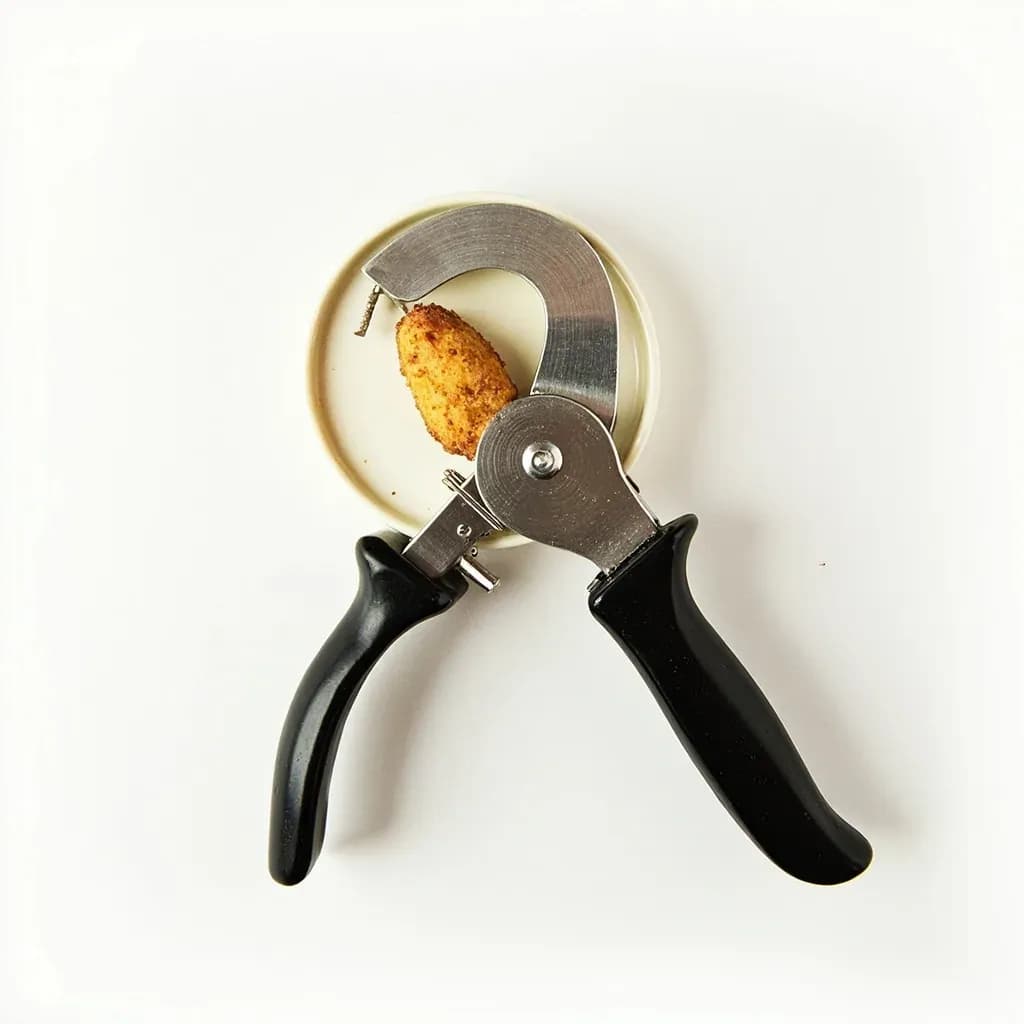
Tin Opener
Hand tool that cuts open the lid of a sealed metal can.
A tin opener uses a sharp cutting wheel and a serrated drive gear to pierce and roll along the rim of a can, separating the lid. It is a basic kitchen essential for accessing canned tomatoes, beans, fish and other pantry staples. Side-cutting models leave a smooth edge and lift the lid off cleanly without dropping it into the food.
Despite the name, a tin opener doesn't open tin — it opens tin-plated steel, the silvery metal that has sealed canned food since the early nineteenth century. The "tin can" is a holdover from when the tin coating was thick enough to give the can its colour; today the can is mostly steel with a microscopically thin layer of tin to keep it from rusting. The opener's job is to cut through that rolled steel lid cleanly enough to lift it free without showering the contents with metal shavings, and to leave a rim you can actually pour from.
The familiar domestic model is a pair of sprung handles with a toothed cutting wheel and a drive gear. You clamp the wheel against the inner lip of the lid, just inside the seam, squeeze to puncture, then turn the handle. The wheel walks round the rim while the gear keeps the cutter biting, and the lid eventually drops inside the can. That basic action, patented by William Lyman in the USA in 1870, has barely changed — though side-cutting openers, which slice the wall of the can just under the rim flange, have become the safer default in many home kitchens because they leave no sharp edge and produce almost no shavings.
It's worth owning one even when most of your cans are ring-pull. Pull tabs snap, scored lids jam, and tins of tomatoes, evaporated milk, stock, and coconut cream still turn up without an easy-open end. A decent opener also doubles as a second vent for draining, a quick fix for a stuck preserving jar in an emergency, and a sensible piece of kit to keep in a drawer at home or a bag for camping.
Alternatives
Types & varieties
The familiar home opener: a turning key drives one cutting wheel around the inner rim of the lid and the lid drops inside the can.
Cuts the lid's side wall just under the flange; leaves no sharp edge, the lid can be re-seated, and almost no shavings fall into the food.
A flat metal lever that punches a triangular hole; standard for evaporated-milk tins and traditional beer and soft-drink cans.
Mains- or battery-powered with a magnet that lifts the freed lid; useful where grip or strength is limited.
A 38 mm folding steel strip with a curved hook; the standard US military opener from 1942 and a camping classic.
Larger folding successor to the P-38 with a built-in bottle-opener notch; still packed in some MRE accessory kits.
Bolt-mounted in restaurant prep; a single lever turn pierces and strips the lid in one motion.
Clamps onto the lid, rotates itself, then releases the lid; designed for arthritic users, hospitals, and care homes.
Heavy cast unit for continuous production use; the can is pushed against a rotating star that cuts and ejects the lid.
Side-cutters versus top-cutters
The most useful distinction between modern openers is not brand or price but where they cut. A standard claw opener drives a single wheel through the top face of the lid, leaving a ragged steel edge and a small shower of filings on the food. A side-cutter mounts its wheel just under the rim flange and slices down through the side wall instead, so the lid comes off with no sharp lip, shavings stay outside the can, and the lid can be pressed back on as a temporary cover. For most home kitchens — and especially where children, older cooks, or anyone with reduced grip is using the tool — a side-cutter is the safer default. Top-cutters remain the workhorse of busy home kitchens and many prep lines because they are faster, easier to clean, and more forgiving on dented or misshapen cans.
- Side-cutter lid: no sharp edge, can be re-seated for short-term covering, almost no metal ends up in the food.
- Top-cutter lid: a jagged steel ring that needs careful pouring and will cut unwiped fingers.
- Side-cutters need a steadier hand to seat correctly on the flange.
- Top-cutters cope better with very large or slightly damaged cans.
- Top-cutters are easier to wash, with fewer moving parts to trap food and salt.
Common uses
Tips & pitfalls
- Seat the cutting wheel on the inner lip of the lid, just inside the seam, then squeeze to puncture; the lid drops inside the can and any shavings stay on the outside, where you can wipe them off.
- Turn the handle with steady, even pressure — cranking fast or jamming in reverse bends the drive gear and rounds the teeth on the wheel, and a stripped opener will skate across the lid instead of cutting.
- Pick a side-cutting opener for any kitchen serving children, the elderly, or anyone with reduced grip; the lid has no sharp edge and can be pressed back on to cover leftovers.
- Wipe the wheel, gear, and hinge with a damp cloth after every use; salt and food acid corrode the steel and gum up the drive, and an opener left wet will pit within weeks.
- If the wheel slips, release the opener, reseat it on a fresh point of the rim, and re-engage — never bear down harder, which just rounds the cutter and bends the lid.
- Refresh the cutting edge occasionally with a fine file or sharpening rod; a sharp wheel cuts with markedly less force and leaves a cleaner, less jagged edge.
- Never open a dented, bulging, or hissing can — internal pressure can launch the lid the moment the seal is pierced, and the contents may already have spoiled.
- Decant opened cans into glass or plastic for storage; the exposed steel rim and tin coating will taint the food within hours, and the bare metal edge will start to rust.
Good to know
- Also known as
- Can opener (US); tin opener (UK, Ireland, Australia, New Zealand)
- First patent
- 1855, Robert Yates, London — a lever-and-chisel design
- Modern hand opener
- 1870, William Lyman, USA — the rotating-wheel design that underpins virtually every domestic model made since
- Why it was needed
- Early 19th-century cans were thick tin-plated iron that had to be hacked open with a chisel and hammer, which limited canned food to working-class, adult use
- Material it cuts
- Tin-plated steel; the name "tin can" is a historical artefact, not a description of the metal
- Where it cuts
- Standard openers slice through the top face of the lid; side-cutting openers run a wheel along the side wall just under the rim flange
- Construction
- Hardened carbon-steel or stainless cutting wheel and drive gear; handles of moulded plastic, beech, or pressed steel
- Military issue
- The P-38 (a 38 mm folding steel strip) and the larger P-51 are still packed in US field rations and sold widely as camping openers
Also called
can opener · tin-opener
Related

Peeler
Swift blade for stripping skin off fruit and vegetables

Grater
Sharp-toothed surface for shredding cheese and vegetables

Microplane
Ultra-fine rasp for citrus zest, garlic, and hard cheese

Mixing Bowl
All-purpose bowl for combining, whisking, and tossing

Whisk
Looped wires that beat air into eggs, cream, and sauces

Spatula
Flat blade for flipping, lifting, and scraping

Slotted Spoon
Pierced spoon that lifts solids and drains the liquid behind

Wooden Spoon
Gentle, heat-friendly spoon for stirring anything