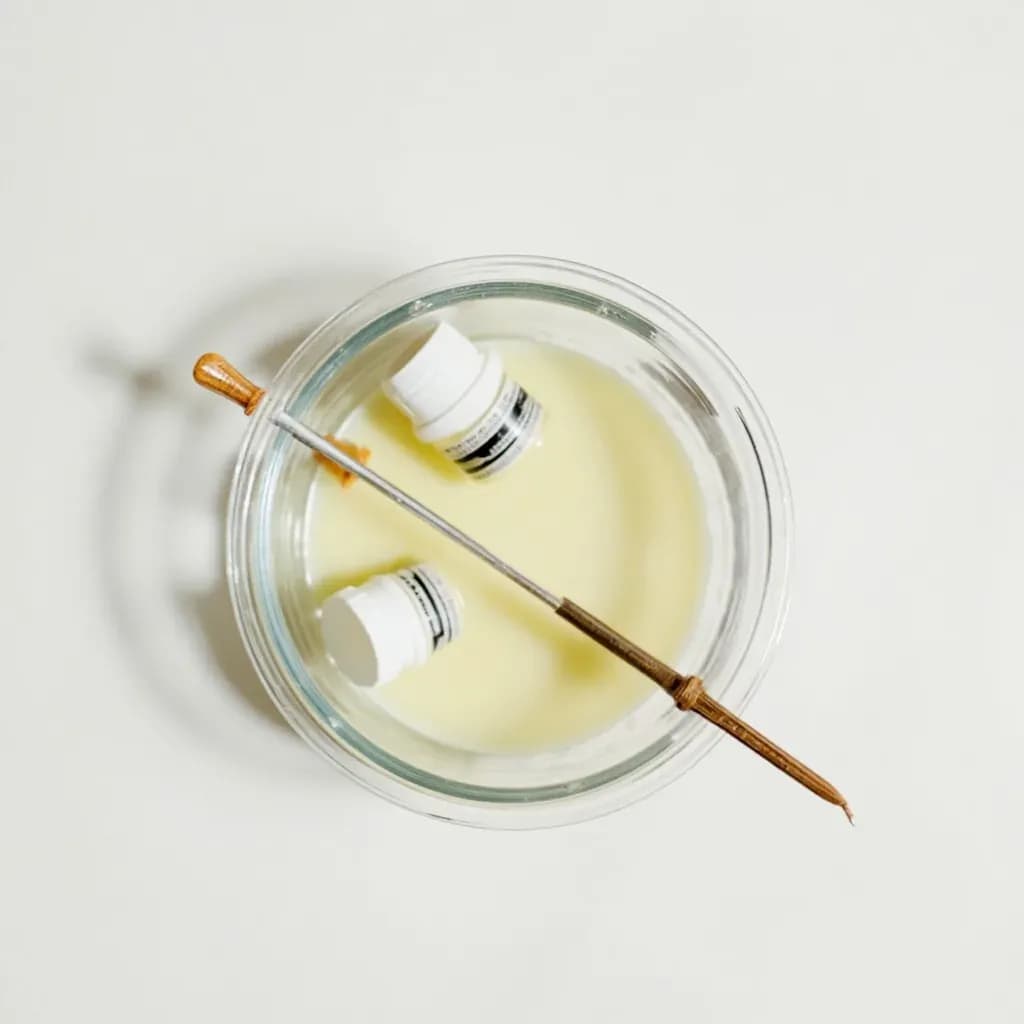
Prep Tools
Acidity Titration Kit
A measuring kit that drips a reagent into a sample to read its exact acidity for fermentation and dairy.
An acidity titration kit measures the total acid content of a liquid by adding a known reagent drop by drop until a color indicator changes. Cheesemakers, winemakers, and fermenters use it to track lactic or titratable acidity and decide precise timing for steps like cutting curd or stopping fermentation. The kit typically includes a graduated syringe or burette, a base solution such as sodium hydroxide, and a phenolphthalein indicator.
An acidity titration kit measures titratable acidity (TA) — the total amount of acid present in a food or drink — by neutralizing it drop-by-drop with a standardized base, usually sodium hydroxide, until an indicator dye turns color. Where a pH meter reports how acidic something feels on a logarithmic scale, titration counts the acid itself, gram for gram, which is the figure that actually drives flavor balance, microbial stability, and the preservative strength of a finished ferment. For the serious home cheesemaker, vintner, brewer, or fermenter, that number is worth knowing precisely.
The kit consists of a small bottle of standardized reagent, a dispensing device (a glass burette with stopcock, a graduated syringe, or in the simplest kits, a calibrated dropper), an indicator solution, a sample flask, and instructions calibrated to a specific reporting unit. Wine kits read in grams per liter of tartaric acid; dairy kits read in percent lactic acid; general-purpose kits often express results as percent titratable acidity against a stated reference acid. The endpoint is reached when a single drop of reagent turns the sample a faint, persistent pink — the moment phenolphthalein shifts from colorless to pink at roughly pH 8.2, the conventional capture point for the buffer curves of the organic acids (tartaric, malic, lactic, citric, acetic) that dominate food.
It sits at the intersection of the kitchen and the lab, but for anyone whose recipes depend on acid levels rather than just acid perception — adjusting sulfur dioxide in a fermenting must, deciding when to pull a Cheddar curd, confirming whether a salsa is safe for water-bath canning — the titration kit is the most direct way to know.
Alternatives
Types & varieties
Calibrated to read grams per liter of tartaric acid; the most common home format; uses phenolphthalein.
Reports percent lactic acid; used on whey and curd to track acid development through the make.
Adapted for wort and beer; results usually converted to lactic acid equivalents.
Multi-purpose with blank vials and indicator; suited to juice, kombucha, pickles, and tomatoes.
Adapted for thick samples; larger sample weight diluted in distilled water before titration.
Handheld electronic systems (e.g., Hanna, Hach) that dose reagent automatically and detect endpoint via electrode; substantially more precise than manual methods.
Counts drops of standardized reagent from a calibrated dropper; simplest and least precise home format.
TA versus pH: why you need both
A common misconception among new fermenters is that pH and titratable acidity are two ways to measure the same thing. They are not. pH is a logarithmic read of free hydrogen ion activity — it tells you how acidic a sample feels and is the figure that governs which microbes can grow. Titratable acidity is the total quantity of acid present, including the portion bound up in undissociated molecules and the buffered reserve that pH alone cannot see. A mature wine at pH 3.6 may carry 6 g/L TA or 9 g/L TA; the pH is identical but the mouthfeel, the color stability, and the sulfur dioxide requirement are very different.
In cheesemaking, the cheesemaker traditionally tracks titratable acidity of the whey rather than pH because it tracks the conversion of lactose to lactic acid more linearly, and because curd acid development is the main lever for moisture, body, and rind behavior. A typical Cheddar make starts around 0.16–0.20% lactic acid in the whey and finishes nearer 0.22–0.25%. pH moves through a much narrower and less informative range over the same period. The two measurements complement each other: pH for microbial safety and starter activity, TA for the buffer reserve that drives flavor and texture.
Choosing a kit
For most home cooks, a manual phenolphthalein kit is the right starting point. Expect precision of roughly ±0.2 g/L on wine and ±0.05% lactic acid on dairy — enough to make real decisions in the kitchen. Move up to a digital mini-titrator with a pH electrode when you need closer precision or when your samples are deeply colored (red wine, dark beer, strongly pigmented ferments), where a visual indicator becomes hard to read. For anyone making the same kind of measurement over and over — a small winery, a cheese operation, a kombucha brand — the digital systems pay for themselves quickly in reagent savings and reproducibility.
Common uses
Tips & pitfalls
- Place a white tile or sheet of paper under the flask so the pink endpoint reads cleanly against a bright surface.
- Degas carbonated samples (wine, beer, kombucha) by swirling or with a brief vacuum before titrating; dissolved CO2 shifts the endpoint and inflates the result.
- Titrate slowly near the endpoint — a single drop can flip the color. The pink should persist at least 30 seconds to count as the true endpoint; if it fades, you overshot.
- Rinse the burette or syringe with the NaOH solution before filling it; residual water dilutes the reagent and skews readings high.
- Re-standardize or replace NaOH after a bottle has been open more than a few months; the solution absorbs CO2 from the air and gradually loses strength.
- For colored liquids — red wine, dark beer, deeply pigmented ferments — use a pH meter endpoint rather than the visual indicator, which is unreliable against strong background color.
- Keep blank and sample at the same temperature; titration volume shifts slightly with temperature and produces inconsistent results if they differ.
- Record sample weight or volume to two decimal places (10.00 g, 10.00 mL). Small errors at this step are the largest source of inaccuracy.
- Wear safety glasses; a splash of 0.1 N NaOH in the eye causes real damage. Flush any skin contact with plenty of water.
- Do not confuse titratable acidity with pH — both matter, but they answer different questions about the same sample.
Good to know
- Primary reagent
- Standardized sodium hydroxide (NaOH), typically 0.1 N (N/10)
- Main indicator
- Phenolphthalein — colorless in acid, faint pink at endpoint (~pH 8.2)
- Alternative indicator
- Bromothymol blue for some dairy applications (pH 6.0–7.6)
- Reading unit (wine/cider)
- Grams per liter tartaric acid (g/L TA)
- Reading unit (dairy/ferments)
- Percent lactic acid by weight (% LA)
- Reading unit (juice/tomato)
- Percent citric acid or percent titratable acidity
- Sample size
- 5–10 mL liquid, or 5–10 g semi-solid diluted in distilled water
- Time per test
- 3–10 minutes including setup
- Reagent shelf life
- 6–12 months once opened; CO2 absorption weakens the solution
- Endpoint detection
- Visual color change with indicator, or pH meter electrode for higher precision
Also called
Free-Acidity Titration Kit · Falling Number Tester · acid test kit
Related

Peeler
Swift blade for stripping skin off fruit and vegetables

Grater
Sharp-toothed surface for shredding cheese and vegetables

Microplane
Ultra-fine rasp for citrus zest, garlic, and hard cheese

Mixing Bowl
All-purpose bowl for combining, whisking, and tossing

Whisk
Looped wires that beat air into eggs, cream, and sauces

Spatula
Flat blade for flipping, lifting, and scraping

Slotted Spoon
Pierced spoon that lifts solids and drains the liquid behind

Wooden Spoon
Gentle, heat-friendly spoon for stirring anything