Prep Tools
Tofu Mold / Pressing Box
A perforated cloth-lined box that presses curds into firm tofu or cheese blocks.
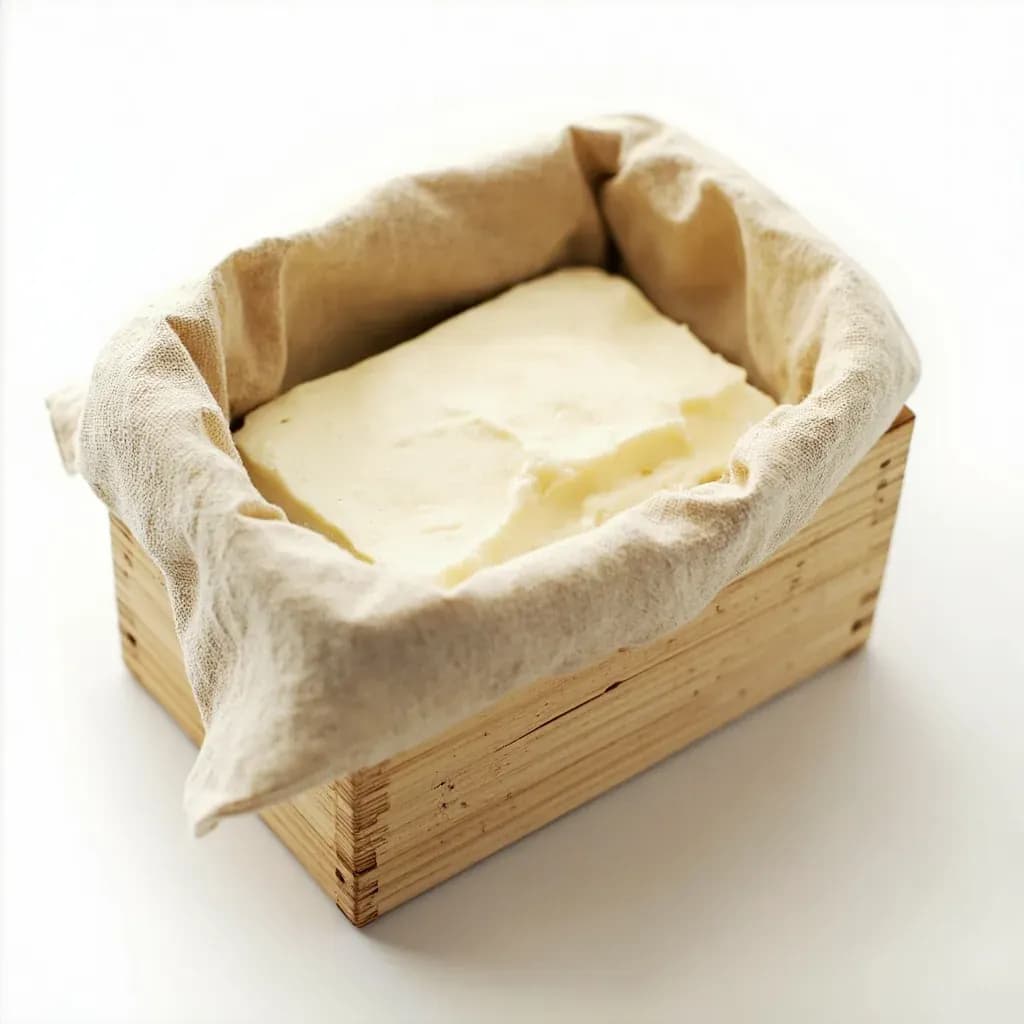
A tofu mold is a perforated box lined with cloth that holds coagulated soy curds while a weighted lid presses out whey, shaping firm blocks of tofu. The drainage holes let liquid escape so the curds knit into a sliceable cake, with longer, heavier pressing yielding firmer tofu. The same perforated-mold-and-cloth principle is used for forming and draining soft cheeses like camembert and tomme.
A tofu mold is a perforated draining box paired with a way to apply weight, used to compress loose soy curds into a coherent, sliceable block. The perforations let whey escape while the curds knit together under steady pressure; the cloth liner — usually cheesecloth or muslin — keeps fine curds inside the box and gives the finished block a clean, smooth surface. Without controlled pressing, a tofu maker is left with a soft, uneven curd that crumbles when lifted, so the mold is the single tool that turns a bowl of curds into a uniform brick that holds its shape for slicing, frying, or grilling.
The traditional Japanese version, the oribako, is built from hinoki cypress, sugi cedar, or kiri paulownia — woods whose natural oils resist bacterial growth and lend a faint resinous note prized in classic tofu. Modern molds in food-grade plastic or stainless steel sacrifice that aromatic contribution for easier cleaning, but the principle is identical: a snug, perforated cavity, a follower or lid, and a source of pressure applied evenly across the top. Outside East Asia the same form has become a small-scale cheese mold, equally suited to paneer, halloumi, queso fresco, and farmer cheese.
A homemade substitute — a colander lined with muslin and weighted with canned goods — works in a pinch, but the results are less uniform and the block is harder to release cleanly. For consistent results, especially when pressing several blocks in a row, a purpose-built mold with a fitted lid and evenly spaced perforations is worth the modest investment.
Alternatives
Types & varieties
Traditional wooden mold of cypress or cedar with a removable perforated bottom plate and a flat lid; the standard tool in Japanese tofu shops for kinu- and momen-style tofu.
Slatted sides and base assembled from individual wood strips; weights are placed on the top slats to drive whey out of the curds.
Modern mechanical press with a cast-iron or plastic body and a calibrated spring that applies even, consistent pressure without separate weights.
Stainless-steel or cast-iron pressing arm borrowed from home cheesemaking; works equally well for tofu blocks.
Lightweight perforated plastic cylinder or box with a follower plug; an inexpensive entry-level option for new tofu makers.
Choosing a mold that suits your kitchen
The variables that matter most are perforation size, lid fit, and material. Perforations should be small enough to retain fine curds but open enough to let whey run freely. A snug lid or follower distributes pressure evenly; a loose lid produces a domed or lopsided block. Material is largely a question of cleaning routine: wooden molds reward hand-washing and occasional oiling with better flavor contribution, while plastic and stainless steel tolerate a dishwasher and are easier to keep odor-free when working with strongly flavored curds.
Common uses
Tips & pitfalls
- Soak a new wooden mold in water for at least an hour before first use to swell the grain and stop the tofu from sticking to the wood.
- Always line the mold with damp cheesecloth or muslin so the block lifts out cleanly and the press doesn't stain.
- Add weight in stages — start light and increase over 10–15 minutes — to avoid crushing curds into a dry, crumbly texture.
- Save the expelled whey; it is rich in protein and works well in soups, smoothies, or bread batters.
- For extra-firm tofu suitable for frying or grilling, press for at least 1–2 hours, then rest the block in the fridge for another hour before cutting so the proteins finish setting.
- Never press silken-style curds in a mold: they lack the protein network to hold a block and will collapse through the perforations.
- Treat wooden molds with food-grade mineral oil a few times a year to repel moisture and odors; plastic or stainless molds can be wiped with white vinegar to remove soy smell and residue between uses.
Good to know
- Origin
- East Asia; the wooden press box has centuries of use in Chinese and Japanese tofu-making traditions
- Japanese name
- Oribako (折箱), sometimes called tofu-kiri-bako
- Materials
- Traditionally hinoki cypress, sugi cedar, or kiri paulownia; modern versions in food-grade plastic or stainless steel
- Construction
- Slatted or perforated base and sides, removable drainage plate, fitted lid, and an external weight or lever
- Liner
- Cheesecloth, muslin, or fine cotton press cloth
- Typical capacity
- Roughly 300 g to 1 kg of curd; common household sizes are 10–15 cm square
- Press time range
- 15–30 minutes for soft tofu; 1–2 hours (or weighted overnight in the fridge) for firm or extra-firm
- Care
- Hand-wash wooden molds, towel-dry, and air-dry fully to prevent mold and warping; never soak or dishwash
Also called
Camembert Mold · Tomme Mold · Basket Mold · Tofu Press · Tofu Mold Box
Related

Peeler
Swift blade for stripping skin off fruit and vegetables

Grater
Sharp-toothed surface for shredding cheese and vegetables

Microplane
Ultra-fine rasp for citrus zest, garlic, and hard cheese

Mixing Bowl
All-purpose bowl for combining, whisking, and tossing

Whisk
Looped wires that beat air into eggs, cream, and sauces

Spatula
Flat blade for flipping, lifting, and scraping

Slotted Spoon
Pierced spoon that lifts solids and drains the liquid behind

Wooden Spoon
Gentle, heat-friendly spoon for stirring anything