Prep Tools
Tomato Press (Spremipomodoro)
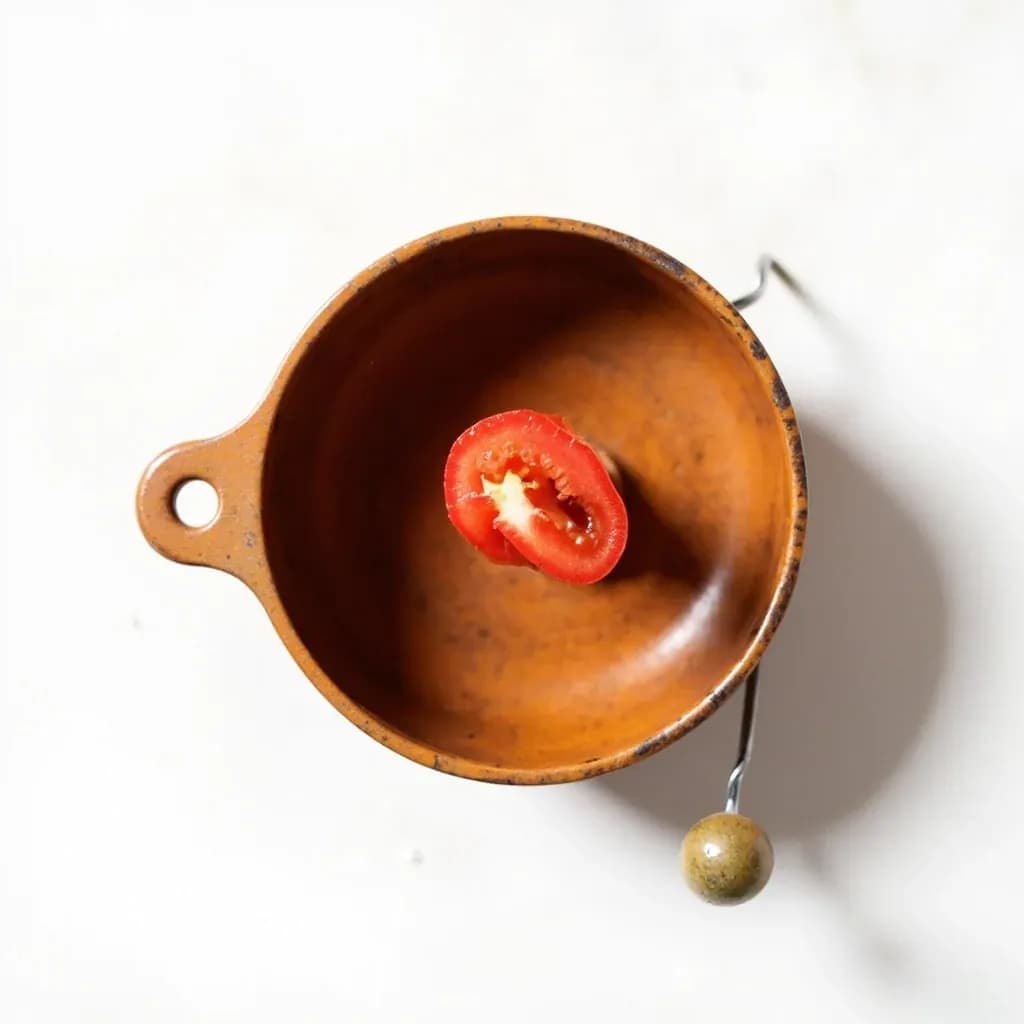
A crank mill that purées tomatoes while separating out skins and seeds.
A tomato press, or spremipomodoro, is a hand- or motor-cranked mill that forces cooked or raw tomatoes through a perforated screen. Smooth pulp and juice pass into a bowl for passata and sauce while skins and seeds are ejected separately, with no peeling or seeding needed. The same machine works as a general food mill for berries, apples, and other soft produce.
The spremipomodoro — literally "tomato squeezer" in Italian — is a hand-cranked mill that purées ripe tomatoes and, in a single pass, ejects the skins and seeds through a separate chute. The result is bright, seedless passata produced without the heat of cooking, the oxidation of blending, or the labor of blanching and peeling. The tool has been a fixture of southern Italian home preserving for generations, and a good cast-iron model will outlast its owner with nothing more than prompt rinsing and a towel dry.
The mechanism is a rotating auger (worm gear) inside a perforated screen. Tomatoes drop into the hopper; the auger forces the flesh through the holes while dragging the dry waste — skins, cores, seeds — out the back. Pulp and juice fall from one spout into a bowl below; the compressed skin-and-seed ribbon drops from a second chute into a separate container. Most countertop models process 5–8 kg of tomatoes in 10–15 minutes, and a typical hopper holds 1.5–3 kg, so a 20 kg batch of Sunday passata is a comfortable afternoon project for one or two people.
The screen is finer than a coarse food-mill disc but coarser than a chinois, which is why most cooks finish their passata with a quick pass through a tamis or fine-mesh sieve when they want a glassy sauce. Material matters more than you might expect: classic Italian units are cast iron with tin or nickel plating; bare aluminum reacts with tomato acid, leaving metallic off-flavors and pitting the metal; stainless steel is the safest option but tends to be lighter and less durable than cast iron.
Alternatives
Types & varieties
The classic Italian countertop model; cast iron body with tin plating, single fine screen, clamp mount; long considered the benchmark home unit.
Italian-made cast iron or enameled versions; same auger-and-screen design, often with rubber feet instead of a clamp.
Pressed-metal Italian spremipomodoro with painted finish; very common in Italian households and similar in mechanism to the Imperia.
Aluminum-bodied manual press with suction-cup base; lighter and cheaper than cast-iron Italian models — the entry-level choice.
Larger hand-cranked or electric presses with greater hopper volume; used in small commercial passata production.
Modern interpretation; non-reactive, often dishwasher-safe, but generally lighter and less durable than cast iron.
Spremipomodoro vs. food mill vs. juicer
The spremipomodoro is a specialized food mill, but the geometry differs in ways that matter. A standard rotary food mill uses a curved blade sweeping against a horizontal perforated disk; a spremipomodoro uses a horizontal or slightly inclined auger that pushes the tomato through a conical or flat screen. The auger is more aggressive on whole raw tomatoes and self-ejects the dry waste, which is why it dominates Italian passata production. A juicer is the wrong tool for the job: it extracts only liquid and discards the meaty pulp that gives passata its body and color. A blender or food processor followed by straining can approximate the result, but it chops the seeds (releasing bitter notes) and aerates the purée, leaving it paler and frothier than the screw-pressed version.
Choosing a tomato press
Three things decide whether a spremipomodoro will be a pleasure or a frustration: the metal, the mount, and the hopper size.
- Cast iron with tin or nickel plating (Imperia, Reber) is heavy, clamps to a thick board, and outlasts its owner if kept dry.
- Aluminum and stainless models are lighter and friendlier to a dishwasher, but bare aluminum reacts with tomato acid and should be avoided for serious work.
- Suction-cup bases are convenient on a smooth granite counter and useless on a wooden butcher block or wet surface.
- Match the hopper to your batch: a 1.5–2 kg hopper suits a couple making passata for the year; a 3 kg hopper is faster but needs two pairs of hands feeding and collecting.
Working with the waste
The dry skin-and-seed ribbon that exits the back of the press still contains a surprising amount of recoverable pulp. Italian cooks traditionally do not throw it away.
- Simmer the waste 20–30 minutes with a little water, then press it again (or run it through a food mill) for a thinner, paler second-quality sauce good for braises and ragù.
- Add the waste directly to a stock pot for vegetable or meat stock — the seeds and skins contribute glutamates and color.
- Compost what you cannot use; the dry ribbon breaks down quickly.
Common uses
Tips & pitfalls
- Halve or quarter tomatoes and cut out the cores and any green shoulders before feeding; large whole tomatoes stall the auger and clog the screen.
- Never push tomatoes down with your fingers — always use the supplied wooden or plastic plunger; the auger is powerful enough to injure.
- Don't run the tomatoes through twice by default; one pass gives the cleanest, least-oxidized purée. Re-pressing the waste raw yields a thinner, more bitter juice better suited to stock than to sauce.
- Clamp the press firmly to a thick wooden board or sturdy counter; suction-cup bases fail on wet, porous, or uneven surfaces.
- Pre-heat the screen with a splash of hot water before starting; cold metal can make very ripe tomatoes slip and smear rather than press cleanly.
- Salt the cut tomatoes lightly and let them sit 15–20 minutes before pressing — the salt draws out juice and noticeably improves yield.
- Process only fully ripe, fully colored tomatoes; under-ripe fruit carries more gel around the seeds and clogs the screen faster while yielding less.
- Rinse and towel-dry every part within minutes of finishing — tomato acid etches plating and stains enamel, and damp cast iron or tin will oxidize in storage.
Good to know
- Italian name
- Spremipomodoro ("tomato squeezer")
- Origin
- Italy; long-standing tradition in southern Italian home and small-scale preserving kitchens
- Mechanism
- Hand-cranked auger (worm gear) that forces tomatoes through a perforated screen
- Output streams
- Two: strained pulp and juice from one spout; dry skins, cores, and seeds from a separate waste chute
- Typical materials
- Cast iron (tin- or nickel-plated), aluminum, or stainless steel body; steel auger; stainless or tinned screen
- Screen mesh
- Single fixed fine screen — coarser than a chinois, finer than a coarse food-mill disc; some models offer interchangeable discs
- Capacity
- Hopper typically holds 1.5–3 kg of tomatoes; commercial floor models are larger
- Throughput
- Roughly 5–8 kg of tomatoes per 10–15 minutes by hand
- Acid reactivity
- Bare aluminum reacts with tomato acid (metallic taste, pitting); cast iron needs plating or enamel; stainless is safest
Also called
Spremipomodoro · vegetable-mill · passata-mill · Tomato Strainer · Food Mill
Related

Peeler
Swift blade for stripping skin off fruit and vegetables

Grater
Sharp-toothed surface for shredding cheese and vegetables

Microplane
Ultra-fine rasp for citrus zest, garlic, and hard cheese

Mixing Bowl
All-purpose bowl for combining, whisking, and tossing

Whisk
Looped wires that beat air into eggs, cream, and sauces

Spatula
Flat blade for flipping, lifting, and scraping

Slotted Spoon
Pierced spoon that lifts solids and drains the liquid behind

Wooden Spoon
Gentle, heat-friendly spoon for stirring anything