Prep Tools
Triangle Scraper
A flat triangular blade for scraping food debris and grease off griddles and flat-top grills.
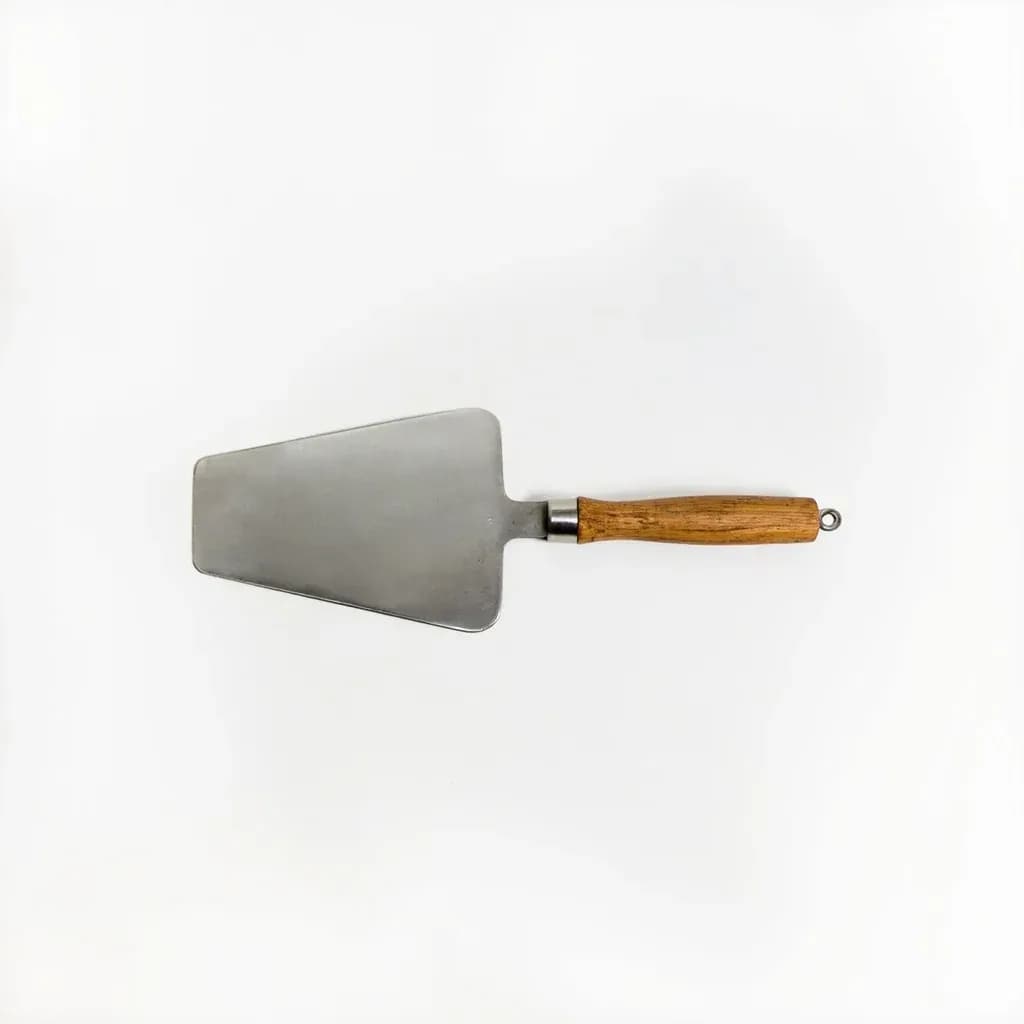
A triangle scraper is a stiff steel or hard-plastic blade shaped like a triangle, usually with a wooden or metal handle, used to clean and degrease flat-top griddles between cooks. Cooks push it across a hot or warm surface to lift stuck-on residue, grease, and carbon. Its pointed corners reach into the edges and seams of a griddle that a flat spatula cannot.
The triangle scraper is the short-order cook's answer to a flat-top griddle that has been working hard. It is a flat, stiff blade, roughly the shape of a rounded isosceles triangle (or sometimes a trapezoid), mounted on a wooden or riveted metal handle, and it is purpose-built to push, chop, and clean a hot steel or cast-iron cooking surface without gouging its seasoning. The blade's working edge is sharpened just enough to bite into carbonized grease and burnt-on food, but kept deliberately short of a knife edge so that it does not dig deeply into seasoned cast iron. In a busy diner, the scraper is rarely put away: it is in a cook's hand almost as often as a spatula, used to chop onions on the grill, to portion and smash burger patties, to sweep crumbs off the plate, and, at the end of a station's life, to clean the surface down to bare metal before re-oiling.
The tool evolved alongside the cast-steel flat-top griddle in the early twentieth century, when American lunch wagons and diners swapped soapstone cooking slabs for the faster-heating steel plates that still dominate short-order cooking today. Its three corners are the real engineering: each one can reach a seam, an edge, or the lip around a thermometer well that a rectangular brick or a pad cannot. A good triangle scraper feels heavier than it looks, sits flat against the griddle without chattering, and develops a slightly polished working face after a season of use.
It is important not to confuse the griddle triangle scraper with a bench or pastry scraper, which shares the general idea of a flat handled blade but is thinner, lighter, rectangular, and used by bakers to portion dough and clean marble counters. The griddle version is a heavier, stiffer, intentionally dull tool built for hot steel, not cold stone.
Alternatives
Types & varieties
Triangular hardened-steel blade with a riveted wooden (usually maple) handle; the standard short-order cook's tool and the form most cooks picture when they hear the name.
Slightly wider at the back of the blade than a true triangle, giving more surface area; favored in heavy commercial use where speed of sweeping matters more than corner access.
Handle extends well past the blade for two-handed leverage on large commercial griddles, reducing wrist fatigue during long service.
Stainless or carbon steel throughout, including a formed or stamped metal handle; tolerates a dishwasher and is common in high-volume kitchens where wooden handles would be a sanitation issue.
Blade with a notched or stepped edge on one side for cleaning between grill grates and a triangular profile on the other, doubling as both a bar-grill tool and a flat-top tool.
Blade shaped to seat a pumice griddle brick against its face, so the cook can scrub and scrape in a single pass across the field of the griddle.
How to use it on the griddle
The scraper is at its best when you treat it as a pushing tool, not a chopping one. Hold the handle with a relaxed overhand grip, lay the blade almost flat against the griddle with the beveled face leading, and push forward with steady pressure. A low angle bites into carbonized grease; a steep angle skates. The corners do the precision work: tip the scraper onto one of its three points to clean along the back edge of the griddle, around a thermometer well, or in the seam where two plates meet. Between orders, the same flat push will sweep chopped onions, smash a ball of ground beef into a thin patty, or shovel a finished portion onto a plate.
- Keep the blade at roughly a 10–20° angle to the surface; the leading edge should be the one doing the work.
- Scrape while the griddle is still warm, not screaming hot; carbon releases more easily from a surface that has cooled just below sizzle.
- Use the broad face for the open field of the plate and switch to a corner for seams, edges, and the gap around a thermometer probe.
- For smashburgers, lay the beef ball on the griddle, press it flat with a spatula, then use the scraper to peel and portion the patty once it has set.
Triangle scraper vs. bench scraper
Both tools share the silhouette of a flat handled blade, and that is where the resemblance ends. A bench or pastry scraper is rectangular, thin, often a little flexible, and built for cold work: portioning dough, scraping flour off a marble counter, lifting a sheet of rolled pastry. Its edge can be quite sharp. A griddle triangle scraper is heavier, stiffer, roughly triangular, and its working edge is kept deliberately short of a knife edge so that it cleans hot steel without digging into seasoning. Cooks who own both tend to color-code or store them on different sides of the kitchen, because reaching for the wrong one in a hurry either damages a griddle or ruins a sheet of puff pastry.
Care and sharpening
Treat a carbon-steel triangle scraper the way you would treat a carbon-steel pan: keep it dry, give it a thin film of food-grade oil between shifts, and don't let it sit wet. Stainless versions are more forgiving but still benefit from a quick wipe-down. The edge does not need to be razor-sharp; a slightly dull, square-edged blade cleans better than a thin knife edge and is far less likely to scar seasoning on a cast-iron plate. When the edge rounds over, re-square it on a bench grinder with light passes, keeping the original bevel angle, and stop before the blade thins into a sliver.
Common uses
Tips & pitfalls
- Hold the blade at a low angle, almost flat to the griddle, with the bevel leading; steep angles skate instead of bite.
- Scrape while the griddle is still hot but not searing-hot; a warm surface releases carbon more easily than a cold one.
- Pair the scraper with a pumice griddle brick: use the brick for the open field of the plate and the triangle's corners for seams, edges, and around thermometer wells.
- Never use a triangle scraper on a non-stick, PTFE, or ceramic-coated griddle; the steel edge will scar the coating and may flake it into food.
- Keep the edge true but not razor-sharp; a slightly dull, square-edged blade cleans better than a knife edge and is less likely to dig into seasoning on cast iron.
- Wipe the blade clean and film it with a light coat of food-grade oil between shifts to prevent rust on carbon-steel models.
- Don't pry with the tip or use the scraper as a chisel on welded seams; the corners can chip and leave steel fragments in the food zone.
- Replace the scraper once the blade has been ground down to a narrow strip; an over-sharpened, thinned blade flexes and loses cleaning power.
- After heavy scraping, re-season a cast-iron griddle with a thin film of oil while it is still warm to restore the patina before the next service.
Good to know
- Tool type
- Flat metal blade with a roughly triangular or trapezoidal outline, mounted on a handle, used to clean and manipulate flat cooking surfaces
- Primary material
- Hardened carbon steel or stainless steel blade; handle typically hardwood (maple is common) or formed/riveted metal
- Common blade size
- Long edge about 3 to 5 inches (7.5–12.5 cm); overall length with handle around 9 to 11 inches
- Also called
- Griddle scraper, grill scraper, flat-top scraper, diner scraper, short-order scraper
- Not the same as
- A bench or pastry scraper, which is rectangular, thinner, and designed for dough and cold work surfaces
- Compatible surfaces
- Steel flat-tops, cast-iron griddles and planchas, and hot plates; not for non-stick, PTFE, or ceramic-coated griddles
- Edge geometry
- Beveled long edge kept slightly dull; corners rounded just enough to reach seams without digging in
- Maintenance
- Wipe dry after use and oil lightly to prevent rust on carbon-steel models; re-square the edge on a bench grinder as needed
Also called
Grill Scraper · Griddle Scraper
Related

Peeler
Swift blade for stripping skin off fruit and vegetables

Grater
Sharp-toothed surface for shredding cheese and vegetables

Microplane
Ultra-fine rasp for citrus zest, garlic, and hard cheese

Mixing Bowl
All-purpose bowl for combining, whisking, and tossing

Whisk
Looped wires that beat air into eggs, cream, and sauces

Spatula
Flat blade for flipping, lifting, and scraping

Slotted Spoon
Pierced spoon that lifts solids and drains the liquid behind

Wooden Spoon
Gentle, heat-friendly spoon for stirring anything