Prep Tools
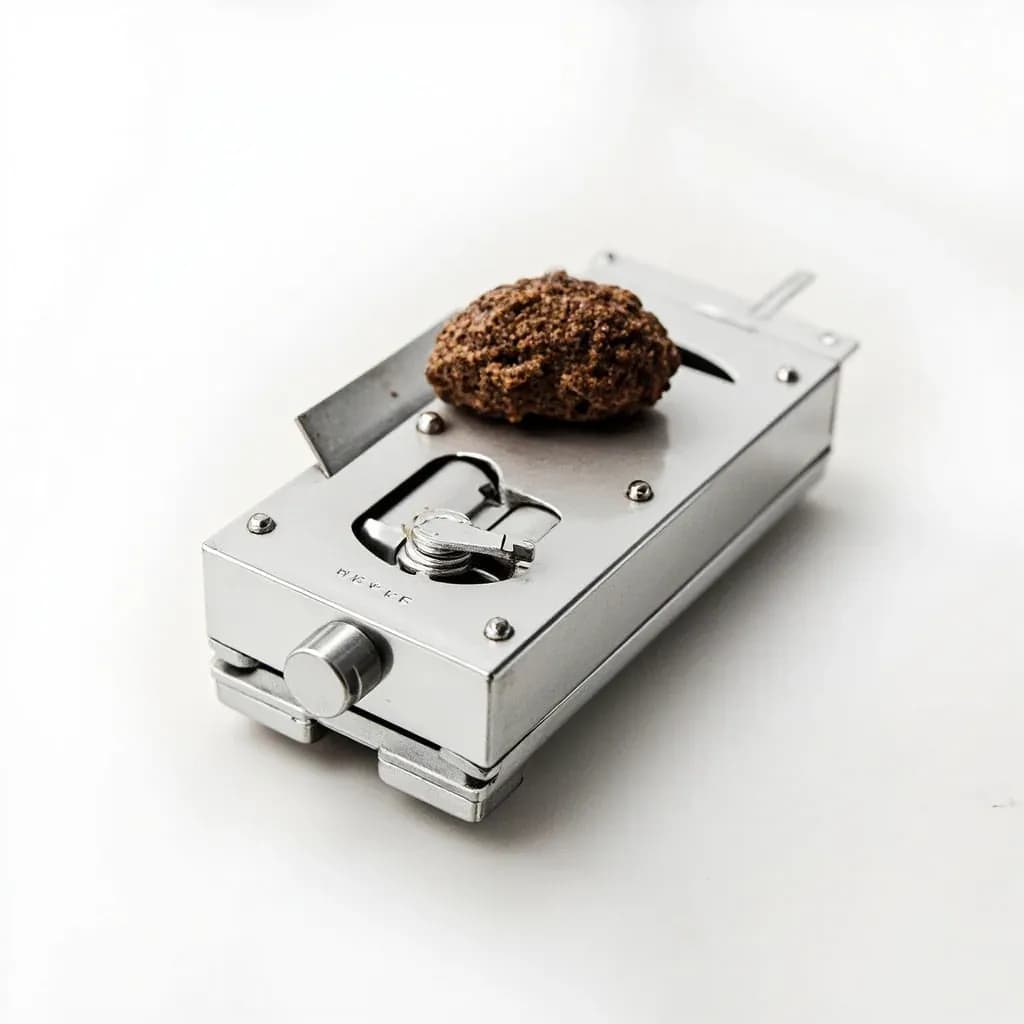
Truffle Slicer (Mandoline à Truffe)
A small handheld slicer with an adjustable blade for shaving truffles paper-thin.
A truffle slicer is a compact stainless-steel tool with a flat plate and a sharp, often adjustable blade used to shave truffles, hard cheese, or chocolate into wafer-thin slices. The cook draws the truffle back and forth over the blade to produce delicate, even shavings finished over a dish. The adjustment screw lets you dial thickness from translucent to slightly thicker curls.
A truffle slicer is a small handheld plane built to shave truffles into paper-thin slices, releasing the truffle's perfume without tearing its spongy interior. The flat blade sits nearly flush with a short handle, and the cook draws the truffle across the edge with a light back-and-forth motion — closer to planing wood than to slicing a vegetable. The resulting thickness matters more than you might expect: truffle aroma is concentrated at the surface of the slice, so a gossamer 0.2–0.5 mm shaving reads as ethereal and fleeting, while a thick cut tastes merely earthy and dense. That is why serious cooks shave to order, directly over the finished dish, rather than slicing in the kitchen and carrying plates to the table.
The tool has changed very little in over a century, and for good reason — the geometry simply works. A narrow blade, a comfortable handle, and either a built-in guard or the natural placement of the thumb keep fingers clear of the edge. Most slicers also handle aged hard cheese and bittersweet chocolate with the same ease, which is why many chefs keep one on the line year-round rather than packing it away between truffle seasons.
Alternatives
Types & varieties
The classic shape: a flat rectangular blade set into a short handle, used with a back-and-forth shaving motion; often called a truffle shaver.
Miniature mandoline with a thumb-set thickness dial; ranges from paper-thin to several millimeters and usually includes a hand guard.
French cutlery tradition with a riveted handle of horn, bone, or olive wood and a polished stainless blade; often given as a gift piece and treated as an heirloom.
Blade with a two-prong fork at the tip that impales the truffle and pulls it across the edge — useful for very small or round specimens that are hard to grip.
Wider blade held at both ends and used like a cheese plane; favored by some restaurant chefs for shaving a large Périgord over a broad surface.
A razor rasp rather than a plane; produces a fine fluff rather than slices, and is considered a different tool by purists.
Choosing a truffle slicer
- A fixed-blade plane handles 90% of home cooking well. Reach for an adjustable mandoline only if you regularly want thicker slices for carpaccio, terrines, or fanned presentations.
- An inexpensive stainless model (around $20) shaves a truffle just as cleanly as a $200 Laguiole. The premium buys handle material, balance, and edge retention, not better slices.
- If you buy an adjustable model, insist on a hand guard. The blade is unforgiving and the guard is a fingertip you will eventually miss.
- Skip the two-handled cheese-plane style for everyday use — it is awkward to control on a small truffle and shines only when shaving a large Périgord across a wide surface.
Beyond truffles: year-round uses
The geometry of a truffle slicer is so well suited to paper-thin shavings that it earns its place in the kitchen long after truffle season ends. Aged hard cheeses — Parmigiano-Reggiano, aged Pecorino, aged Comté, manchego — shave into translucent curls that hold their shape on top of a carpaccio or a composed salad, where grated cheese would simply sink. Bittersweet chocolate shaves cleanly with the same tool, producing the kind of delicate shavings that finish a dessert or top an espresso without melting into a smear. A few cooks also use a truffle slicer on cold, firm European butter, though a vegetable peeler is generally a more comfortable tool for that particular job.
Common uses
Tips & pitfalls
- Chill the truffle in the refrigerator for 15–30 minutes before slicing — cold flesh shaves cleanly. Do not freeze it: a frozen truffle shatters into crumbs the moment it meets the blade.
- Wipe the blade with a dry cloth between passes. Truffle moisture and butter are the slicer's two main enemies and will gum up the edge in seconds.
- Use a light, back-and-forth draw rather than pressing down. Let the sharpness of the blade do the work — heavy pressure crushes the truffle and risks slipping toward a thumb.
- Shave directly over the finished dish so the slices land where they will be eaten and the volatile aroma is captured in the steam rather than lost to the kitchen air.
- A microplane grater is not an equivalent tool — it tears the truffle into shreds and releases aroma prematurely. Use it only when shreds, not slices, are what the dish needs.
- Never put a quality truffle slicer in the dishwasher. Clean with a soft brush or a dry cloth, dry the blade immediately, and store in a cloth pouch or its original box.
- For very small or soft truffles that crumble under the plane, switch to a swivel vegetable peeler or a sharp paring knife — they will give cleaner results than fighting a slicer that is too large for the job.
- Wipe and dry the slicer before putting it away, and hone the edge on a fine steel once or twice a year to keep the shavings clean.
Good to know
- Also known as
- Truffle shaver, truffle plane, mandoline à truffe
- Origin
- France; the classic form dates to 19th-century gastronomy
- Typical size
- 12–15 cm (5–6 in) overall; blade roughly 4–6 cm long
- Slice thickness
- 0.2–0.5 mm on a fixed plane; up to 2–3 mm on adjustable mandolines
- Materials
- Stainless steel blade; traditional handles of olive wood, juniper, boxwood, horn, or bone
- Notable makers
- Laguiole, Forge de Laguiole, Peugeot, De Buyer, Matfer, Microplane
- Best on
- Firm, fresh Périgord (black) and Alba (white) truffles; works poorly on soft, overripe, or very small specimens
- Care
- Wipe blade dry after use; never soak or dishwash; hone occasionally on a fine steel
Also called
Mandoline à Truffe · Truffle Shaver
Related

Peeler
Swift blade for stripping skin off fruit and vegetables

Grater
Sharp-toothed surface for shredding cheese and vegetables

Microplane
Ultra-fine rasp for citrus zest, garlic, and hard cheese

Mixing Bowl
All-purpose bowl for combining, whisking, and tossing

Whisk
Looped wires that beat air into eggs, cream, and sauces

Spatula
Flat blade for flipping, lifting, and scraping

Slotted Spoon
Pierced spoon that lifts solids and drains the liquid behind

Wooden Spoon
Gentle, heat-friendly spoon for stirring anything