Prep Tools
UV Inspection Light
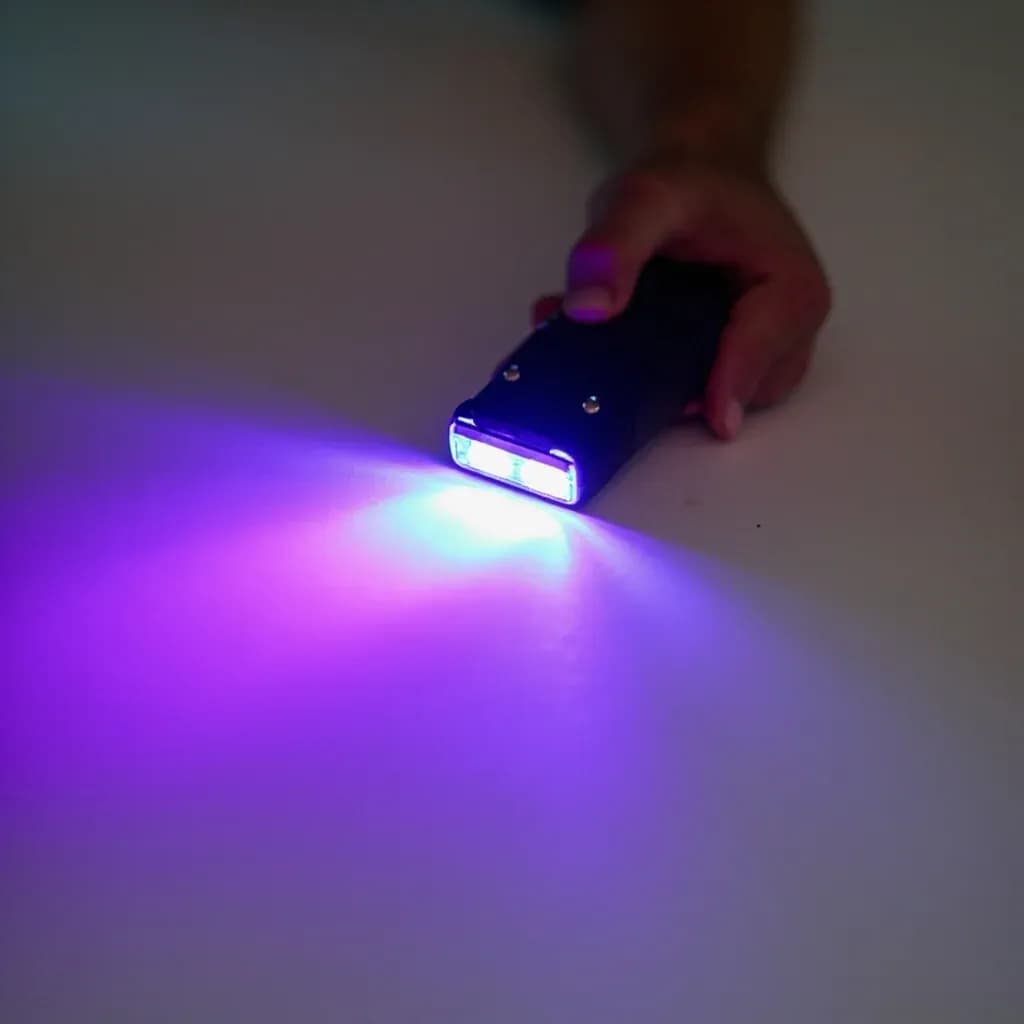
Ultraviolet lamp that reveals residues, contaminants and fluorescence invisible in normal light.
A UV inspection light emits ultraviolet wavelengths that make certain residues, sanitizer films, molds and adulterants fluoresce so they can be spotted. Food handlers use it to check the thoroughness of cleaning and handwashing, and quality teams use it to flag contamination on surfaces or ingredients. It is a verification tool rather than something used in actual cooking.
A UV inspection light is a focused source of ultraviolet radiation used to reveal substances that are invisible or barely visible under normal lighting. In the kitchen it acts as a screening tool, exposing biological residues, gaps in cleaning, and ingredient adulteration by causing certain organic compounds to fluoresce. The physics are simple: UV photons excite molecules in residues like urine, saliva, skin oils, and many food dyes, which then re-emit visible light in characteristic colors that the eye reads as bright streaks, smears, or pools against an otherwise dark surface.
Wavelength dictates everything about how the tool behaves. A 365 nm lamp (long-wave UV-A) is the workhorse for inspection work — it produces minimal visible glare while triggering strong fluorescence in organic residues and most food-fraud indicators. The cheaper 395 nm 'blacklight' floods the work area in violet light and yields a weaker fluorescence response, which translates to lower contrast and more false negatives. Short-wave 254 nm UV-C lamps are primarily germicidal and require quartz optics; they will sanitize a surface but demand strict eye and skin protection, and they are a poor choice for residue inspection.
Treated as part of a hygiene or ingredient-quality routine rather than a magic wand, a UV lamp pays for itself quickly in a professional kitchen and offers surprising utility to a careful home cook. The single most important habit is working in a darkened room, where faint fluorescence from thin residue films or dilute adulterants is otherwise drowned out by overhead light.
Alternatives
Types & varieties
Workhorse wavelength for residue and contaminant detection; preferred by food-safety inspectors and serious home cooks.
Consumer 'blacklight' — emits visible violet glare, weaker fluorescence response, lower cost; acceptable for casual checks only.
Short-wave ultraviolet for sanitizing surfaces, packaging, or air; can double as a residue inspector but requires quartz optics and strict skin/eye protection.
Stable overhead or articulating unit with a focused beam for repeated surface audits on prep tables and equipment.
Enclosed chamber that blocks ambient light for forensic-style inspection of small samples — spices, oils, honey, single leaves.
Dual-LED unit that switches between standard white light and UV for side-by-side cleaning verification.
Choosing the right wavelength
The single most consequential decision when buying a UV inspection light is the wavelength, not the brand or the brightness. 365 nm is the right answer for nearly all kitchen work: fluorescence is strong, the visible glare is low, and the difference between a clean surface and a residue film is obvious to the eye. 395 nm lamps cost less and are widely sold as 'blacklights,' but they flood the work area in violet visible light that masks the very fluorescence you are trying to read, especially under any ambient light. Save 395 nm units for casual play, party effects, or large-area spot checks where contrast is less critical. UV-C at 254 nm is a different tool entirely: it inactivates microorganisms and is useful for sanitizing a work surface or sealed container, but ordinary glass blocks it, the light is genuinely dangerous to skin and eyes, and it produces a weaker and harder-to-read fluorescence response in organic residues than 365 nm. Reserve it for germicidal duty and reach for the long-wave lamp whenever you actually want to see something.
- 365 nm: best general-purpose inspection wavelength; buy this unless you have a specific reason not to.
- 395 nm: budget option; expect lower contrast and more false negatives in normal lighting.
- 254 nm: germicidal only; never use without UV-blocking eyewear and quartz-path optics.
Ingredient authentication with UV
One of the most rewarding uses for a 365 nm lamp is screening premium ingredients for the kinds of fraud that are otherwise invisible to the buyer. Pure extra-virgin olive oil shows a characteristic red-orange fluorescence from its chlorophylls and pheophytins; when diluted with refined oils, that glow dims, and when cut with certain seed oils, a different fluorescence signature in yellow or blue-green appears. Either deviation from the EVOO baseline is worth flagging. Pure honey carries a characteristic pale fluorescence from its flavonoids; honey cut with high-fructose corn syrup or invert sugar typically deviates in brightness or hue, though the exact pattern depends on the syrup used. Saffron threads dyed with tartrazine or other artificial colorants can fluoresce in colors the genuine Crocus sativus does not. Turmeric bulked with chalk, starch, or lead chromate shows patches of dim or non-fluorescent material against the bright yellow-green glow of pure turmeric. None of these observations are a legal verdict — confirm questionable product with a lab or a trusted supplier — but they are an excellent first filter, and a 30-second scan in the receiving area can catch problems that would otherwise have made it into the dish.
- Olive oil: pure EVOO glows red-orange from natural pigments; diluted or adulterated samples deviate in intensity or color.
- Honey: adulterated samples with sugar syrups read differently from the characteristic pale fluorescence of pure honey.
- Saffron: dyed threads fluoresce vivid colors that genuine Crocus sativus does not.
- Turmeric: bulked product shows dark, non-fluorescent specks against the natural yellow-green glow.
Common uses
Tips & pitfalls
- Buy a true 365 nm unit rather than a 395 nm toy — the difference in fluorescence contrast is dramatic and worth the modest upcharge.
- Test the lamp on a known fluorescent reference before trusting it in service: tonic water (quinine) glows blue, a banana peel fluoresces blue under 365 nm, and petroleum jelly glows bright green.
- Work in a darkened room; even modest overhead lighting washes out faint fluorescence from dilute residues.
- Wear UV-blocking safety glasses whenever the lamp is on — UV-A is invisible but still damages the cornea with prolonged exposure, and the visible glare from cheaper lamps disguises the danger.
- Use it as a screening tool, not a forensic verdict: not every contaminant fluoresces, and not everything that fluoresces is a contaminant. Confirm with ATP swabs or lab testing when the stakes are high.
- For rodent-urine checks, scan at a low angle close to the floor — residue pools along baseboards, inside cabinet corners, and under equipment kick plates rather than spreading across open surfaces.
- Keep the lens clean and the battery charged — UV LEDs dim as voltage drops, and a weak lamp will miss real contamination that a fully powered unit would catch.
- Pair UV inspection with a white-light pass: UV reveals what is invisible, white light confirms what is visible, and the two together catch what single-pass inspections miss.
Good to know
- Tool type
- Handheld flashlight or bench-top lamp emitting ultraviolet light for non-destructive inspection of food, surfaces, and ingredients.
- Primary wavelengths
- 365 nm (UV-A) for fluorescence detection; 254 nm (UV-C) for germicidal sanitizing; 395 nm (UV-A) for budget consumer units.
- Preferred inspection wavelength
- 365 nm — minimal visible glare, strong fluorescence in organic residues and food-fraud markers.
- Working distance
- 10–30 cm for surface inspection; 5–10 cm for fine ingredient checks on small samples.
- Ambient light
- Must be used in dim or darkened conditions; even modest overhead lighting washes out weak fluorescence.
- Eye safety
- UV-A causes photokeratitis ('welder's flash') with prolonged direct viewing; wear UV-blocking safety glasses whenever the lamp is on.
- Typical cost
- $15–$60 for a serviceable 365 nm flashlight; $80–$300+ for professional bench lamps and viewing cabinets.
- Lens material
- Borosilicate glass is fine for UV-A; UV-C requires quartz because ordinary glass blocks short-wave UV.
Also called
UV light · blacklight inspection lamp · ultraviolet lamp
Related

Peeler
Swift blade for stripping skin off fruit and vegetables

Grater
Sharp-toothed surface for shredding cheese and vegetables

Microplane
Ultra-fine rasp for citrus zest, garlic, and hard cheese

Mixing Bowl
All-purpose bowl for combining, whisking, and tossing

Whisk
Looped wires that beat air into eggs, cream, and sauces

Spatula
Flat blade for flipping, lifting, and scraping

Slotted Spoon
Pierced spoon that lifts solids and drains the liquid behind

Wooden Spoon
Gentle, heat-friendly spoon for stirring anything