Prep Tools
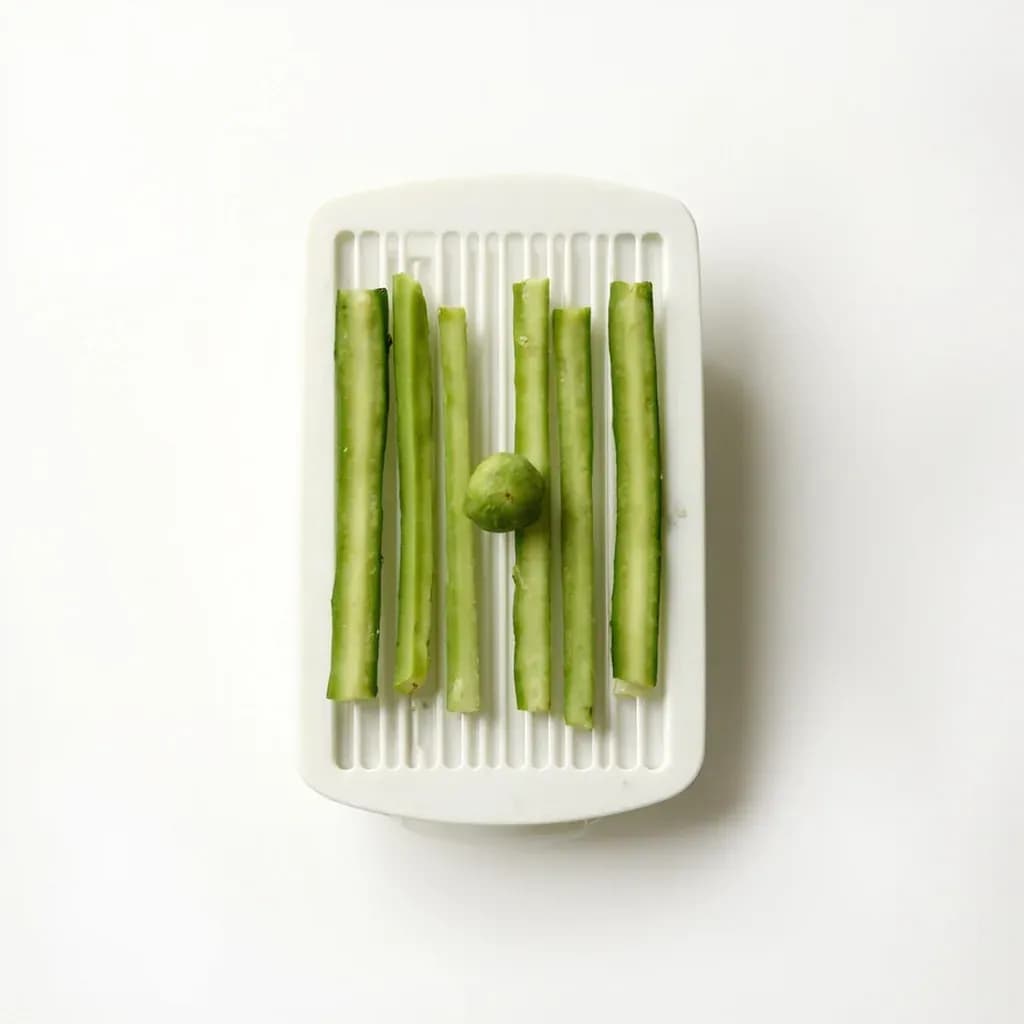
Vegetable Slicer
A bladed tool for slicing vegetables into fast, uniform pieces.
A vegetable slicer is a handheld or bench tool with one or more fixed blades that cut produce into even slices as the food is pushed across them. Cooks use it to speed prep for salads, gratins, stir-fries, and chips, achieving consistent thickness that's hard to match by knife. Many models include adjustable thickness and interchangeable blades for julienne, crinkle, or wavy cuts.
The vegetable slicer, more commonly called a mandoline in both professional and home kitchens, is a stationary cutting tool that uses a fixed blade to shave food into precise, repeatable slices. Unlike a chef's knife, where the blade moves across stationary food, the mandoline holds the blade still and the cook pushes the food across it, usually along an adjustable rail. This inverted geometry is what allows for paper-thin, perfectly even cuts that change the texture and cooking behavior of vegetables in meaningful ways — a 1 mm potato slice dehydrates into a chip, a 3 mm slice becomes a tender gratin layer, and a 5 mm slice holds its shape on a fork.
The tool is best understood as a category rather than a single implement. The classic French mandoline with an angled V-blade is the professional benchmark for razor-thin, uniform cuts; the lightweight Japanese Benriner excels at paper-thin vegetable sheets and quick julienne; and rotary drum slicers keep fingers far from the blade for batch prep. Most home cooks get the broadest range of use from an adjustable model with a hand guard and at least one julienne insert. Before any technique, the single most important habit is using that guard or a cut-resistant glove — mandoline-related finger lacerations are among the most common serious injuries in both home and restaurant kitchens.
Alternatives
Types & varieties
Stainless steel body with an angled V-shaped blade (e.g., de Buyer, Bron/Matfer); very sharp and prized by professional kitchens, usually without a julienne attachment.
Thin, lightweight plastic body with straight blades; excellent for paper-thin vegetable and daikon sheets, and can be tilted for bias slices.
Dial or knob adjusts slice thickness; many accept julienne and crinkle inserts and are the most versatile option for home cooks.
Hand-cranked cylinder with interchangeable cutting drums; safer because fingers stay clear of blades and good for larger batches.
Wavy or fluted blade for crinkle-cut chips, pickles, and garnishes.
Collapses flat for storage; usually fixed thickness with an optional julienne insert.
Stays sharp longer than steel but is more brittle and can chip if dropped or twisted.
Power-driven alternative for large volumes; less precise than a hand mandoline but very consistent.
Safety and the Hand Guard
The mandoline is one of the few kitchen tools that injures experienced cooks more often than beginners, because speed and confidence outpace the habit of using the guard. Treat the blade as a fixed razor: keep your guiding hand either inside the hand guard with the food prongs engaged in the food, or wrapped in a high cut-resistant glove. The guard is not there to slow you down — it is what lets you push the last nub of vegetable all the way through the blade without losing a thumbnail. A dull blade is more dangerous than a sharp one because it grabs and tears rather than slicing cleanly, so replace or professionally resharpen inserts on schedule rather than working around a tired edge.
- Always test the guard's prongs in the food before pushing through the blade.
- Never reach for a piece that has fallen on the cutting surface while the blade is exposed.
- A single short, steady stroke is safer than a hesitant, sawing motion.
- Keep a cut-resistant glove nearby even when the guard is fitted; some cuts — the last nub, a wide item that overhangs the guard — require a gloved hand.
Choosing the Right Model
Mandolines are largely interchangeable for a home cook's everyday prep, but the differences matter once a kitchen develops a specialty. A French V-blade pays off for gratin, chip, and high-volume slicing where precision and edge retention are paramount. A Benriner is the right tool for fine garnish work, daikon sheets, and quick julienne of softer vegetables. An adjustable model with interchangeable inserts is the best starting point for most kitchens because it covers the widest range of tasks in one footprint, while a rotary drum is the safest pick for batch prep and for cooks wary of exposed blades.
- Buy what your most frequent task requires, not the most feature-heavy model.
- Prefer thicker bodies and heavier bases for stability when speed and volume are priorities.
- Replaceable, standardized blades make long-term ownership cheaper and sharpening easier.
- Test the hand guard before buying — a guard that the food slips out of defeats the point.
Common uses
Tips & pitfalls
- Always use the included hand guard or a cut-resistant glove; mandoline blades are sharper than most chef's knives.
- Cut a flat base on round vegetables (potatoes, tomatoes, radishes) before slicing so they don't rock on the rail.
- Let the blade do the work — apply steady, even pressure rather than forcing the food through.
- Wet the blade or the food surface lightly for cleaner slices and to reduce drag on starchy vegetables.
- For long vegetables like carrots or zucchini, finish with the tail end tucked safely against the guard or your glove.
- Replace or professionally sharpen blades; a dull mandoline slips and is more dangerous than a sharp one.
- Never attempt bone, frozen food, or very hard items like butternut squash skin without prior prep.
- Hand-wash and dry immediately to prevent rust and staining on steel parts.
- Store with the blade guard on and out of reach of children.
- When using a julienne insert, watch the orientation of round vegetables — they can spin and catch unevenly.
Good to know
- Also called
- Mandoline (or mandolin) slicer, julienne cutter
- Origin
- France, 19th century; name borrowed from the mandolin musical instrument due to the angled, almond-shaped cutting surface
- Primary material
- Stainless steel blade; body typically plastic, stainless steel, or wood
- Blade types
- Straight, serrated, julienne (matchstick), crinkle/waffle
- Thickness range
- Most adjustable mandolines cut from roughly 1 mm to 10 mm (about 1/32 in to 3/8 in)
- Typical widths
- Cutting surface usually 3–5 inches (7.5–13 cm) wide; compact models smaller
- Safety
- Among the most common sources of serious kitchen cuts; a hand guard or cut-resistant glove is strongly advised
- Cleaning
- Most are hand-wash only; disassemble fully to clean between blade and body
- Storage
- Blade should be stored with guard or cover in place, ideally in a drawer where it cannot be reached blindly
- Skill level
- Beginner-friendly, but requires practice for consistent, even slices
Also called
Mandoline Slicer · Vegetable Cutter
Related

Peeler
Swift blade for stripping skin off fruit and vegetables

Grater
Sharp-toothed surface for shredding cheese and vegetables

Microplane
Ultra-fine rasp for citrus zest, garlic, and hard cheese

Mixing Bowl
All-purpose bowl for combining, whisking, and tossing

Whisk
Looped wires that beat air into eggs, cream, and sauces

Spatula
Flat blade for flipping, lifting, and scraping

Slotted Spoon
Pierced spoon that lifts solids and drains the liquid behind

Wooden Spoon
Gentle, heat-friendly spoon for stirring anything