Prep Tools
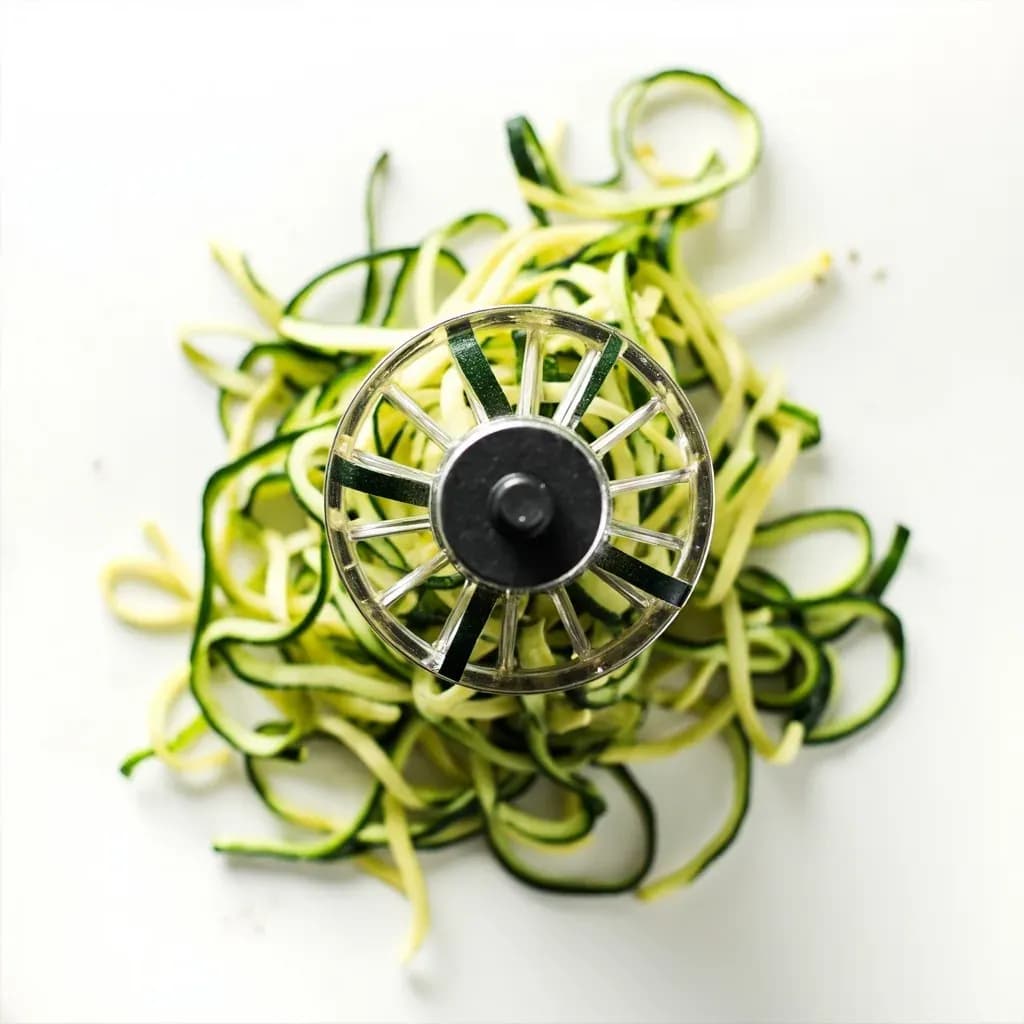
Vegetable Spiralizer
Hand crank or twist tool that cuts vegetables into long noodle-like spiral strands.
A vegetable spiralizer presses produce against a rotating blade to shave it into curly ribbons or noodles, often called zoodles. Cooks use it to turn zucchini, carrots, beets and potatoes into low-carb pasta alternatives, garnishes and salads. Models range from compact handheld cones to crank-driven countertop frames with interchangeable blades.
A vegetable spiralizer is a hand-cranked or motorized julienne tool that turns firm produce into long, continuous strands resembling pasta — from angel-hair-thin curls to broad, flat ribbons. It sits between a mandoline and a vegetable peeler in capability, but outpaces both in the volume of uniform, attractive strands it produces in seconds. At its core, the tool clamps a vegetable against a rotating blade (or rotates the blade around the vegetable), shaving it into a continuous coil that drops into a waiting bowl.
The modern countertop spiralizer traces back to Japan's Benriner turning slicer from the 1960s, but it was the 2013–2015 wave of low-carb and gluten-free cooking — and Ali Maffucci's Inspiralized brand in particular — that pushed it into American home kitchens. Today it is less a diet gadget than a basic prep tool, valued for the texture and visual interest it brings to raw salads, quick sautés, and lighter takes on noodle dishes.
The spiralizer shines on firm, cylindrical produce longer than about 4 inches — zucchini, carrot, sweet potato, daikon, butternut, beet, apple, and cucumber. It struggles with soft, watery, or seedy items, which crush rather than curl. Understanding which vegetables behave well, and how to manage the moisture that comes with them, is the difference between crisp, vivid "noodles" and a watery bowl of mush.
Alternatives
Types & varieties
The Paderno-style workhorse: vegetable skewered horizontally while a crank turns the blade assembly. Most common home model, very stable for long items like butternut or sweet potato.
Smaller footprint with the vegetable held vertically. Good for shorter items like carrots and zucchini halves; tends to be more portable and easier to store.
Pen-sized tool twisted by hand directly into a bowl. Best for quick jobs on zucchini, cucumber, and carrots; produces thinner curls and is more limited on long or dense produce.
Motorized crank for hands-free operation. Useful for large batches, commercial prep, or anyone with limited grip strength.
Powered by a stand mixer such as a KitchenAid. Saves counter space but is pricier and ties up the mixer.
Japanese single-blade turning slicer from the 1960s. Produces very fine, uniform vegetable strands rather than long continuous spirals — the original ancestor of today's multi-blade spiralizers.
Choosing the right vegetable
The spiralizer is only as good as what you put into it. Ideal candidates share three traits: firm flesh, a roughly cylindrical shape, and enough length (at least 4 inches / 10 cm) to maintain a continuous spiral. The best starters are zucchini, carrot, daikon, cucumber, and firm apples or pears. Dense root vegetables like sweet potato, beet, and butternut squash also work beautifully, but require a flat base cut and, in the case of butternut, peeling and seeding first. Soft, watery, or seedy produce — ripe tomatoes, overripe mango, very soft eggplant — crushes rather than curls, and the result is pulp rather than noodles.
Managing moisture
The single biggest spiralizer problem is water. Zucchini in particular is roughly 95% water, and the moment it is cut it begins to weep. For raw preparations, toss the noodles with a teaspoon of salt, let them rest in a colander for 15–20 minutes, then squeeze gently in a clean kitchen towel. For cooked preparations, a brief salting step or a thorough pat-dry makes the difference between a vibrant sauté and a puddle of zucchini water. Other vegetables behave better — carrot, sweet potato, and butternut hold their structure — but the salting step is still worth knowing for borderline cases like cucumber.
Cooking spiralized vegetables
The cardinal rule is brief heat. Zucchini noodles need only 1–3 minutes in a hot pan, or even less if they are being wilted in a hot sauce off the heat. Carrot, sweet potato, and butternut tolerate longer cooking and are well suited to stir-fries, roasts, and casseroles. For baked dishes like lasagna, ribbons of butternut or zucchini stand in for pasta sheets, often with a pre-roast to drive off moisture. Air-fryer curly fries made from spiralized sweet potato are an especially good use of the ribbon or thick spaghetti blade.
Common uses
Tips & pitfalls
- Cut a flat base on round vegetables — zucchini, sweet potato, beet — so they sit squarely against the prongs and do not wobble; off-center or rocking vegetables produce short, broken strands.
- Center the vegetable precisely on the prong axis. Even a small offset throws the cut off and turns long strands into stubs.
- Salt and squeeze zucchini noodles for 15–20 minutes before saucing, or at minimum pat them very dry. Untreated noodles will weep into any sauce and turn the dish watery.
- Spiralize just before cooking or serving. Pre-cut noodles lose crunch, weep moisture, and discolor within hours even in the fridge.
- Choose long, straight, dense vegetables for unbroken extra-long strands. Short, curved, or knobby pieces stop short and produce scraps.
- Let the blade do the work. Pressing harder does not cut faster and can bend or snap thin blades.
- Always keep the safety holder or food pusher between your hand and the blade. Spiralizer blades are razor-sharp and a slip means a real cut.
- Hand-wash blades and dry them immediately, even on dishwasher-safe models, to prevent rust and preserve the edge.
- Replace blades as soon as they dull — a torn or ragged strand (rather than a clean cut) is the tell that the edge is gone.
- Trim the seedy core from butternut squash and the blossom-end nub from zucchini before spiralizing; both spots catch and clog the blade.
- Cook zucchini noodles only 1–3 minutes, or simply wilt them in a hot sauce off the heat. Prolonged heat turns them to mush.
Good to know
- Tool type
- Hand-cranked or electric julienne slicer producing long spiral strands
- Precursor
- Benriner turning slicer, Japan, 1960s
- Modern adoption
- Popularized in U.S. home kitchens circa 2013–2015
- Typical construction
- ABS plastic body with stainless-steel blades
- Standard blade set
- 3–4 interchangeable blades: angel hair (~1.5 mm), spaghetti (~3 mm), fettuccine/ribbon (~5 mm), sometimes a flat shredder
- Power options
- Manual hand crank, electric countertop, or stand-mixer attachment
- Best vegetable
- Zucchini — firm flesh, straight shape, moderate moisture
- Yield
- One medium zucchini (~150 g) yields roughly 2 cups of noodles
- Time per vegetable
- About 30 seconds to 2 minutes depending on density and length
- Storage
- Raw noodles keep 2–3 days refrigerated in a sealed container lined with paper towel; do not freeze raw zucchini noodles
- Not suitable for
- Soft, watery, or seedy produce — overripe tomatoes, ripe mango, very soft eggplant — which crush rather than curl
- Nickname
- "Zoodle maker" — zoodles being zucchini noodles
Also called
spiralizer · vegetable noodle maker · zoodle maker
Related

Peeler
Swift blade for stripping skin off fruit and vegetables

Grater
Sharp-toothed surface for shredding cheese and vegetables

Microplane
Ultra-fine rasp for citrus zest, garlic, and hard cheese

Mixing Bowl
All-purpose bowl for combining, whisking, and tossing

Whisk
Looped wires that beat air into eggs, cream, and sauces

Spatula
Flat blade for flipping, lifting, and scraping

Slotted Spoon
Pierced spoon that lifts solids and drains the liquid behind

Wooden Spoon
Gentle, heat-friendly spoon for stirring anything