Prep Tools
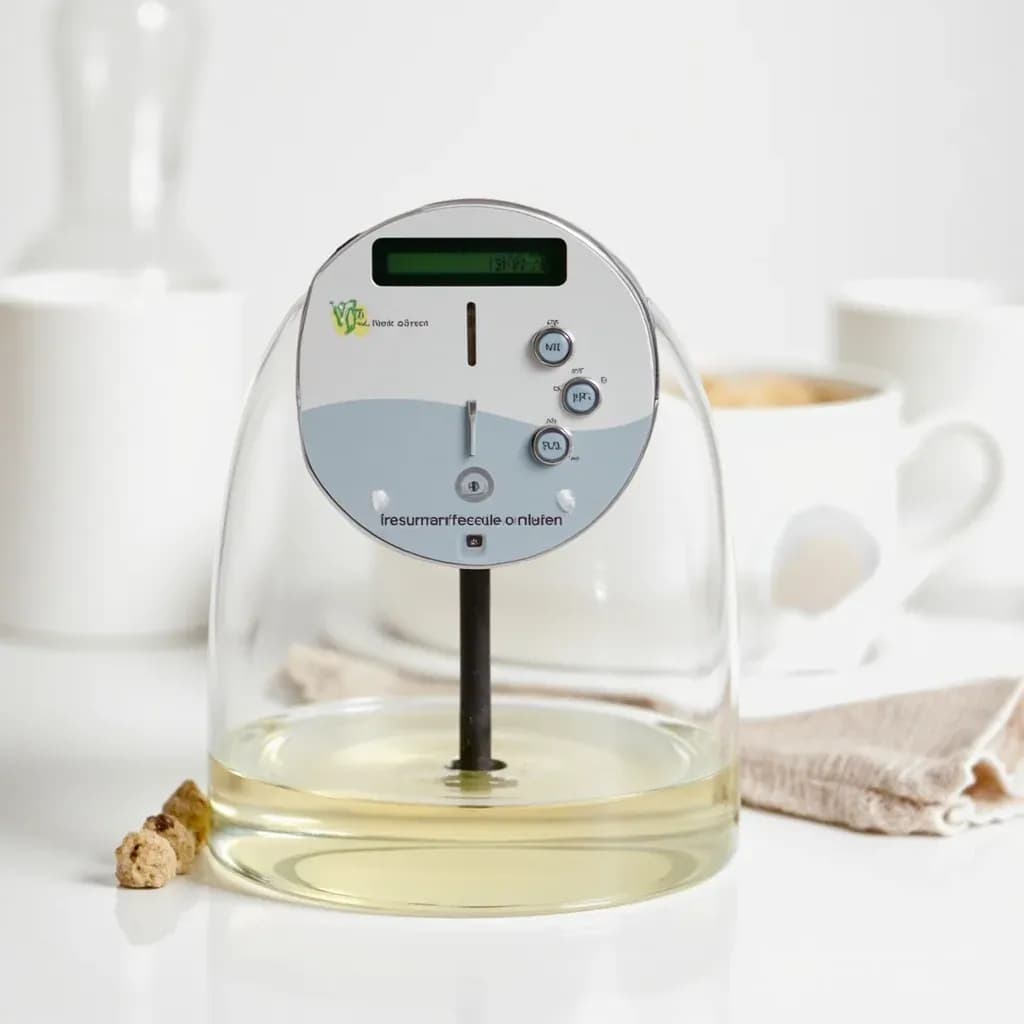
Water Activity Meter
A device that reads a food's free water (aw) to judge shelf stability and microbial safety.
A water activity meter measures aw, the amount of free unbound water available in a food, on a scale from 0 to 1. Producers of cured meats, dried fruit, jerky, and confections use it because microbial growth and shelf stability depend on water activity, not just moisture content. A sample is sealed in the chamber and the meter reads the equilibrium humidity to give the aw value.
Most food-safety regulations are written in terms of water activity (aw) rather than percent moisture, and a water activity meter is the instrument that produces that number. It works by sealing a small sample in a sealed chamber and reading the relative humidity the food produces at the surface once the air and product reach vapor-pressure equilibrium. The result, expressed as a ratio from 0.00 (bone dry) to 1.00 (pure water), is one of the few values that directly predicts whether a food will support bacterial growth, mold, or yeast — which is why the U.S. Food Code, USDA FSIS, and Codex Alimentarius all cite it as an official control parameter.
In a working bakery, smokehouse, jam kitchen, or R&D lab the meter replaces a lot of educated guessing. A finished jerky that reads 0.83 has crossed the USDA line for pathogen control; a jam at 0.82 will not ferment in the jar; a cake at 0.93 will mold in a week. The two common sensing technologies are capacitance hygrometers (fast, robust, the workhorse of production floors, around five minutes per read) and chilled-mirror dew-point sensors (slower but reference-grade, used when numbers will be quoted on a certificate of analysis, ten to thirty minutes per read).
The most useful thing to internalize is that aw is about water that has been 'tied up' by sugar, salt, fat, and starch — which is why a 70 Brix jam is shelf-stable while a fresh tomato of equal weight is not. A meter turns that intuition into a number you can record, repeat, and defend to a health inspector.
Alternatives
Types & varieties
Reference-grade accuracy (typically ±0.001 aw); used by labs and as the basis of AOAC and ISO methods. Slower, needs a clean mirror, and is the standard for compliance work.
Workhorse of the food industry — fast (about 5 min), robust, ±0.003–0.005 aw, easier to use on production floors and in a busy kitchen.
Older design using a lithium-chloride or polymer sensor; still seen in legacy QC setups, gradually being replaced by capacitance and chilled-mirror units.
Newer benchtop design (e.g., AquaLab TDL) that measures water vapor partial pressure directly; claims sub-minute reads and resists interference from ethanol, acetic acid, and propylene glycol.
Battery-powered field unit for spot checks on a line, in a smokehouse, jerky cabinet, or drying room; lower precision but invaluable for in-process verification.
Fixed probe mounted in a dryer, dehydrator, or storage room for continuous monitoring, often tied to a chart recorder or PLC.
Reading the Scale
A few reference points make the 0–1 scale intuitive and let you know when a product has crossed a meaningful safety line.
- Pure water: 1.00; fresh meat, fish, and milk: 0.97–0.99; fresh bread crumb: 0.95–0.96.
- Hard cheese interior: 0.90–0.94; surface-ripened cheese rind: 0.92–0.96 (managed for rind development).
- USDA-compliant jerky: ≤ 0.85; fermented sausage (salami): 0.85–0.91 in finished product.
- Properly set jam: 0.80–0.85; honey: ~0.55; dried pasta: ~0.50; crisp crackers: 0.30–0.45.
Why Aw, Not Moisture, Drives Spoilage
Microbes, enzymes, and most non-enzymatic reactions (Maillard, lipid oxidation, sugar recrystallization) need water that is chemically active, not just present. Dissolved sugars and salts bind water tightly, fat physically dilutes it, and starch granules lock it away — all of which lower aw without removing moisture. That is why a 70 Brix strawberry jam and a ripe strawberry of equal weight behave so differently on the shelf, and why a salt-cured ham at 55% moisture (aw ~0.88) is shelf-stable while a fresh pork chop at 70% moisture (aw ~0.98) spoils overnight.
Common uses
Tips & pitfalls
- Always bring the sample to room temperature (20–25 °C) before reading; a warm sample gives a falsely high aw and a cold one a falsely low.
- Fill the sample cup about half to two-thirds full — underfilling lengthens equilibration, overfilling prevents the headspace from forming properly.
- Cover the sample with the sensor block immediately; leaving the cup open lets surface moisture escape and skews the reading downward.
- Run a two- or three-point verification with saturated salt standards (commonly 0.33, 0.75, 0.84) at the start of each shift, not just a single-point check.
- Do not confuse percent moisture with aw — a cracker and a piece of fresh meat can have very different moistures but similar aw values.
- For oily or fatty foods (butter, chocolate, pâté), scatter the sample thinly in the cup; a solid pat gives slow, uneven equilibration.
- For products with ethanol, vinegar, or propylene glycol, prefer a chilled-mirror or TDL instrument — capacitance sensors can drift in solvent vapors.
- Clean the sensor block and chamber weekly with the manufacturer's recommended wipes; residue from sugary or salty samples is the most common cause of drift.
- Record sample temperature alongside the aw value; a reading without a temperature is essentially uninterpretable.
- Aim for a safety margin of at least 0.02 aw below the published microbial limit, because readings tend to drift upward in storage as moisture redistributes.
Good to know
- What it measures
- Water activity (aw) — the ratio of the vapor pressure of water in a food to the vapor pressure of pure water at the same temperature, on a scale of 0.00 to 1.00.
- Aw vs. moisture
- Aw is not the same as percent moisture. A dry, sugary food can have low moisture but high aw (e.g., dried fruit), while a fatty food can have high moisture and low aw (e.g., butter).
- Sensing methods
- Capacitance hygrometer (fast, ~5 min, the production workhorse) and chilled-mirror dew point (slower, 10–30 min, the AOAC/ISO reference method).
- Critical microbial thresholds
- Most spoilage bacteria stop below 0.91, most yeasts below 0.88, most molds below 0.70. Clostridium botulinum toxin formation is inhibited below 0.94; Staphylococcus aureus enterotoxin below ~0.86.
- USDA jerky benchmark
- Finished jerky must reach aw ≤ 0.85, usually combined with a validated 5-log pathogen reduction during drying.
- Typical sample
- Most bench units use 7–15 mL in a disposable plastic cup, filled about half to two-thirds full so headspace can equilibrate.
- Temperature sensitivity
- Aw is strongly temperature-dependent; meters are typically held at 25 °C (±0.2 °C) or correct the reading to that reference, and a reading without a recorded temperature is meaningless.
- Calibration
- Verified with saturated salt slurries — roughly LiCl 0.11, MgCl₂·6H₂O 0.33, NaCl 0.75, KCl 0.84, K₂SO₄ 0.97 at 25 °C.
- Regulatory standing
- Aw is an official control parameter in the U.S. Food Code, USDA FSIS, and Codex Alimentarius for defining shelf-stable and intermediate-moisture foods.
Also called
aw meter · water activity analyzer
Related

Peeler
Swift blade for stripping skin off fruit and vegetables

Grater
Sharp-toothed surface for shredding cheese and vegetables

Microplane
Ultra-fine rasp for citrus zest, garlic, and hard cheese

Mixing Bowl
All-purpose bowl for combining, whisking, and tossing

Whisk
Looped wires that beat air into eggs, cream, and sauces

Spatula
Flat blade for flipping, lifting, and scraping

Slotted Spoon
Pierced spoon that lifts solids and drains the liquid behind

Wooden Spoon
Gentle, heat-friendly spoon for stirring anything