Prep Tools
Wide-Mouth Mason Jar
Threaded glass jar with a broad opening for canning, fermenting and storing food.
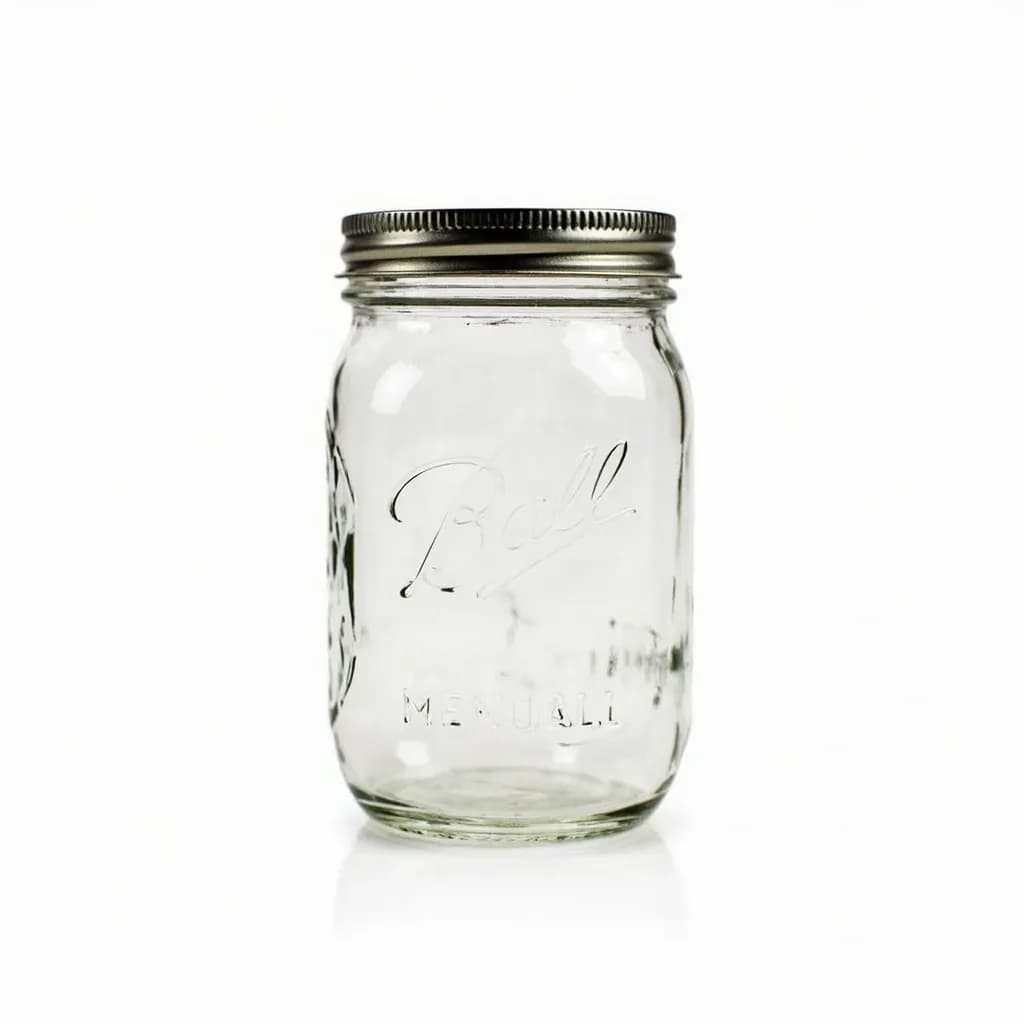
A wide-mouth mason jar is a sturdy glass jar with a two-piece lid and a large opening that makes filling, packing and emptying easy. Cooks use it for water-bath and pressure canning, fermenting vegetables, storing dry goods, and serving layered salads or overnight oats. The wide mouth accepts fermentation weights and large pieces of produce without bruising.
The wide-mouth Mason jar is a soda-lime glass jar, typically labeled as tempered, with a roughly 3-inch (86 mm) opening, a threaded finish, and a two-piece metal closure consisting of a flat sealing disc and a screw band. Patented by John Landis Mason in 1858, it was the first commercially successful jar designed for home canning with a reusable threaded lid, and that basic design — a thick-walled, heat-tolerant glass vessel sealed by vacuum against a flat lid — has changed very little since. The wide-mouth opening is the defining practical feature: whole peaches, pickle spears, carrot sticks, and a cook's hand all fit through it, where the older 2.75-inch standard mouth does not.
The jar is engineered for the thermal stress of canning — boiling water baths and pressure canners — but it is not a piece of cookware. It should not go on a stovetop, in an oven, or under a broiler, and a sudden temperature drop (a hot jar onto a marble counter, for instance) can crack the glass. The 86 mm opening is shared across the major North American brands, so lids and bands are fully interchangeable, which is the other quiet reason the format has lasted: a working pantry can be assembled from Ball, Kerr, and Bernardin stock without buying a single proprietary part.
Beyond canning, the wide-mouth jar has migrated into nearly every corner of a modern kitchen: fermentation crocks in miniature, freezer containers for broth, drinking glasses, lunch jars, and dry-goods canisters. The two-piece metal lid is an American convention; the European clamp-top and Weck glass-lid jars solve the same problem with a different mechanism and are not interchangeable. Pick a system and stay with it.
Alternatives
Types & varieties
The best-known US brand; current production by Newell Brands; pint, quart, and half-gallon are the workhorses of the line.
Direct competitor to Ball; identical 86 mm opening, fully interchangeable lids and bands.
Dominant Canadian brand (Newell); same US-standard 86 mm opening and lid system as Ball and Kerr.
Colored and patterned wide-mouth jars sold for décor and gifting; functional for canning but check the manufacturer's care note for dishwasher and heat limits.
Store/generic brand; same 86 mm dimensions, lids typically sold separately.
Plastic lid with replaceable rubber gasket; reusable across many canning cycles instead of the single-use flat metal disc.
Separate lid systems — glass or hinged-wire closures — not interchangeable with Ball/Kerr/Bernardin.
Why the wide opening matters in practice
The 86 mm mouth is not a marketing flourish; it is the difference between a jar you can actually work with and one you fight. Whole small plums, peach halves, asparagus spears, and whole pickles slide into a wide-mouth pint; the same items have to be cut down to fit a standard mouth. Hand-washing is also meaningfully easier — a sponge or bottle brush reaches the bottom and curves of a wide-mouth jar in a way the narrower opening does not allow. For fermenting, the wide mouth accepts a standard fermentation lid, pickle pipe, or a weight small enough to keep vegetables submerged. For storage, it accepts a 1/2-cup measure and a hand. None of this is true of the standard-mouth jar.
- Whole fruits and vegetables fit through the 3-inch opening without trimming.
- Hand and bottle brush reach the bottom and shoulders for thorough cleaning.
- Standard fermentation lids, pickle pipes, and ceramic weights all fit the 86 mm opening.
- Fills and empties faster — meaningful when processing a bushel of tomatoes.
Canning vs. non-canning jars
Any glass jar with a screw-band lid looks like a Mason jar, but only jars labeled for canning are guaranteed to handle the temperature differential of a boiling-water bath or, more demanding, a pressure canner. Decorative and imported jars may look identical, but their glass is often not rated for the repeated thermal stress of home canning, and a failure in a pressure canner is dangerous. When in doubt, check the bottom of the jar: a true canning jar will be marked 'Mason' and carry a volume in both metric and US units.
- Look for the word 'Mason' molded into the glass and a US/metric volume marking on the base.
- Pressure canning requires jars specifically rated for it; decorative jars are not.
- European Fido/Le Parfait and Weck jars are designed for canning but use a different closure system.
Common uses
Tips & pitfalls
- Use a new flat lid for every canning batch — the sealing compound deforms on first use and will not reliably form a vacuum a second time. Bands, by contrast, are reusable indefinitely unless rusted or dented.
- Tighten bands to 'fingertip tight': snug enough that the band resists further turning, loose enough that you can still lift the sealed jar by the lid alone. Over-tightening traps air inside, which can buckle lids and break the seal.
- Inspect every jar and band before use. A chip on the rim is a permanent defect that prevents a vacuum seal, and a rusted or dented band will not hold the lid flat against it during processing.
- Follow the recipe's headspace to the quarter-inch. Jams want 1/4 in, fruits in syrup 1/2 in, and pressure-canned low-acid foods 1 in. Too little headspace causes siphoning and food in the seal; too much leaves an air pocket that can break the vacuum as it cools.
- Never set a hot, freshly filled jar on a cold, wet, stone, or metal surface. The thermal shock can crack tempered glass instantly. Use a wooden board, a folded kitchen towel, or the canner rack.
- To free a stuck lid, slide a thin flexible knife (a fillet knife works) around the rim rather than prying with a screwdriver or table knife, which chips the glass and ruins the jar for future canning.
- Keep wide-mouth jars in the freezer at 1–2 inches of headspace for liquids. Glass expands as it freezes, and a brim-full jar of broth will crack the jar and leak across the freezer.
- For ferments, fill only to the shoulder of the jar, not the rim — carbon dioxide needs somewhere to go, and a daily 'burp' of the lid is easier than mopping brine off the ceiling.
Good to know
- Inventor
- John Landis Mason, US patent 1858, Newark NJ
- Wide-mouth opening
- Approximately 3 inches (86 mm) inner diameter
- Standard-mouth opening (for contrast)
- Approximately 2.75 inches (70 mm)
- Common volumes
- 4 oz, 8 oz (half-pint), 12 oz, 16 oz (pint), 24 oz, 32 oz (quart), 64 oz (half-gallon)
- Material
- Soda-lime glass, typically labeled as tempered; clear is standard, with colored and embossed variants
- Lid system
- Two-piece: flat sealing disc (single-use for canning) plus threaded metal band (reusable)
- Safe for
- Boiling-water-bath and pressure canning, refrigerator, and freezer (with 1–2 in headspace)
- Not safe for
- Oven, stovetop, broiler, microwave (in most cases), or sudden temperature changes
- Major North American brands
- Ball and Kerr (Newell), Bernardin (Canada), plus store-brand Golden Harvest
- Lid interchangeability
- All wide-mouth flat lids and bands across Ball, Kerr, and Bernardin are interchangeable
Also called
wide mouth mason jar · canning jar · Ball jar
Related

Peeler
Swift blade for stripping skin off fruit and vegetables

Grater
Sharp-toothed surface for shredding cheese and vegetables

Microplane
Ultra-fine rasp for citrus zest, garlic, and hard cheese

Mixing Bowl
All-purpose bowl for combining, whisking, and tossing

Whisk
Looped wires that beat air into eggs, cream, and sauces

Spatula
Flat blade for flipping, lifting, and scraping

Slotted Spoon
Pierced spoon that lifts solids and drains the liquid behind

Wooden Spoon
Gentle, heat-friendly spoon for stirring anything