Prep Tools
Wine Aerator
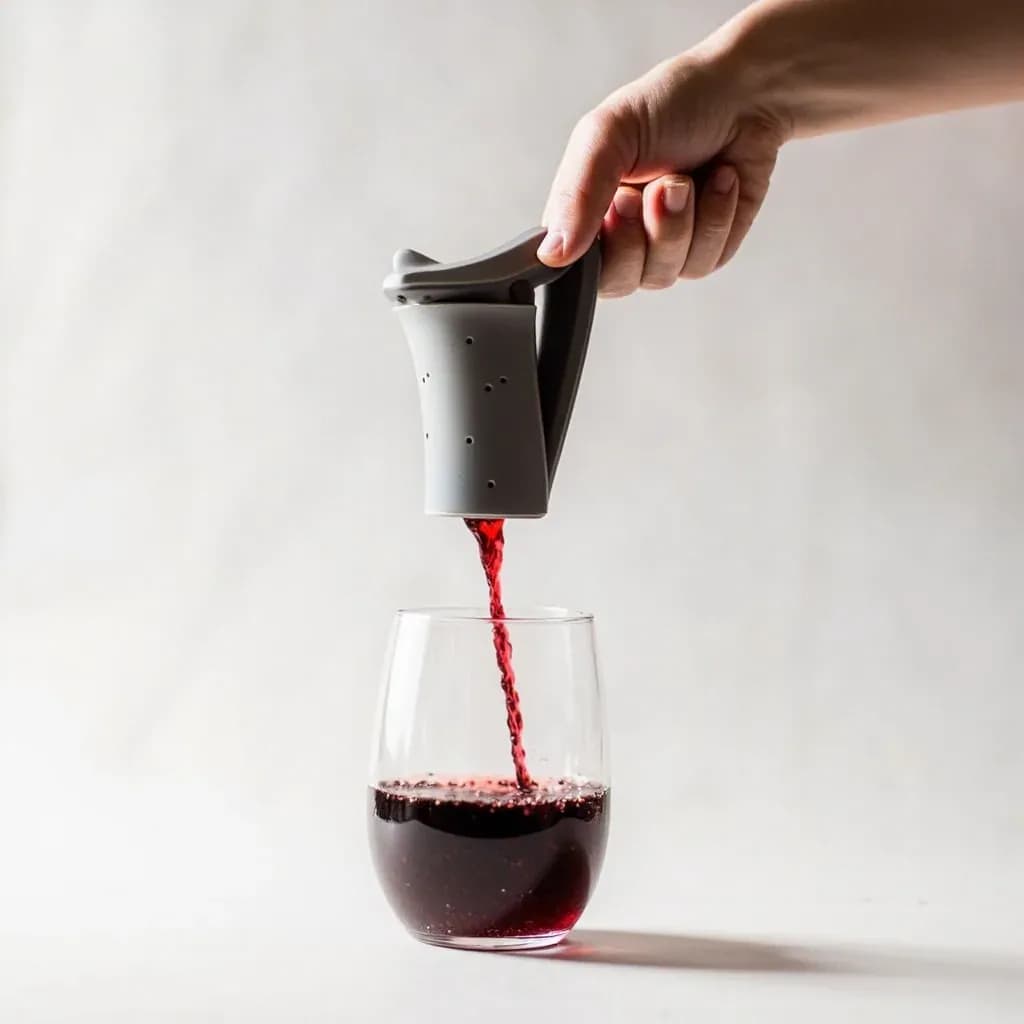
Pour-through device that mixes air into wine to open up its aromas quickly.
A wine aerator funnels wine through channels that draw in air as it pours, exposing it to oxygen instantly instead of waiting for it to breathe in a decanter. The aeration softens tannins and releases aromatics, improving young red wines in particular. Inline pourer styles attach to the bottle neck while tower styles sit over a glass.
A wine aerator is a small, pour-through device that mixes a controlled stream of air into wine as it leaves the bottle, softening harsh tannins and lifting suppressed aromatics in a single pour. The most common designs exploit the Venturi effect — wine rushing through a narrowed channel creates a pressure drop that draws in air through a side vent, and the two streams blend in a small mixing chamber before the wine hits the glass. The result mimics a fraction of what hours of decanting or bottle-breathing would achieve, but in roughly two to four seconds per ounce.
The convenience is the whole point. Where a decanter asks you to plan ahead — twenty minutes for a young red, an hour or more for something tight and structured — an aerator lets you open a bottle and serve the first glass already opened up. That makes it a workhorse at dinner parties, tasting flights, and any moment when you are pouring one glass now and saving the rest of the bottle for later. It is not, however, a substitute for every function of a decanter: it cannot separate sediment, it does not let a wine rest and re-integrate over time, and on truly old bottles it can over-expose fragile fruit.
The practical rule of thumb: reach for the aerator on young to mid-age reds with firm tannin or a closed nose, and leave the decanter on the shelf for aged bottles, sediment-heavy vintages, and any wine you actually want to watch evolve over the course of an evening.
Alternatives
Types & varieties
Sits on the bottle or in mid-pour; wine and air mix through an internal venturi chamber. The category-defining design, typified by the Vinturi and Trudeau models.
Screws onto the bottle neck and aerates as you pour, leaving the bottle itself as the reservoir. Good for full-bottle service at the table.
A small spout that introduces a modest amount of air; less aggressive than a full venturi design and well suited to lighter reds and everyday wines.
Held over the glass or decanter; wine is poured through it rather than mounted on the bottle. Best for single-glass use.
Draws wine through a diffuser and into the bottle or decanter using suction (e.g., Menu Wine Breather); useful when you want to leave sediment behind in the original bottle.
Battery- or motor-driven; pumps air through wine as it dispenses. More common behind a bar than at home.
Sits on top of a decanter; a built-in screen or chamber mixes air as wine passes through during transfer. Bridges the gap between decanting and instant aeration.
A small disc or screen placed inside the wine glass that aerates each pour in the glass itself.
How It Works: The Venturi Principle
The science behind the device is a 19th-century piece of fluid dynamics that found a 21st-century kitchen application. When wine flows through the narrowest point of a venturi chamber, its velocity spikes and its static pressure drops below the surrounding atmospheric pressure. That pressure differential pulls air in through a small side vent, and the two streams collide in a downstream mixing chamber where bubbles of air are sheared into the wine. By the time the liquid exits into the glass, it carries a meaningful — though not enormous — dose of dissolved oxygen that begins working on tannins and volatile aromatics almost immediately.
Aerator vs. Decanter
The two tools overlap in goal but differ in scope. An aerator adds oxygen in seconds but cannot do anything else: it will not clarify a sediment-heavy bottle, it will not let a wine slowly re-integrate after shipping, and it cannot help a wine that is simply too young to show well no matter how much air you throw at it. A decanter does all of those things, but on a longer clock. Use an aerator for the young, robust, tannic red you want to drink right now. Use a decanter for the older vintage with sediment, the bottle that just arrived from a warehouse, or the wine you want to watch open up over an hour. The two are complements, not rivals.
- Aerator: seconds of oxygen contact, no sediment separation, no time for re-integration.
- Decanter: minutes to hours of oxygen contact, plus separation and gentle re-integration.
- Best pairing: aerate first, then pour into a decanter for presentation and continued slow opening.
Common uses
Tips & pitfalls
- Use on young to mid-age reds with firm tannin or a closed nose; very old wines (10+ years past peak) often deteriorate on contact with excess oxygen.
- Pour slowly and steadily — a fast, splashing pour reduces effective air contact and can drive wine out of the side vent.
- Hold the device firmly or seat it on the bottle mouth so it does not fall mid-pour; most models have a rubber grommet for grip.
- Rinse with warm water immediately after use; residual tannins dry on the internal chamber, staining it and gradually clogging the vent.
- Skip the dishwasher unless the manufacturer explicitly states top-rack safe; high heat warps acrylic bodies and degrades silicone seals.
- Do not aerate aged vintage Ports, late-harvest Rieslings, or any wine with significant sediment — the turbulence will break sediment up and drive it into the glass.
- If a wine tastes thin or hot after aeration, the bottle was already past peak and the device simply revealed it; switch to a softer pour or skip aeration entirely.
- Dry the aerator thoroughly before storing; trapped moisture inside a sealed unit can develop mildew and off-flavors by the next pour.
Good to know
- Also called
- wine aerating pourer, in-line aerator, instant aerator
- Primary mechanism
- Venturi effect — wine flowing through a constriction draws in and mixes air
- Time saved vs. decanting
- Roughly 20–90 minutes of decanting compressed into a single pour
- Best suited to
- Young to mid-age red wines high in tannin or with closed aromas
- Average pour time
- About 2–4 seconds per ounce, depending on model
- Typical materials
- Acrylic body with stainless-steel or plastic internals and silicone seals
- Cleaning
- Hand-rinse under warm water; most models are not dishwasher safe
- Modern origin
- Late 1990s–early 2000s; the Vinturi (Rio Sabadicci) popularized the category around 2003–2005
Also called
wine aerator · aerating pourer
Related

Peeler
Swift blade for stripping skin off fruit and vegetables

Grater
Sharp-toothed surface for shredding cheese and vegetables

Microplane
Ultra-fine rasp for citrus zest, garlic, and hard cheese

Mixing Bowl
All-purpose bowl for combining, whisking, and tossing

Whisk
Looped wires that beat air into eggs, cream, and sauces

Spatula
Flat blade for flipping, lifting, and scraping

Slotted Spoon
Pierced spoon that lifts solids and drains the liquid behind

Wooden Spoon
Gentle, heat-friendly spoon for stirring anything