Prep Tools
Wine Pouring Cradle
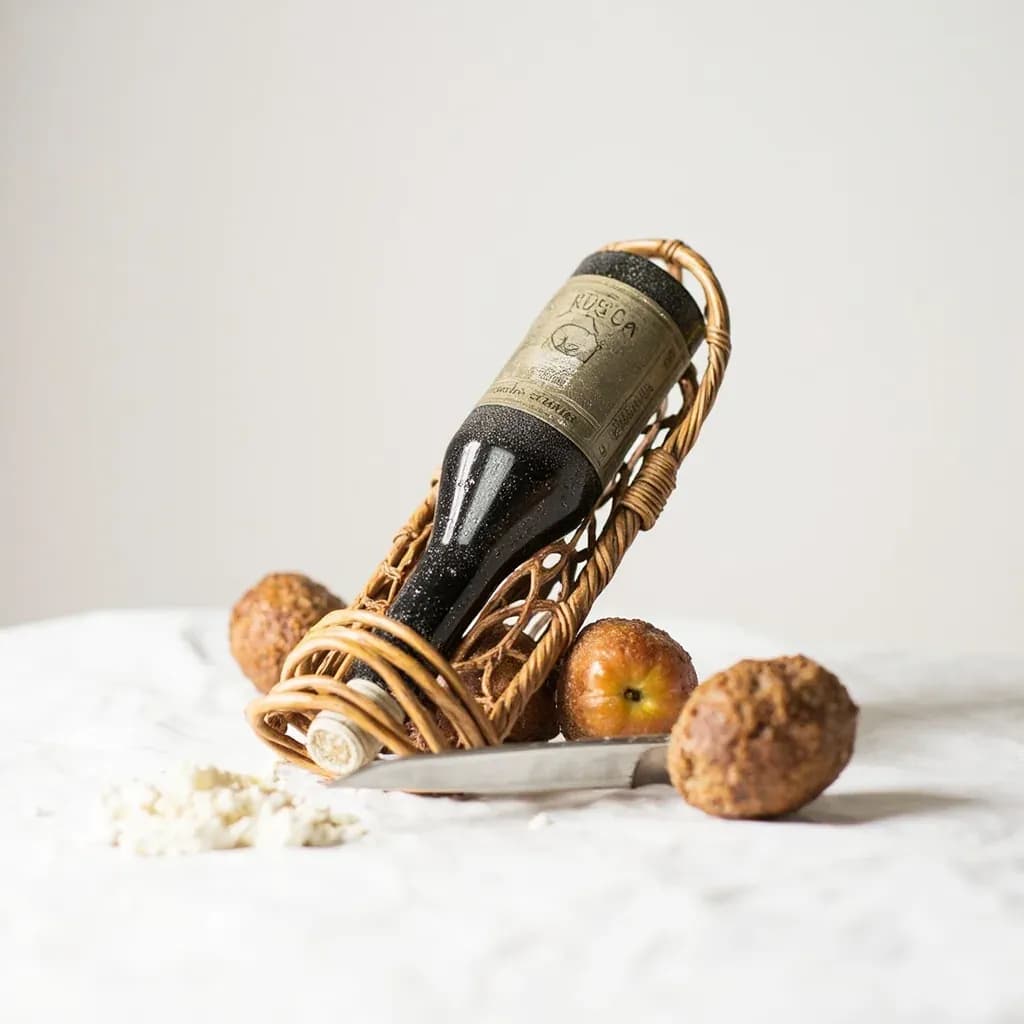
Tilted basket that holds an old bottle near-horizontal to pour without disturbing sediment.
A wine pouring cradle, or pouring basket, holds a bottle at a gentle angle so an aged wine can be poured smoothly while its sediment stays settled at the bottom. It is used for mature reds and vintage ports brought up from the cellar and served without first standing upright. The cradle lets the wine move directly from bottle to glass or decanter with minimal disturbance.
A wine pouring cradle (also called a decanting cradle or, in French, a *panier à bouteilles*) is a small pivoting basket that holds a single bottle of wine near-horizontal and lets the server tip it gradually toward vertical with one hand. The classic version is woven from wicker or rattan in a long oval shape with a hinge or fulcrum at the center; modern interpretations are made of stainless steel or wrought iron but follow the same geometry. It exists for one specific job: pouring an old, sediment-heavy bottle cleanly into a decanter or directly into glasses without stirring up the crust at the shoulder.
The reason it works is mechanical. A bottle that has lain on its side for years develops a compacted layer of tartrate crystals and tannin-pigment deposits on the side that was lowest in the cellar. Lifting it and tipping it quickly sends that sediment tumbling toward the neck. A cradle keeps the bottle supported along its full length and pivots it on a single, slow arc, so the wine shifts gradually and the sediment stays where it is. Combined with a candle or LED light behind the shoulder, the server can watch the dark cloud approach and stop the pour before it reaches the neck.
The cradle is not a daily tool. For a young, clear wine a simple pour from the bottle is fine, and a decanter handles the same sediment problem off the table without ceremony. The cradle shines when the bottle is old enough to be fragile, the guest is part of the ritual, and the server wants full control over the moment the wine begins to flow.
Alternatives
Types & varieties
Traditional French style; flexible weave gently grips the bottle and looks elegant at the table.
Built-in holder for a tea light or taper behind the bottle to backlight sediment as it moves.
Modern restaurant service version; durable, dishwasher-safe, polished finish suited to high-volume service.
Larger banquet version that holds a second bottle so two wines can be decanted in parallel.
Minimalist design with a single axis point; bottle is gripped by the neck and tilts on a hinged base rather than resting in a basket.
Why a cradle, not a decanter
A decanter does the same sediment-removal job, and for most home cooks it is the better choice. The cradle earns its place at the table, in front of the guest, when the bottle is too old to be lifted without risk and too valuable to pour blind. The basket supports the glass along its full length, so there is no torque on a brittle cork or a fragile neck, and the slow pivot is easier to control than a freehand pour.
- Use a cradle when the bottle is 10+ years old and visibly throwing sediment.
- Use a cradle when decanting in view of the guest is part of the meal's theater.
- Use a decanter instead when the bottle is young, or when you simply need a clean pour without ceremony.
- Use a tilting decanting stand (no basket) when storage space is tight and the bottle is not fragile.
Reading the bottle with a candle
The traditional technique pairs the cradle with a small light source — a tea light, taper, or modern LED candle — placed on the far side of the bottle from where you are pouring. Held at neck height, the light passes through the wine at the shoulder, the narrowest part of the bottle, and any sediment in suspension shows up as a dark, moving cloud. The pour stops the moment that cloud reaches the shoulder, even if it means leaving a finger of wine in the bottle.
- Position the light at the same height as the bottle's shoulder for the clearest read.
- Start the pour slowly; the first stream clears the neck and shows you what is coming.
- If you cannot see a clear boundary, the bottle likely needs more upright settling time.
- Modern LED 'candles' work just as well and eliminate the open flame near linen tablecloths.
Common uses
Tips & pitfalls
- Stand the bottle upright in the cradle (or a separate rack) for 24–48 hours before service so sediment settles fully to the lower shoulder.
- Place a lit candle or LED on the side opposite the pour to backlight the shoulder and reveal sediment as a dark cloud.
- Tilt the cradle in one smooth, continuous arc; jerky changes in angle stir up sediment you have already let settle.
- Stop pouring the instant the sediment reaches the shoulder — it is better to lose 30 mL of wine than to cloud the glass.
- Use a thumb over the bottle mouth as a final safety net when you stop the pour, especially with old Port that tends to drip.
- Wipe the bottle neck with a clean cloth before setting it upright, since drips on the table can stain linen.
- Do not force a bottle with a crumbling or fragile cork into a cradle — pull the cork (or filter through a mesh strainer into a decanter) first.
- Keep wicker cradles dry between uses; damp weave mildews and can leave a musty odor on the basket.
Good to know
- Also called
- Bottle basket, panier à bouteilles, wine decanting cradle, sommelier's cradle
- Primary material
- Hand-woven wicker or rattan; modern versions in stainless steel, chrome, or wrought iron
- Origin
- Traditional French service tool, used by sommeliers and wine merchants since at least the 19th century
- Bottle capacity
- Single standard 750 mL bottle (some banquet versions hold two)
- Typical dimensions
- Roughly 30–35 cm long, 12–15 cm wide
- Mechanism
- Pivoting fulcrum at center; bottle tilts from horizontal toward vertical while cradled
- Skill level
- Beginner to intermediate; requires a steady hand and a light source to read sediment
- Best for
- Aged red wines, vintage Port, and old Burgundy or Bordeaux with sediment
- Storage
- Store dry to prevent wicker rot; metal versions are low-maintenance
Also called
Wine Pouring Basket · wine cradle · pouring basket · decanting basket
Related

Peeler
Swift blade for stripping skin off fruit and vegetables

Grater
Sharp-toothed surface for shredding cheese and vegetables

Microplane
Ultra-fine rasp for citrus zest, garlic, and hard cheese

Mixing Bowl
All-purpose bowl for combining, whisking, and tossing

Whisk
Looped wires that beat air into eggs, cream, and sauces

Spatula
Flat blade for flipping, lifting, and scraping

Slotted Spoon
Pierced spoon that lifts solids and drains the liquid behind

Wooden Spoon
Gentle, heat-friendly spoon for stirring anything