Prep Tools
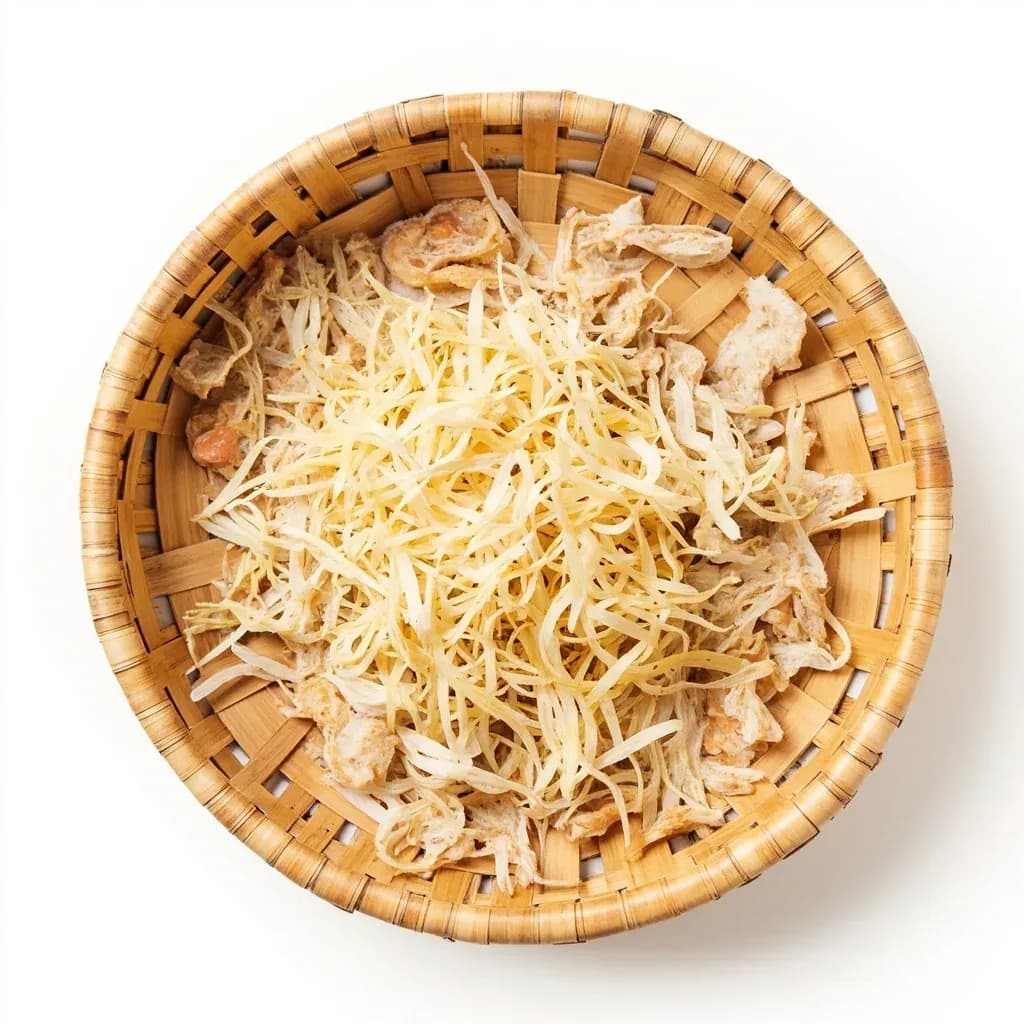
Winnowing Basket
A shallow woven tray used to toss grains and pulses so chaff and dust blow or fall away.
A winnowing basket is a flat or gently curved woven tray that cooks shake and toss to separate edible grain, rice, or lentils from lighter husks, chaff, and grit. The rhythmic flicking lets the wind carry off debris while heavier seeds settle back into the tray. Common across South and Southeast Asian and African kitchens, it is also handy for sorting stones and broken grains before cooking.
A winnowing basket is a shallow woven tray used to separate grain from chaff using nothing more than a toss and a breath of moving air. Unlike a sieve, which sorts by particle size, it sorts by weight and aerodynamics: lifted grain is allowed to fall back through a gentle breeze, and the lighter husks, dust, and empty hulls drift off while the heavier, intact kernels return to the basket. The technique is among humanity's oldest food-prep methods, depicted in Old Kingdom Egyptian tomb reliefs and on Shang-dynasty Chinese bronzes, and the woven tray itself remains the standard household tool across much of South, East, and Southeast Asia.
In a modern kitchen the basket survives chiefly among cooks who work with whole, heritage, or farm-milled grains — heritage wheats, hand-pounded rice, freshly threshed barley, teff, or millet — where loose chaff and field dust are still part of the package. It is also useful for aerating just-cooked rice, sorting dried legumes, and sifting coarse whole-grain flour. Because it relies on air rather than holes, it does work a sieve cannot: lifting dust and fine debris off grain without forcing the grain itself through any mesh.
The winnowing basket is easy to confuse with its close relatives — the winnowing fan (a flat paddle that creates or directs the breeze) and the winnowing riddle (a coarse perforated tray that pre-cleans) — but the basket is the vessel that catches and lifts the grain. The fan and riddle are its companions in a traditional three-step cleaning sequence, and together they sit between threshing and milling in nearly every historic grain culture.
Alternatives
Types & varieties
The familiar Indian and South Asian household tray: flat, round, tightly woven, with a low rim, lifted and tilted with two hands
A flat-bottomed, rectangular woven tray with a sloped back wall; used to scoop, sort, and winnow grain, beans, and dried chillies
A squared, flat winnowing basket woven from bamboo or wood splints; traditionally paired with a flat winnowing fan called mi-fuki
A flat, paddle-shaped fan (not a basket) of woven straw or wicker on a handle; the original 'van' from Latin vannus, the same root that gives us 'vane'
Wide, shallow baskets of grass, palm, or sisal common across West and East Africa for cleaning millet, sorghum, fonio, and teff
A coarse mesh or perforated tray used as a pre-step before winnowing to remove large debris like stones and stalks
The three-step grain cleaning sequence
Traditional grain kitchens almost never rely on winnowing alone. A complete cleaning passes through three complementary tools, each doing what the others cannot:
- Riddle or coarse sieve — removes stones, straw, unthreshed heads, and other large debris by size. Done first, because chaff cannot rise cleanly through a layer of sticks.
- Winnowing basket — separates the remaining fine chaff, dust, and empty hulls from the grain by air. Done second, on dry grain only.
- Wash — rinses residual dust and any soil clinging to the kernel. Done last, because wet husks are heavier and will not blow away.
When to reach for one in a modern kitchen
You do not need a winnowing basket to cook supermarket white rice, but the moment you start working with whole, hand-pounded, farm-milled, or heritage grains, dust and chaff re-enter the picture. A woven winnow earns its shelf space for any of the jobs in the uses list below — and nothing else in a standard kitchen quite imitates the lift-and-toss gesture it is built for.
Common uses
Tips & pitfalls
- Work outdoors in a steady cross-breeze, or indoors in front of a standing fan set to low — still or gusty air defeats the purpose.
- Pour grain slowly from a height of 20–30 cm in a thin, even ribbon; a hard throw blows good grain away with the chaff and loses you yield.
- Make sure grain is fully dry before winnowing; damp kernels are heavier and stay tangled with the husk.
- Do small batches so the grain spreads in a single thin layer across the basket — chaff cannot rise through a thick heap.
- Winnow before final washing, not after; once wet, husks cling stubbornly and will not separate.
- Riddle out large debris first, then winnow, then rinse — the three steps are complementary, not interchangeable.
- Inspect the rim and weave before tossing; a split or loose section will drop grain straight into the dirt.
- Store the basket flat or hung on a peg, never under stacked weight, or the woven base will sag and lose its flat tossing surface.
Good to know
- Also known as
- Winnow, winnowing tray, chhaj (Hindi), supa (Marathi), bòjī 簸箕 (Chinese), mi 箕 (Japanese), criba (Spanish), vanno (Italian)
- Material
- Traditionally woven bamboo, rattan, palm leaf, or wicker; modern versions sometimes plastic or thin wood
- Shape
- Shallow, flat base with a low rim; commonly round or oval, occasionally rectangular (especially the Chinese bòjī form)
- Typical size
- Roughly 40–90 cm (16–35 in) across; household versions ~30–50 cm
- Origin
- One of humanity's oldest food-prep tools; winnowing scenes appear in Egyptian Old Kingdom tomb reliefs (~2500 BCE) and Shang-dynasty Chinese bronzes
- Mechanism
- Air separation — tossing threshed grain into a light breeze so lighter chaff drifts away while heavier grain falls back
- Distinct from
- A sieve, which sorts by hole size, and a winnowing fan, which is a flat paddle used to create the breeze
Also called
Woven Winnowing Basket · Winnowing Tray (Intara) · Woven Winnowing Tray (Van) · Bamboo Winnowing Tray (Tampah/Nyiru) · Winnowing Tray
Related

Peeler
Swift blade for stripping skin off fruit and vegetables

Grater
Sharp-toothed surface for shredding cheese and vegetables

Microplane
Ultra-fine rasp for citrus zest, garlic, and hard cheese

Mixing Bowl
All-purpose bowl for combining, whisking, and tossing

Whisk
Looped wires that beat air into eggs, cream, and sauces

Spatula
Flat blade for flipping, lifting, and scraping

Slotted Spoon
Pierced spoon that lifts solids and drains the liquid behind

Wooden Spoon
Gentle, heat-friendly spoon for stirring anything