Prep Tools
Wok Spatula (Wok Chuan)
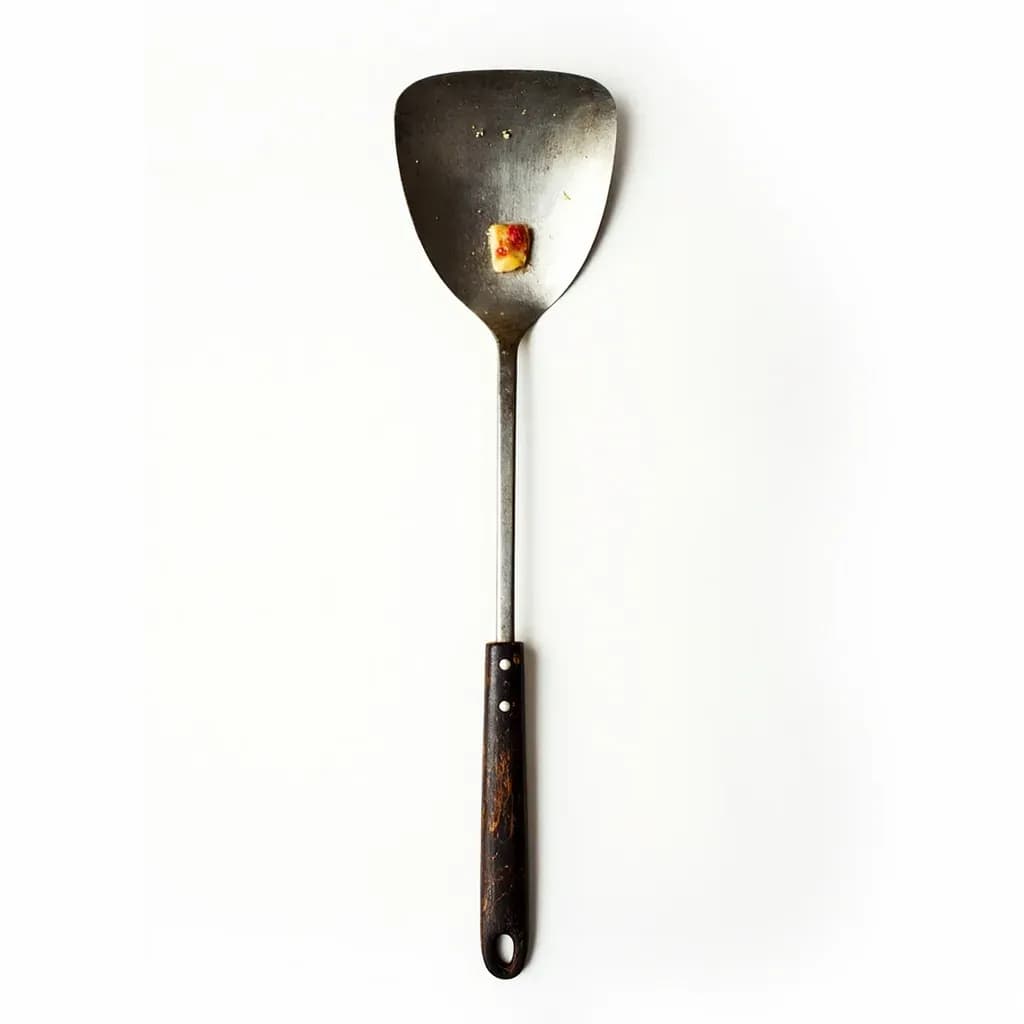
A long-handled shovel-shaped spatula curved to scoop and toss food in a round-bottomed wok.
A wok spatula, or wok chuan, has a slightly curved, shovel-like head and a long handle that matches the contour of a wok for fast stir-frying. The cook uses it in a scooping, flipping motion to keep ingredients moving over high heat and to scrape the curved sides. Its rounded edge and length keep the hand away from the flames while moving food efficiently.
The wok chuan is the curved-bladed Chinese spatula built specifically to work the belly of a round-bottomed wok. Unlike a Western turner or fish spatula — both flat and short — the chuan has a thin, gently concave blade that hugs the wok's interior curve, so the edge reaches the hot center where food actually cooks. The handle is long (typically 12 to 16 inches overall) so the cook's hand stays well above the rim and the flare of the burner, which matters when a restaurant wok station runs at the intense BTU output of professional cooking.
What defines the chuan in practice is its pairing with a wok ladle. Together they form the classic two-tool Chinese cooking set: the spatula in the dominant hand scoops, lifts, and tosses, while the ladle in the off hand holds, ladles sauce, or plucks aromatics from the oil. The motion they enable — a quick wrist snap that sends food briefly airborne over an open flame — is what produces wok hei, the smoky, charred breath that good stir-fried food is judged by. A flat spatula cannot do this; it cannot get under food at the bottom of a round pan, and it cannot support the controlled toss without knocking ingredients against the wall.
Material matters as much as shape. The traditional restaurant chuan is a single piece of thin carbon steel, stamped or hammered, with no rivets, no plastic grip, and no coating — it seasons like the wok it works in and develops a dark, slick patina over time. Home versions often swap the bare metal for a riveted stainless head with a wooden handle, trading some of the toss-friendly lightness for comfort and rust resistance. Wooden and silicone versions exist, but they exist for non-stick woks, not for the carbon steel pan the chuan was actually designed to work in.
Alternatives
Types & varieties
Shorter handle (about 12 in) and a slightly wider, rounder blade; the everyday restaurant tool in Southern China, where wok work tends to be brisk but not as long-tossed as in Sichuan kitchens.
Longer handle and a narrower blade, built for vigorous tossing over very hot flames and for working in deeper woks.
Traditional restaurant standard: thin, light, no rivets, no grip. Seasons alongside the wok and has the flex and balance cooks train their wrists on.
Home-cook version with a riveted or welded stainless head and a wooden or stainless grip. Heavier than the one-piece steel version but won't rust and is easier on bare hands.
Used only with non-stick or very well-seasoned carbon steel woks where metal would scratch. Lacks the rigidity for aggressive tossing.
Modern, heat-resistant, gentle on non-stick coatings. Flexible, which limits its ability to slide under seared food and to support a real toss.
Why the curve matters
The defining geometry of the chuan is not the handle but the blade's concave face. A round-bottomed wok holds most of its food in a small pool at the lowest point of the bowl. A flat Western turner can only contact the top of that pile; the chuan's curve lets the leading edge reach the metal at the bottom, where the sear happens. The same curve also lets the cook scoop — the blade becomes a shallow ladle when tilted — so a finished portion can be lifted and plated without a second tool. Substituting a fish spatula or a flat-edge stir-fry paddle sacrifices both the reach and the scoop, which is why Chinese cooks who switch to a flat tool typically find themselves pushing food around the sides instead of cooking it.
The two-tool system
In a working Chinese kitchen, the chuan almost never appears without its partner, the wok ladle (hoak). The two are designed as a set: the ladle's deep bowl holds liquid, scoops, and grips loose ingredients, while the chuan lifts, turns, and flips. Mastering the two-handed rhythm of the pair is what allows a single cook to keep food in constant motion over a flame that would burn a still ingredient in seconds. Home cooks who buy only the chuan often underestimate how much the ladle does; even a simple wire skimmer or a long-handled spoon will do for the off hand while you learn the rhythm.
- Dominant hand: chuan for scooping, lifting, tossing, and plating
- Off hand: ladle for holding ingredients back, adding sauce, fishing aromatics from oil
- The two tools let you plate straight from the wok without setting the pan down
- Practice the wrist snap on cold rice in a dry wok before attempting it over high heat
Common uses
Tips & pitfalls
- Hold the chuan loosely — a tight, white-knuckled grip stiffens the wrist and kills the controlled toss stir-frying depends on.
- Pair it with a wok ladle in the other hand; one tool alone forces you to set the wok down to plate, which costs heat and momentum.
- Match the blade's curve to your wok's curve — a flat-edged spatula will not reach the bottom of a round pan, so food steams instead of sears.
- If your wok is carbon steel, choose a carbon steel chuan: they season together, behave as a single surface, and slide more cleanly than mixed materials.
- Never use a metal chuan on a non-stick or carefully seasoned wok you want to keep — reach for wood or silicone instead, and accept the trade-off in toss control.
- Pick a length that keeps your hand at least 6–8 inches above the rim; high-heat wok work will reach farther up the handle than you expect.
- Keep the blade thin. Thick, heavy spatulas bruise delicate ingredients like pea shoots and don't slide under seared pieces without tearing them.
- Hang carbon steel versions to dry and oil them lightly after washing — dishwasher detergent strips the seasoning that the spatula, like the wok, depends on for slickness.
Good to know
- Chinese name
- 锅铲 (guō chǎn), commonly shortened to chuan
- Also called
- Wok shovel, Chinese spatula, ho spatula, stir-fry spatula
- Origin
- China; the form has been used for centuries alongside the round-bottomed wok
- Primary material
- Carbon steel (traditional); also stainless steel, iron, wood, or silicone
- Typical length
- 12–16 in (30–40 cm) overall; blade roughly 4–5 in wide
- Companion tool
- Wok ladle (hoak) — used in the off hand alongside the chuan
- Pairing
- Designed for round-bottom woks; not interchangeable with a Western turner
- Heat tolerance
- Metal versions tolerate the extreme heat of wok cooking; wood and silicone are for non-stick pans
Also called
wok chuan · wok shovel · flat spatula · stir-fry spatula
Related

Peeler
Swift blade for stripping skin off fruit and vegetables

Grater
Sharp-toothed surface for shredding cheese and vegetables

Microplane
Ultra-fine rasp for citrus zest, garlic, and hard cheese

Mixing Bowl
All-purpose bowl for combining, whisking, and tossing

Whisk
Looped wires that beat air into eggs, cream, and sauces

Spatula
Flat blade for flipping, lifting, and scraping

Slotted Spoon
Pierced spoon that lifts solids and drains the liquid behind

Wooden Spoon
Gentle, heat-friendly spoon for stirring anything