Prep Tools
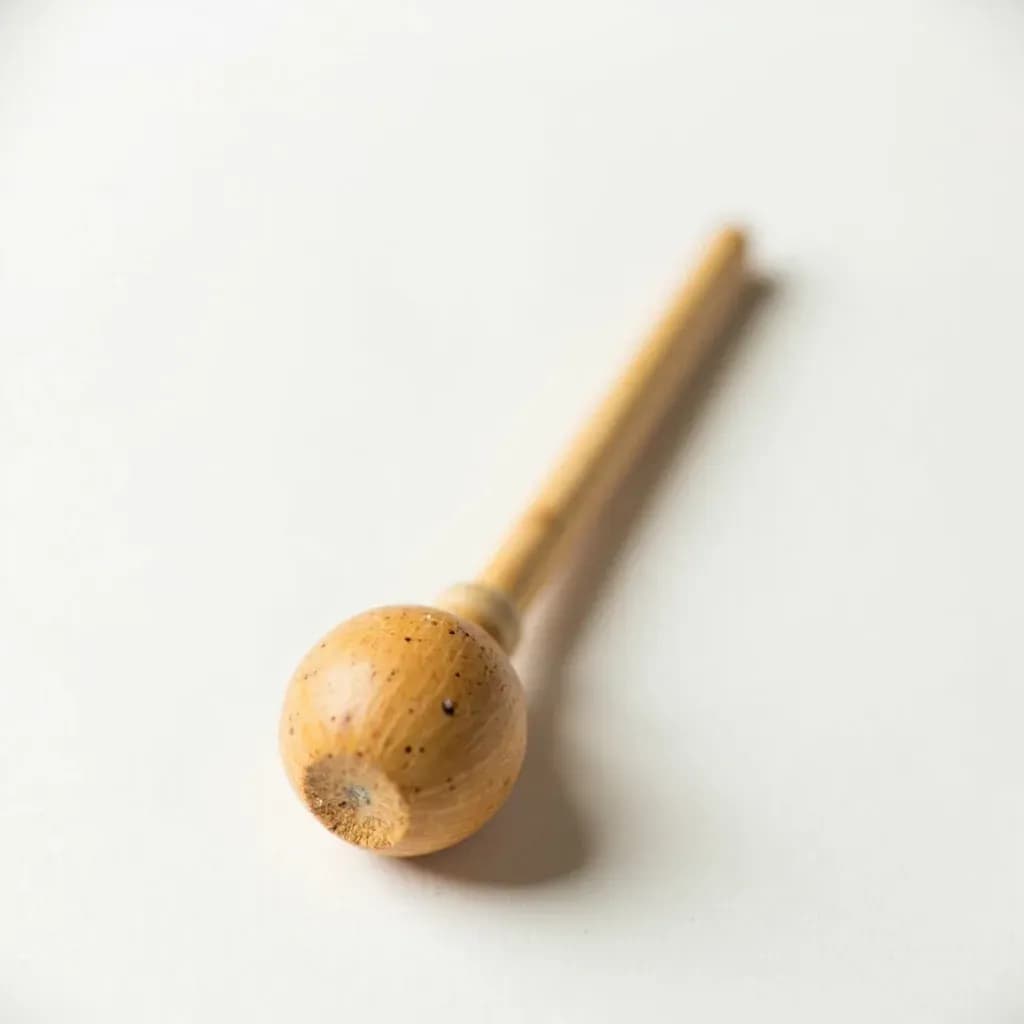
Wooden Kraut Tamper
A heavy wooden pounder used to pack and bruise shredded cabbage for sauerkraut.
A wooden kraut tamper is a club-shaped hardwood tool used to press and pound salted shredded cabbage in a crock or jar when making sauerkraut and other ferments. The pounding bruises the vegetables to release their juices and packs them tightly under the brine, excluding air. Its blunt end fits into crocks and jars to compress layers as you go.
A wooden kraut tamper is a purpose-built pounder, typically turned from a single billet of dense hardwood, with a flat or slightly domed disc on the business end and a palm-friendly knob or mushroom cap on top. Its job in a fermentation crock is twofold: to rupture the cell walls of shredded cabbage so the briny juice can escape, and to compress those shreds into a tight, oxygen-excluding mass beneath that rising brine. Unlike a mortar pestle, which is built for grinding in a circular motion, the kraut tamper is designed purely for vertical force — the weight of the tool plus steady hand pressure does the work, not impact.
The choice of wood is not decorative. Tight-grained hardwoods like beech, oak, or maple resist splintering, do not absorb liquid the way softwoods do, and survive years of wet-and-dry cycles without harboring mold at the grain. A well-made tamper is heavy enough to feel like an extension of your hand yet balanced enough that you can work in a narrow crock opening without striking the glaze. Many fermenters treat it as a generational tool, one that seasons with use and outlasts the ceramic crocks it was made to fill.
The shape is closely associated with German and Central European home fermentation, but the design transfers cleanly to Korean kimchi, Salvadoran curtido, and any other salt-brined vegetable ferment where the goal is the same: bruise, submerge, exclude oxygen. Modern plastic tampers perform the same function but tend to float, slide on wet cabbage, and feel insubstantial. The wooden version stays put, develops a patina, and rewards the cook who keeps it for decades.
Alternatives
Types & varieties
Short, stout body with a wide rounded cap that fits comfortably in the palm; the classic German Bauernstampfer shape
A turned wooden knob (often ball- or bun-shaped) on top of a straight shaft; easier to grip with one hand in a narrow crock
Longer, slimmer profile with a smaller pounding base; useful in deeper or narrower vessels
A broad, flat bottom for pressing wide layers in large crocks; less hand force needed per stroke
Handle and shaft lathe-turned from a single hardwood billet; the common modern reproduction style
Choosing the right tamper
Match the disc to the vessel before you buy. The pounding face should sit comfortably inside the crock's rim with at least a centimeter of clearance on every side — any less and a hard press will chip the glaze; any more and the tamper will tilt and pack unevenly. Heft matters more than height: a short, dense tool in beech or oak will outwork a tall, light one in a softer wood. Look for grain that runs vertically through the handle and end to end on the disc; cross-grain construction is the first place a tamper splits. Avoid painted, glued, or oiled finishes on the working end — anything that can leach into a ferment has no business in the crock.
- Disc diameter should be roughly 1 cm smaller than the crock's inner rim
- Vertical, straight grain resists splitting better than cross-cut blocks
- One-piece turnings outlast glued or stacked assemblies
- Bare wood only — no varnish, paint, or glued handles on the working end
Care and longevity
A wooden tamper is one of the few kitchen tools that genuinely improves with age, but only if you treat it the way you would a wooden cutting board. Water is the enemy over time, not in the moment: a ferment session is wet, but the tool must dry completely between uses. Standing it on its disc in a ventilated spot lets moisture drain out of the end grain rather than sit in a pooled cabinet. Season lightly once a year with a food-grade, non-polymerizing oil to slow checking. Replace the tool when the disc develops deep fissures or when an off smell lingers after washing — those are signs the grain is harboring microbes that no rinse will reach.
- Rinse with hot water only; soap soaks into the grain and can flavor future ferments
- Stand upright to dry so end grain drains and the working face does not sit in a puddle
- Oil the disc once a year with food-grade mineral oil or fractionated coconut oil — never olive or other vegetable oils, which go rancid
- Retire the tamper if deep cracks appear or a sour smell survives washing
Common uses
Tips & pitfalls
- Tamp in thin layers of about an inch at a time, not in one deep fill — layers release juice faster and pack more evenly
- Use steady, firm downward pressure rather than hard strikes; a hard hit can crack a stoneware crock
- Stop pressing the moment brine rises above the cabbage; over-tamping bruises cell walls excessively and makes the kraut mushy
- Keep a dedicated tamper for ferments and do not use the same tool for raw meat or strong aromatics like garlic and onion, which flavor the wood
- Rinse with hot water only — soap and detergents soak into the grain and can leach into future batches
- Once a year, rub the working end lightly with food-grade mineral oil or fractionated coconut oil to slow drying and checking; do not use vegetable oils, which go rancid
- If the wood develops deep cracks or a sour smell that lingers after washing, retire it — the fissures harbor unwanted microbes
- Choose a tamper whose disc fits comfortably inside the rim of your crock so it cannot strike and chip the glaze
Good to know
- Also called
- Sauerkrautstampfer, cabbage tamper, kraut pounder
- Traditional material
- Dense hardwoods such as beech, oak, or maple; one-piece construction
- Typical overall height
- 8–12 inches (20–30 cm)
- Pounding surface
- Flat or slightly domed disc, roughly 3–4 inches (7–10 cm) across
- Handle style
- Mushroom- or knob-shaped top for palm grip, occasionally a turned knob
- Used with
- Fermentation crock (Steinguttopf), stoneware jar, or wide-mouth glass vessel
- Origin
- Central European / German fermentation tradition, used for centuries with stoneware crocks
- Primary purpose
- Pack shredded cabbage tightly enough to drive out moisture and exclude oxygen
- Care
- Hand wash in warm water, dry upright immediately; never soak; never put in dishwasher
- Avoid
- Softwoods (pine, fir, cedar) that splinter or leach resin; painted or glued assemblies
Also called
Kraut Pounder · Cabbage Tamper · Fermentation Tamper
Related

Peeler
Swift blade for stripping skin off fruit and vegetables

Grater
Sharp-toothed surface for shredding cheese and vegetables

Microplane
Ultra-fine rasp for citrus zest, garlic, and hard cheese

Mixing Bowl
All-purpose bowl for combining, whisking, and tossing

Whisk
Looped wires that beat air into eggs, cream, and sauces

Spatula
Flat blade for flipping, lifting, and scraping

Slotted Spoon
Pierced spoon that lifts solids and drains the liquid behind

Wooden Spoon
Gentle, heat-friendly spoon for stirring anything