Prep Tools
Y-Peeler
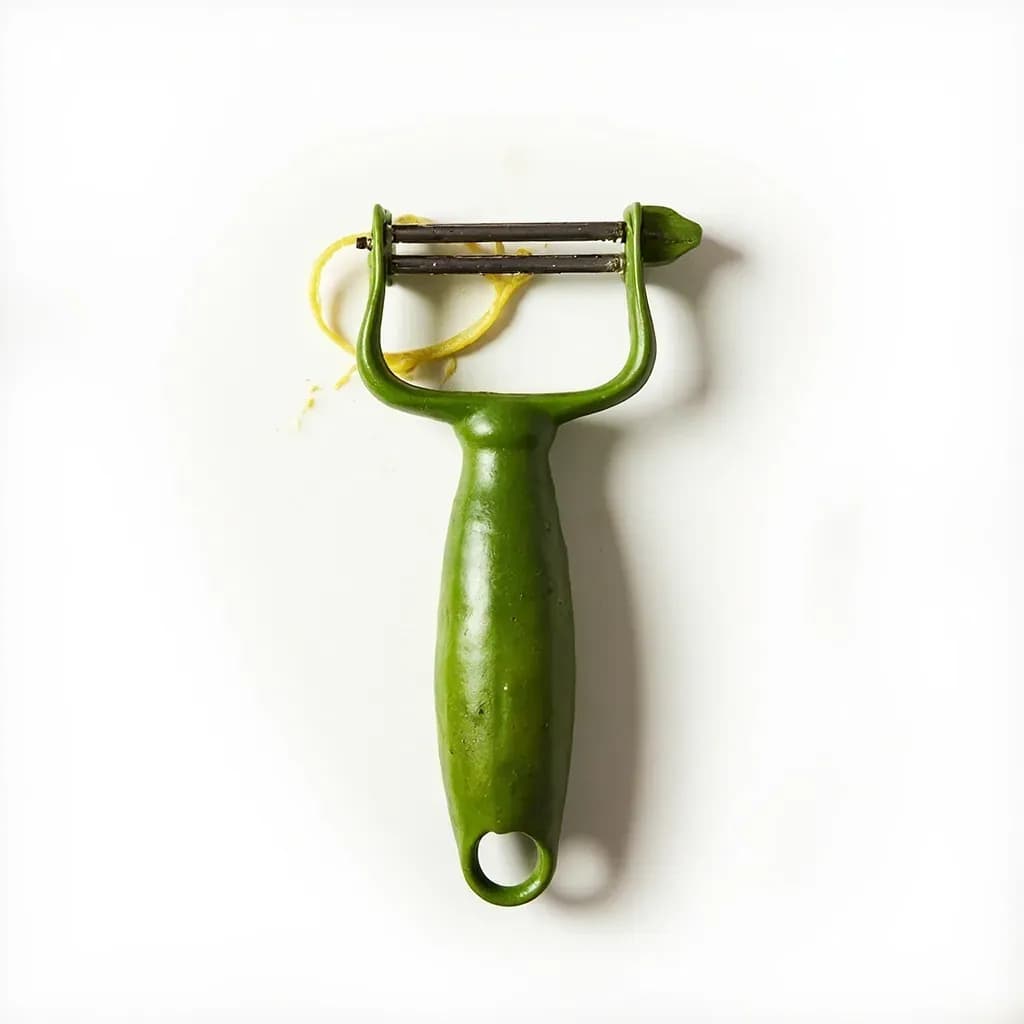
A Y-shaped vegetable peeler with a swiveling crossbar blade for fast paring.
A Y-peeler is a vegetable peeler shaped like the letter Y, with the blade set across the top so it pulls toward the user in a quick stroke. Many cooks find it faster and more ergonomic than a straight peeler for potatoes, carrots, apples, and squash. The wide blade also shaves clean ribbons of cheese, chocolate, or vegetables for garnish.
The Y-peeler is a vegetable peeler shaped like the letter Y: a vertical handle that splits into two prongs holding a swiveling blade mounted crosswise between them. That perpendicular orientation is the whole point — the blade sits across the path of motion rather than parallel to it, so you hold the tool upright like a joystick and pull it toward your body in long, confident strokes. The geometry keeps knuckles well away from the edge and lets the swiveling pivot follow the curve of whatever you're peeling, producing thin, even skins with very little wrist effort.
It is the workhorse peeler of most professional kitchens and the default for high-volume prep because of its speed on long, firm produce. A traditional European-style swivel peeler is faster in tight hands and better for small or rounded items, but for carrots, parsnips, potatoes, cucumbers, and hard squash, the Y-peeler is unmatched. The Kuhn Rikon Original Swiss Peeler, designed in Switzerland and in production for decades, set the modern benchmark; nearly every competitor's Y-peeler borrows from its proportions and balance. For most home cooks who already own a paring knife, a single good Y-peeler covers the vast majority of peeling work.
Alternatives
Types & varieties
The everyday form: a pivoting straight blade that follows the contour of the produce.
No swivel pivot; cheaper and simpler in construction, but does not hug curves as smoothly.
Adds a row of small teeth that cuts thin matchsticks as you peel — carrot and zucchini noodles in one pass.
Serrated edge grips soft, waxy, or fuzzy skins (peaches, tomatoes, kiwis) that a straight blade would skate over.
Zirconia blade that holds an edge much longer than steel and will not rust or react with acids.
Better balance, ergonomic grips, and corrosion-resistant finishes; some offer replaceable blades.
How to hold and stroke it
The grip is the skill. Hold the handle upright, point the blade down, and lock your wrist. The motion is one long pull toward your body, with the produce held in your non-dominant hand, fingers curled back so the knuckles — not fingertips — guide the blade. A Y-peeler pulled this way is genuinely safer than a paring knife, because the cutting edge is on the side facing the work and the force is moving toward you, not into your fingers. Push strokes are how cuts happen; pull strokes are how peels happen.
- Keep the blade perpendicular to the surface for the thinnest skin; tilting it flattens the cut and removes more flesh.
- For a butternut or other hard squash, score shallow lines on the first pass, then go back and take full strips — don't try to take the skin off in one heavy stroke.
- Let the swivel pivot rotate freely; if it sticks after a wash, dry the rivet and work it back and forth.
Y-peeler vs. traditional swivel peeler
They look similar and both have a swiveling blade, but they behave very differently. A traditional peeler (sometimes called a European or straight peeler) has the blade parallel to the handle, so the tool lies across the palm and the motion is a sideways or pushing stroke. The Y-peeler stands up, and the motion is a pull toward your body. Reach for the Y-peeler for long, firm, straight produce; reach for the straight swivel peeler for tight work on small or rounded items where more finger control matters.
- Y-peeler wins on: carrots, parsnips, long potatoes, cucumbers, zucchini, eggplant, butternut squash, hard cheese, chocolate curls.
- Traditional swivel peeler wins on: apples, potatoes you want to keep round, peaches, kiwis, tomatoes, garlic.
- Both can be used one-handed; only the Y-peeler is truly safe to use at speed.
Common uses
Tips & pitfalls
- Always pull toward you — never push the Y-peeler away from your body, which is how most nicks happen.
- Curl the fingers of your non-dominant hand under so the knuckles, not fingertips, are the nearest thing to the blade.
- Use light pressure and let the sharp blade do the work; pressing harder tears the flesh instead of taking clean skin.
- For very long vegetables, peel in overlapping sections rather than dragging the blade the full length in one pass.
- Set the peeler down with the blade facing down and away from you — leaving it blade-up on a cutting board is the most common way to grab the wrong end.
- Rinse and dry the pivot joint if the blade starts to stick; a stiff swivel tears instead of gliding.
- Score tough squash skin with a shallow first pass before committing to full strips, or microwave the squash briefly to soften the rind.
- Upgrade to a ceramic Y-peeler if you peel large volumes or want a blade that will not rust or need sharpening for years.
Good to know
- Design
- Y-shaped frame with a swiveling blade mounted crosswise between two prongs extending from a vertical handle.
- Orientation
- Blade sits perpendicular to the handle, unlike a traditional swivel peeler where the blade is parallel to the handle.
- Grip & Motion
- Held upright like a joystick; stroke is a pull toward the body, not a push away.
- Best For
- Long, firm produce: carrots, parsnips, cucumbers, zucchini, potatoes, sweet potatoes, butternut squash, eggplant.
- Less Ideal For
- Small, round, or highly contoured items like tomatoes, kiwis, peaches, and garlic.
- Blade Material
- Typically stainless steel; ceramic (zirconia) versions stay sharp longer and won't react with acidic produce.
- Size
- Roughly 6–7 inches long overall, with a blade about 1.5–2 inches wide.
- Iconic Model
- Kuhn Rikon Original Swiss Peeler, the design that defined the category.
Also called
Speed Peeler · Y Peeler · Harp Peeler
Related

Peeler
Swift blade for stripping skin off fruit and vegetables

Grater
Sharp-toothed surface for shredding cheese and vegetables

Microplane
Ultra-fine rasp for citrus zest, garlic, and hard cheese

Mixing Bowl
All-purpose bowl for combining, whisking, and tossing

Whisk
Looped wires that beat air into eggs, cream, and sauces

Spatula
Flat blade for flipping, lifting, and scraping

Slotted Spoon
Pierced spoon that lifts solids and drains the liquid behind

Wooden Spoon
Gentle, heat-friendly spoon for stirring anything