Prep Tools
Yuba Lifting Rack
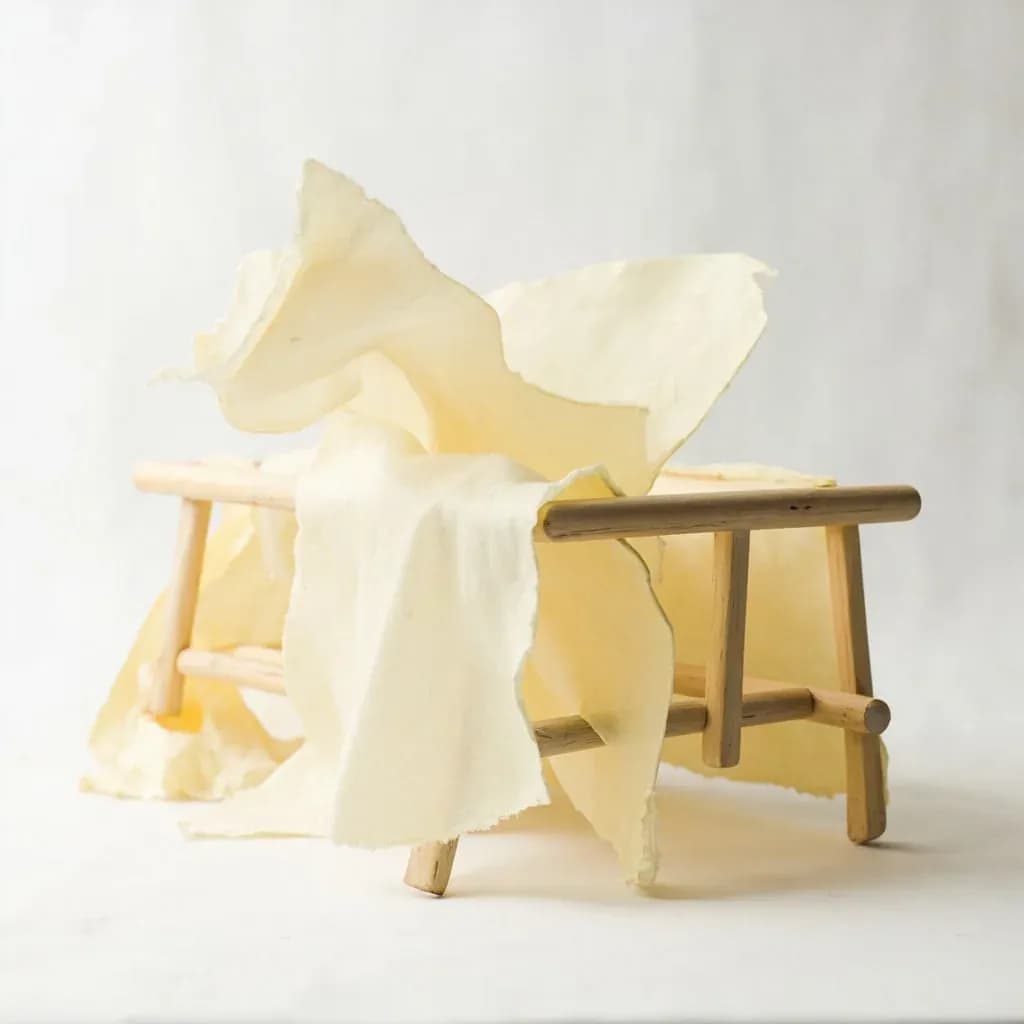
Framed rack of rods for lifting and hanging tofu skin (yuba) off simmering soy milk.
A yuba lifting rack is a frame fitted with horizontal rods used to skim the delicate film that forms on the surface of gently heated soy milk. Each sheet of yuba (tofu skin) is lifted onto a rod where it drapes and dries slightly before the next sheet forms. It is a specialized tool of tofu and yuba makers.
The yuba lifting rack is a specialist implement, almost unknown outside yuba-making kitchens, but central to anyone producing fresh tofu skin at home or in a small workshop. It looks disarmingly simple — a square or rectangular wooden frame strung with thin, parallel bamboo laths — yet it solves a tricky problem: the protein film that forms on simmering soy milk is gossamer-thin, sticky, and tears if you approach it with a ladle, slotted spoon, or chopsticks. The rack works because the film naturally adheres to the parallel rods as it sets; when the frame is lifted horizontally, the entire sheet comes away intact, draped across the rods like washing on a line.
In Kyoto and Nikko, where yuba is a centuries-old craft and a centerpiece of shōjin temple cuisine, the rack is the yuba-maker's signature tool, sized to span a wide, shallow soy-milk pan. Production moves through successive skins — the first mukimi, the middle layers nakaawa, and the thick last skin uwawa — and the same rack handles all of them. Learning to use it well is really a lesson in reading soy milk: its temperature, its protein concentration, and the quiet patience required to let a usable film form without breaking it.
Alternatives
Types & varieties
The classic Kyoto/Nikko style: square wooden frame with thin bamboo laths spaced roughly 2–3 cm apart, sized to fit over a wide shallow soy-milk pan
Not a rack per se, but the simplest variant — a pair of thin sticks laid across the pan to catch the film; produces narrower strips rather than full sheets
Used in larger yuba and fuzhu production lines; easier to sanitize, less traditional, sometimes built as a multi-tier hanging frame over a long heated trough
A taller frame or peg rack on which the just-lifted yuba is draped to drip and air-dry before being moved to a drying mat
Caring for a seasoned wooden or bamboo rack
A traditional yuba rack is a working heirloom, not a disposable tool — the wood and bamboo develop a patina over time that actually helps the film release cleanly. Treat it more like a well-seasoned wooden sushi board than a spatula.
- Rinse only in hot water, never with dish soap, which strips the patina and can leave residue that flavors the next batch.
- Air-dry standing on edge so both faces breathe; never put it in a dishwasher or soak it.
- Store out of direct sun to prevent the frame from warping or the bamboo laths from cracking.
- If the rack ever feels sticky or the film clings too aggressively, a brief scald in plain boiling water refreshes the surface without stripping it.
Common uses
Tips & pitfalls
- Lower the rack onto the soy milk very gently and hold it still — any lateral movement will tear the forming film.
- Keep the soy milk at a bare simmer (~85–90 °C / 185–194 °F); a rolling boil breaks the film before it can be lifted.
- Do not submerge the rack; the film should adhere as the rack is rested on the surface, not pushed under.
- Pour a thin top-up of soy milk after each lift to keep the working depth consistent across the session.
- If a sheet tears, lift the pieces on the rack anyway — they can be patched together or used as smaller pieces for simmered dishes.
- Avoid soap-washing a seasoned wooden or bamboo rack; rinse in hot water and air-dry so the surface patina is preserved.
- Practice the timing: a film usually forms in 10–20 minutes depending on soy concentration and heat, growing thicker with longer rests.
- Use a wide, shallow pan rather than a deep pot so the rack can sit across the full surface and lift a usable-sized sheet.
Good to know
- Primary function
- Lifts the delicate protein film (yuba) that forms on simmering soy milk in a single, intact sheet
- Traditional material
- Bamboo rods set in a square wooden frame; modern versions use food-grade stainless steel or plastic
- Construction
- Square or rectangular frame with multiple thin, parallel rods (laths) evenly spaced across
- Origin region
- Japan, with Kyoto and Nikko as the most famous centers
- Related craft
- Equivalent tools are used in Chinese fuzhu/doufu pi (腐竹/豆腐皮) production and in Korean tofu-skin work
- Method
- Rested lightly on the soy milk surface; the forming film adheres to the rods and lifts off in one continuous sheet
- Working position
- Held horizontally just above the pan, then set on a drying rack so the fresh yuba drapes and stiffens slightly
- Hygiene note
- Wood and bamboo racks are seasoned with use; they should never be washed with strong soap, which strips the patina that helps release the film
- Skill level
- Professional or dedicated home use; a specialist tool, not general kitchen equipment
Also called
yuba rack · tofu skin lifting rack · yuba drying rack
Related

Peeler
Swift blade for stripping skin off fruit and vegetables

Grater
Sharp-toothed surface for shredding cheese and vegetables

Microplane
Ultra-fine rasp for citrus zest, garlic, and hard cheese

Mixing Bowl
All-purpose bowl for combining, whisking, and tossing

Whisk
Looped wires that beat air into eggs, cream, and sauces

Spatula
Flat blade for flipping, lifting, and scraping

Slotted Spoon
Pierced spoon that lifts solids and drains the liquid behind

Wooden Spoon
Gentle, heat-friendly spoon for stirring anything