Prep & Assembly
Making the Flour Well (Fontana)
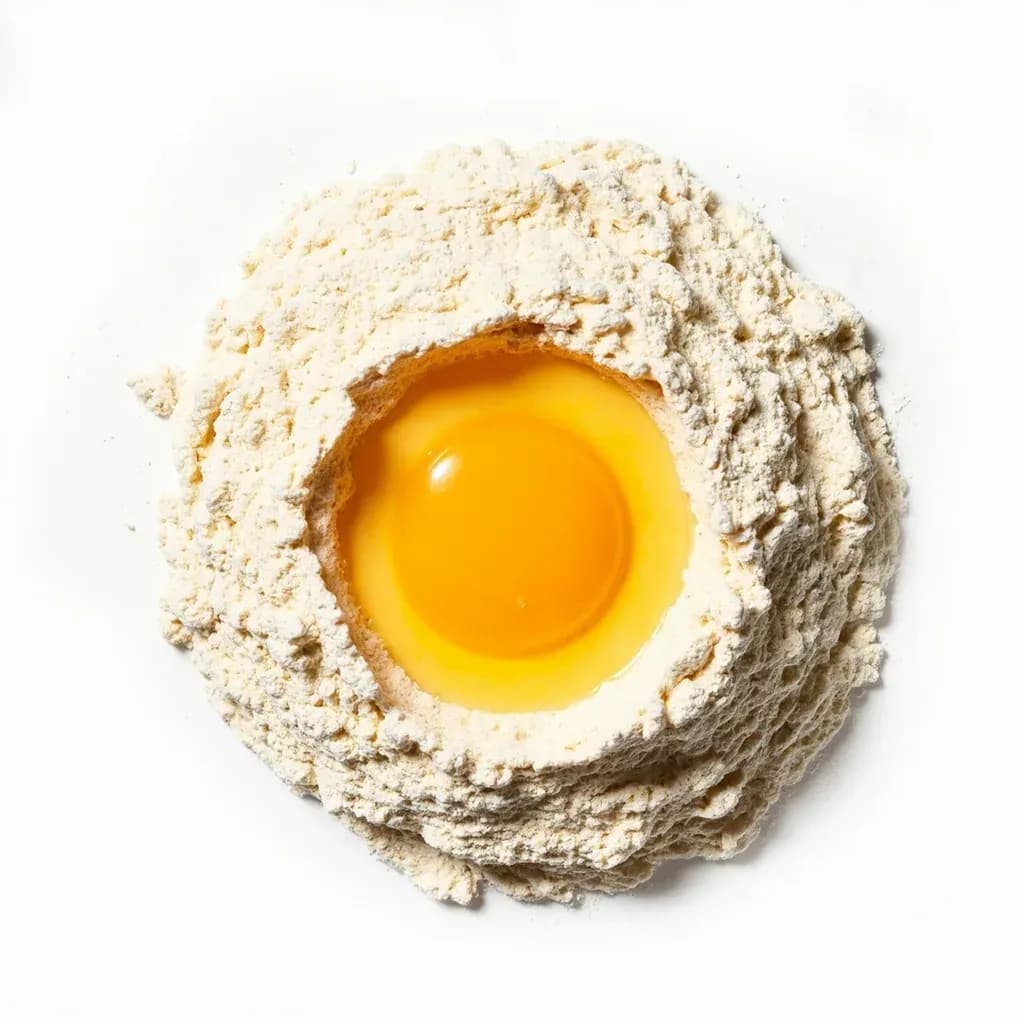
Mounding flour with a center crater to mix in eggs gradually for pasta dough.
Making the well, or fontana, mounds flour on a board with a crater in the center where eggs and liquids are added. The cook whisks the wet ingredients while slowly drawing in flour from the walls, controlling hydration so the dough comes together gradually without lumps. It is the traditional hand method for fresh egg pasta and many doughs.
The fontana — Italian for "fountain," sometimes called *a vulcano* for obvious reasons — is the canonical hand method for hydrating flour with eggs to make fresh egg pasta. A mound of flour is shaped into a wide, deep crater on a work surface, cracked eggs are pooled inside, and the dough is assembled from the inside out using a fork and then the fingertips. Flour is gradually pulled from the inner wall of the well into the swirling eggs until a thick paste becomes a shaggy mass, at which point a bench scraper brings in the remaining dry ring and kneading takes over.
The technique persisted in Italian kitchens long after food processors and stand mixers arrived because it requires nothing more than a board, a fork, and a cloth — equipment every household had — and because it gives the cook continuous visual and tactile feedback no machine can replicate. You see the eggs thicken, you feel the dough transition from paste to mass to smooth ball, and you learn what properly hydrated pasta dough actually is in the hand. That intuition, once built, makes you a better cook even when you switch to mechanical methods.
Today the fontana is as much a teaching exercise as a production method. Many professional sfogline still teach it first, then move students to food processors for speed. The dough it produces is equivalent to dough made any other way, provided the ratios and resting time are honored.
- Difficulty
- Medium
Types & varieties
Whole eggs plus flour only; the northern-Italian baseline for tagliatelle, pappardelle, and lasagna sheets.
Whole eggs plus extra yolks (about 1 yolk per 100 g flour) for a richer, more pliable dough suited to ravioli, tortellini, and cappelletti.
A blend of 00 and semolina — commonly 50/50 or 60/40 — for a slightly grainier, more rustic texture favored in parts of central and southern Italy for hand-formed shapes with a rougher, bite-prone surface.
Marcella Hazan's measured version: 1 large egg per 100 g flour, lightly beaten in the well before any flour is drawn in, no oil or water.
A splash of extra-virgin olive oil (about 1 tsp per egg) added to the well; yields a slightly more tender, golden dough common in some Tuscan and Umbrian homes.
How to do it
- 1
Sift and mound the flour
Sift the measured flour onto a clean, dry work surface. Form a mound roughly 6–7 inches across and 2 inches high using your hands or the back of a large spoon. A stable, well-packed mound is the foundation of a stable well.
- 2
Build the well (fontana)
With the fingers of one hand curled like a claw, press into the top center of the mound and slowly rotate, widening the crater to about 4–5 inches across and 1.5 inches deep. Press the inner walls firmly so they stand vertically. The base of the wall should be at least half an inch thick; a thin wall will collapse as soon as liquid hits it.
- 3
Season the eggs, then add them to the well
In a small bowl, lightly beat the eggs with a pinch of salt — and, if using, about 1 teaspoon of olive oil per egg — just to combine yolks and whites; do not whisk to a froth. Pour the beaten eggs into the well. Cracking each egg into a ramekin first makes stray shells far easier to retrieve than from a slumping flour wall.
- 4
Beat the eggs in the well
Using a fork, gently stir the pooled eggs in a circular motion, keeping the tines within the crater and avoiding the flour wall. The eggs should swirl smoothly and stay contained. Loosening them in the ramekin first ensures the yolk-and-white mass hydrates the flour evenly.
- 5
Draw flour in gradually
With the fork, slowly pull small pinches of flour from the inner wall of the well into the eggs, working around the circle. The mixture will thicken into a paste, then a soft, wet mass. As soon as the eggs thicken enough to hold the wall, switch to your fingertips and continue pulling flour in small pinches — always from the inside wall, never the outside.
- 6
Repair any cracks immediately
If a wall begins to split or eggs begin to leak, stop at once, pinch a little extra dry flour over the breach, and press it into place with your fingers before continuing. A quick patch is far easier than rescuing broken dough from the table.
- 7
Bring in the remaining flour
Once the inner mass is thick enough that it will not run, use a bench scraper to draw the surrounding dry flour ring into the center, turning and folding. You will end up with a shaggy, rough ball with a few dry streaks — that is exactly right.
- 8
Knead to smooth and elastic
Knead by hand for 8–10 minutes: push the dough forward with the heel of your palm, fold it back over itself, give a quarter turn, repeat. The dough is ready when it is smooth, satiny, slightly warm, and springs back slowly when poked. Under-kneaded dough tears when rolled; over-kneaded dough feels tight and rubbery.
- 9
Rest the dough
Shape the dough into a ball, wrap tightly in plastic wrap (or set under an inverted bowl), and rest at room temperature for at least 30 minutes. Refrigerated, the dough keeps up to 24 hours; bring back to room temperature before rolling, as cold dough cracks and resists the pin.
- 10
Roll and shape
Cut the rested dough into quarters and roll one piece at a time, keeping the rest wrapped. The rested dough should roll to a thin, translucent sheet without springing back — the clearest sign the fontana method was performed correctly.
Why the fontana still matters
In an era of food processors and stand mixers, it is fair to ask why anyone would bother building a flour volcano by hand. Three reasons. First, the method requires no equipment beyond a board, fork, and bench scraper — useful in any kitchen, anywhere. Second, and more importantly, it forces real-time sensory feedback: you see the eggs thicken, feel the paste turn to mass, and learn to recognize the exact moment the dough is properly hydrated. That intuition is permanent and transfers to every dough you make afterward, mechanical method or not.
- Visual control: you can see the dough's hydration develop moment by moment.
- Tactile learning: kneading cues (stickiness, springiness, smoothness) become second nature.
- Universal equipment: a board, a fork, and a cloth exist in every kitchen in the world.
- Pedagogical value: many Italian sfogline still teach it as a first lesson, even in professional kitchens.
Flour, eggs, and hydration
The classic 1-egg-to-100-g-flour ratio is forgiving — it tolerates roughly 5–10% variation in either direction — but the cook's job is to read the dough rather than the scale. Egg size varies, flour absorbs differently on humid versus dry days, and '00' behaves differently from all-purpose. A blend of 70–80% 00 with 20–30% semolina is a useful hedge: the semolina adds chew and keeps the dough from going gummy in damp weather. When the dough feels sticky, dust the board and knead in flour a teaspoon at a time. When it feels dry and crumbly, wet the hands lightly or work in half-teaspoons of water. The fontana teaches you to make those calls without thinking.
Common uses
Tips & pitfalls
- Make the well generous: at least 4–5 inches across and 1.5 inches deep, with walls at least half an inch thick at the base. A shallow well almost always fails.
- Sift the flour before mounding. Lumps left in the mound are the most common cause of wall punctures once the eggs go in.
- Crack each egg into a small ramekin first, then slide into the well. Stray shells are far easier to retrieve from a ramekin than from a slumping flour wall.
- Always pull flour from the inside wall, never the outside, and work in a slow circular motion. Patch any crack immediately with a little extra flour before continuing.
- Knead for the full 8–10 minutes. Under-kneaded dough tears when rolled; resting will not rescue a poorly developed gluten network.
- Resting is non-negotiable. Wrapped tightly, rested dough relaxes its gluten so it rolls out without snapping back and cooks more evenly on the plate.
- Common failure — well collapses. Cause: flour too aerated, eggs too cold, or walls too thin. Fix: start over, or rescue by adding flour a tablespoon at a time and kneading into a ball.
- Common failure — sticky dough. Cause: humid kitchen, oversized eggs, or insufficient flour pulled in. Fix: dust the surface and knead in flour a teaspoon at a time until tacky but not sticky.
- Common failure — dry, crumbly dough. Cause: small eggs or too much flour pulled in too early. Fix: wet your hands lightly and knead, or work in half-teaspoons of water.
- A bench scraper is the single most useful tool: it lifts sticky dough off the board, gathers crumbs, and portions the rested dough for rolling.
Good to know
- Italian name
- Fontana (also "a fontana" or "a vulcano")
- Origin
- Traditional Italian home cookery, associated with fresh egg pasta (pasta all'uovo) of Emilia-Romagna, Tuscany, and northern Italy
- Standard ratio
- 1 large egg (~50 g, ~45 g liquid) per 100 g flour — the "golden ratio" of fresh egg pasta
- Preferred flour
- Italian "00" soft-wheat flour; all-purpose or a 00/AP blend also works
- Yield reference
- 2 large eggs + 200 g flour yields roughly 350–400 g dough — enough for 4 servings of tagliatelle or about 36 ravioli
- Kneading time
- 8–10 minutes by hand until smooth, satiny, and elastic
- Resting time
- Minimum 30 minutes at room temperature, wrapped tightly; up to 24 hours refrigerated
- Ideal surface
- Untreated hardwood (maple, beech, oak) for slight absorbency; marble stays cool but is non-absorbent; plastic works in a pinch
Also called
Fontana · Flour Well
Related

Whisk
Beat ingredients smooth and aerated with a looping wire motion

Sift
Pass dry ingredients through mesh to aerate and remove lumps

Strain
Pour through mesh to separate solids from liquid for a smooth result

Filter
Pass liquid through fine material to clarify out the smallest particles

Rice
Press cooked potatoes through small holes for fluffy, lump-free texture

Mash
Crush soft cooked food into a rustic, creamy purée

Grind
Crush food into a coarse to fine texture, from spices to meat

Grate
Shred food into fine bits against a sharp-toothed surface