Lamb & Goat — Primal & Subprimal
Alya (Fat-Tail Lamb) — Trimming & Rendering Cuts
Also: alya, اليه, kurdyuk, курдюк, fat-tail fat, sheep tail fat, dumba, دنبه
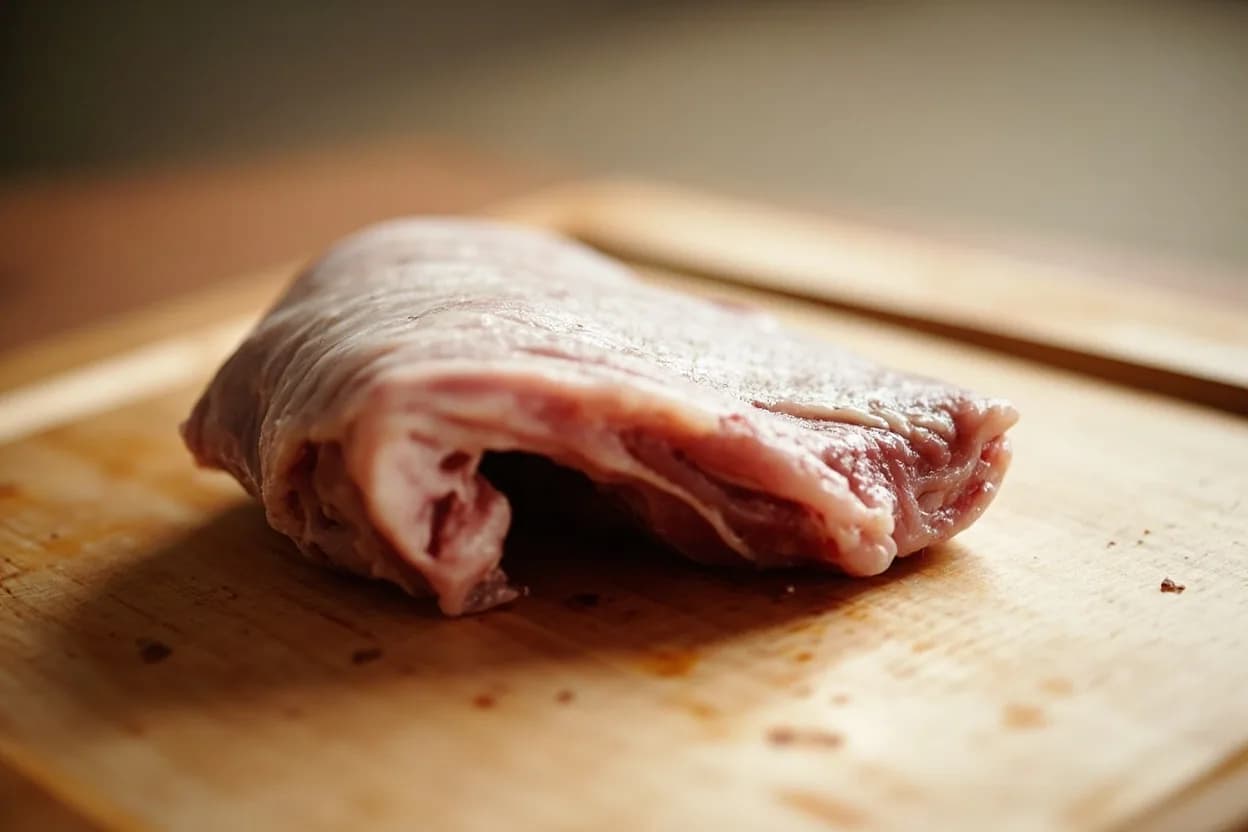
The massive adipose deposit at the base of the tail in fat-tail sheep breeds — rendered into the primary cooking fat of Levantine and Central Asian kitchens, and used raw as a flavour-carrying medium for kebabs and rice dishes.
Fat-tail breeds (most importantly Awassi, Karakul, Balouchi, Najdi, and Sanjabi) store energy in an enlarged bilobed fat deposit behind the pelvic girdle and along the caudal vertebrae rather than dispersing it as subcutaneous or intramuscular fat across the body. This deposit — known as alya (Arabic اليه) or kurdyuk (Turkish/Central Asian) — can weigh 5–30 kg on a mature ram and accounts for 5–15% of the animal's live weight. The fat is composed predominantly of saturated triglycerides (palmitic and stearic acids) with a higher melting point than pork lard (~38–44 °C), giving it a waxy texture at room temperature. It has a distinctive mild, slightly sweet lamb aroma and imparts a characteristic richness without the strong lanolin notes of body fat. When rendered, it produces a white cooking fat used as the primary shortening in Persian, Levantine, and Central Asian traditions. Small diced cubes are threaded raw onto kebab skewers between pieces of lean meat to baste them during grilling.
In photos


Where it comes from
A bilobed subcutaneous and intramuscular fat deposit located at the base of the tail (caudal fat pad) and extending over the rump, genetically selected over millennia in the arid Middle East and Central Asia as an energy reserve analogous to a camel's hump. The tail itself may be pendulous and elongated (Awassi, Karakul) or broad and flat (Najdi). Not present in European or British breeds.
Best for
How to cook it
- 1Trimming the deposit: with the lamb carcass chilled, locate the bilobed pad attached to the caudal vertebrae and the rump; use a firm boning knife to separate the fat cleanly from the muscle beneath, following the natural seam between fat and gluteal muscle group; remove the caudal vertebrae if they remain attached.
- 2Separating raw cubes for kebabs: chill the fat to just above freezing for firmness; cut into 2–3 cm cubes; thread alternately with lean lamb morsels on flat metal skewers so each cube is sandwiched between meat pieces; grill over live charcoal — the fat melts and drips, flaring the coals and basting the lean meat.
- 3Dry rendering: dice the fat into 2 cm pieces, place in a heavy-bottomed pan over low heat with 2 tablespoons water to prevent scorching; cook, stirring occasionally, until all water evaporates and the tissue turns golden and crispy (qawarma/greben stage); strain through muslin into a sterilised jar; the crispy residues (cracklings) are eaten salted as a snack.
- 4Wet rendering (for a cleaner fat): simmer diced fat covered with water for 1–2 hours; allow to cool, skim the solidified fat from the top, and discard the water; repeat once for a purer product.
- 5Storage: rendered alya fat keeps refrigerated for 3–4 months in a sealed jar; it will keep indefinitely in the freezer.
Prep & butchery
- Work with the fat well chilled (0–4 °C); at room temperature it becomes slippery and difficult to dice cleanly.
- Use a firm boning knife rather than a flexible fillet knife — the fat's waxy texture requires controlled pressure.
- Remove any blood spots or lymph nodes visible in the deposit (they occur at the junction with the rump muscles); they impart bitter notes if not excised.
- For kebab cubes, chill further in the freezer for 20 minutes before dicing to get clean 2–3 cm cubes with flat faces.
- For rendering, a coarse dice (2 cm) renders faster and more evenly than large chunks; do not mince or the fat will stick and scorch.
Substitutes
- Lamb Kidney Fat (internal leaf fat)
Similar saturated fat composition; less aromatic; acceptable substitute for rendering but does not thread onto skewers.
- Sheep Tail Fat (commercial cryovac)
Pre-packaged Awassi or Karakul tail fat sold frozen in Middle Eastern and Central Asian supermarkets; identical product, convenient format.
- Ghee (clarified butter)
The standard substitute for alya in rendered-fat roles; slightly more aromatic; melting point similar; use 1:1.
- Beef Suet
Higher melting point; more neutral flavour; acceptable in pastry and rendering applications; does not replicate the lamb character.
Related cuts
- Lamb Neck Fat (collar fat)
Also high in saturated fat; smaller deposit; rendered in the same way for the same uses.
- Lamb Kidney Fat (leaf fat)
Internal abdominal fat deposit; purer and more neutral; the closest European equivalent in rendering use.
- Beef Kidney Fat (suet)
Analogous ruminant fat depot used in European traditions for pastry and rendering.
Appears in
References
- 1.Flatbreads and Flavors: A Baker's Atlas — Jeffrey Alford & Naomi Duguid
- 2.The Whole Beast: Nose to Tail Eating — Fergus Henderson
- 3.Zaitoun: Recipes from the Palestinian Kitchen — Yasmin Khan
- 4.Samarkand: Recipes and Stories from Central Asia and the Caucasus — Caroline Eden & Eleanor Ford
- 5.Journal of Food Composition and Analysis — Fatty acid composition of fat-tail sheep breeds (peer-reviewed)
Confidence: high
Notes
Breed geography and the fat deposit
Fat-tail sheep are native to the arid belt running from North Africa through the Levant and Anatolia into Central Asia and the Indian subcontinent. The Awassi (Syria, Lebanon, Jordan, Iraq) and the Karakul (Uzbekistan, Tajikistan, Afghanistan) are the two most commercially important fat-tail breeds. The fat deposit evolved as a portable energy reserve for animals in drought-prone environments where body-wide fat storage is thermodynamically inefficient. Modern European and North American lamb — Suffolk, Merino, Dorset — do not carry this deposit; alya is therefore unavailable at most Western butchers and must be sought at Middle Eastern or halal butchers who stock Awassi or similar breeds.
Culinary significance in Central Asian plov
In authentic Uzbek plov (osh), the sequence is non-negotiable: kurdyuk cubes go into the kazan (cast-iron pot) first over high heat, are rendered until golden cracklings form, then removed; the onions and carrots fry in the rendered fat; the lamb and spices follow; then rice and water. The cracklings (jizdak) are considered a cook's perquisite — salted and eaten with raw onion while the plov finishes. No other fat — not cottonseed oil, not ghee — produces the same characteristic flavour of a true Fergana-style plov.