Beef — Primal & Subprimal
Beef Tenderloin — Medallion Portioning & Chain Removal
Also: beef tenderloin, whole tenderloin, PSMO tenderloin, filet, chateaubriand, filet mignon, tournedos, tenderloin chain, side muscle
The most tender cut on the steer — a tapered torpedo of near-fat-free muscle that must be broken down precisely into châteaubriand, center-cut filets, and tail portions before a single ounce is wasted.
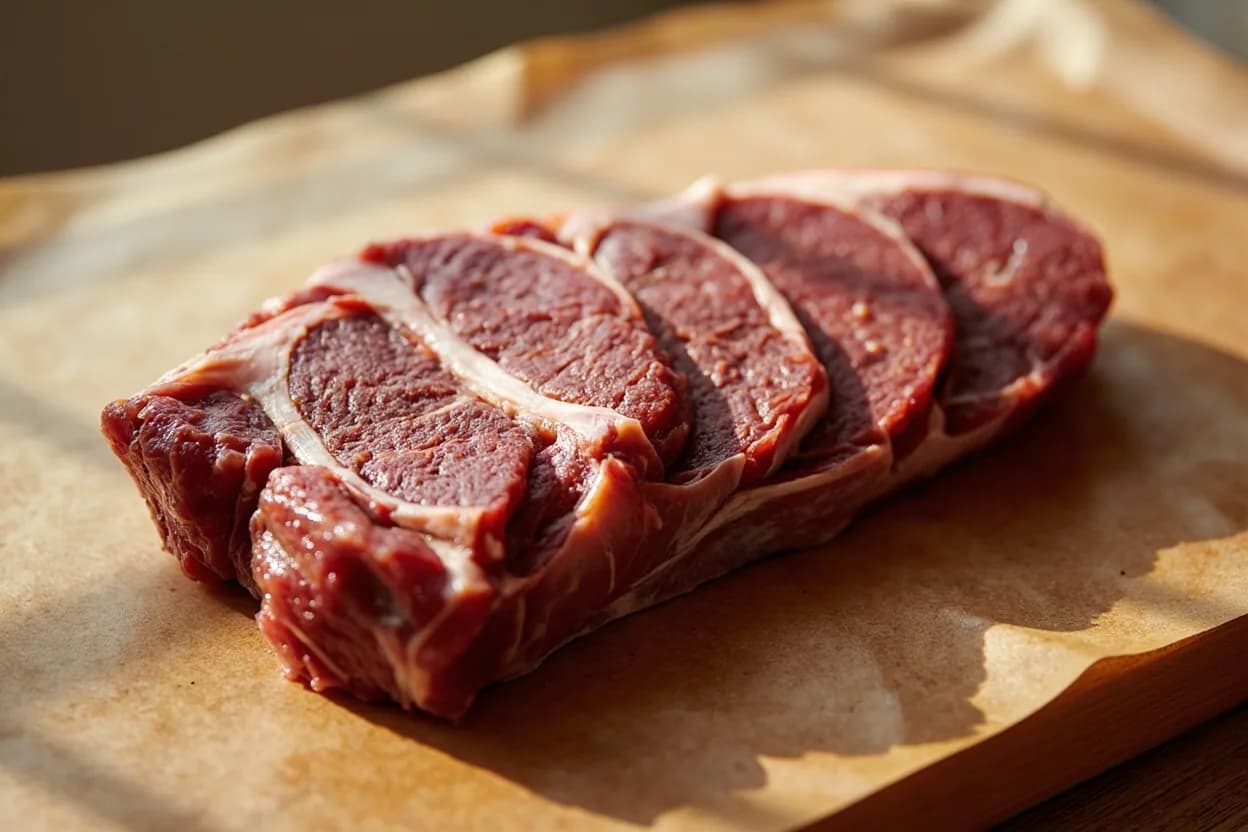
The beef tenderloin is the psoas major muscle, a spindle-shaped muscle running along the inside of the spine beneath the sirloin. Because this muscle does virtually no physical work in the animal's lifetime, it accumulates almost no connective tissue, making it the most tender cut available. A whole tenderloin (PSMO — peeled, side muscle on) weighs 5–7 lb (2.3–3.2 kg) untrimmed and must be broken down into its three zones — head (butt), center, and tail — plus the chain muscle (side muscle) before portioning.
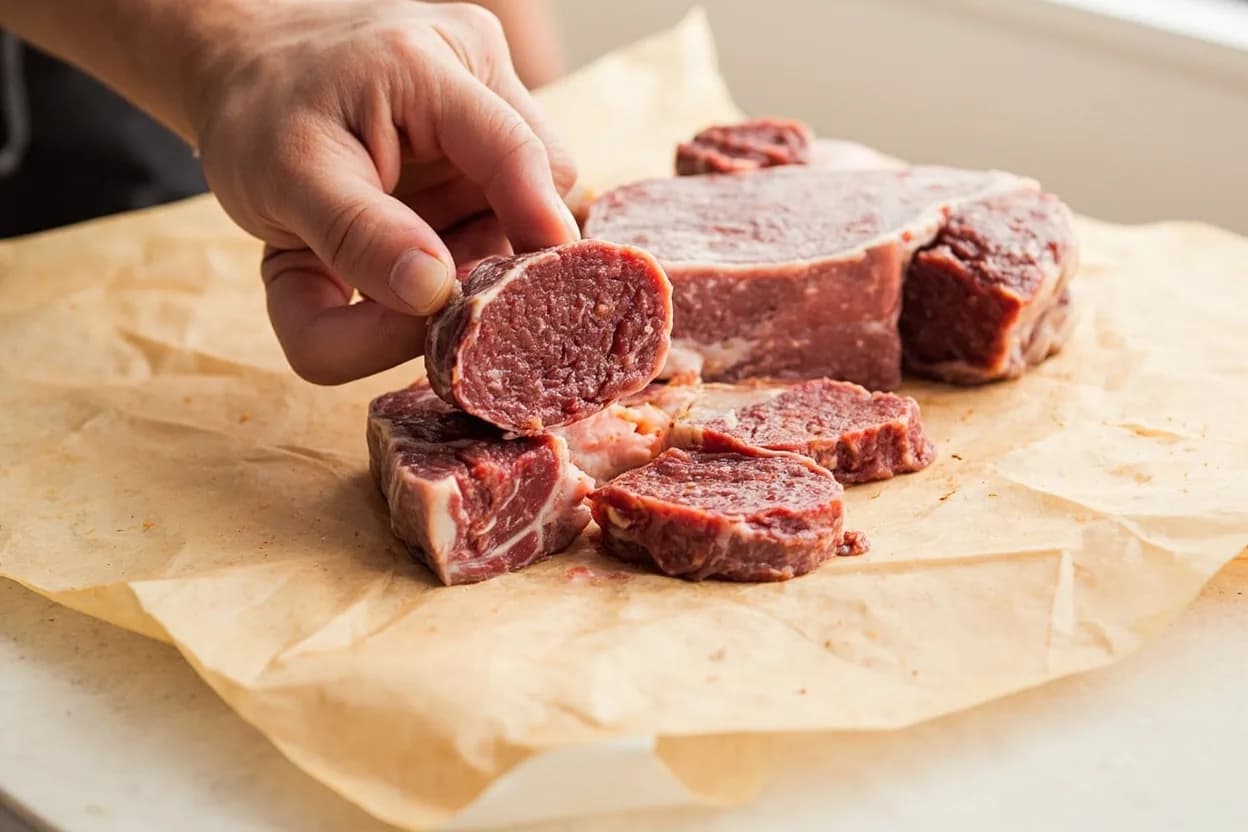
In photos

Where it comes from
The psoas major runs from the last thoracic vertebra through the lumbar region, tucked inside the pelvis. It is harvested as part of the short loin and sirloin primals. The tenderloin sits beneath the strip loin (NY strip) and is separated by the 'chain' — a thin strip of meat and fat (the psoas minor and its surrounding fascia) running the length of the tenderloin on its side.
Best for
How to cook it
- 1Never cook beyond medium (135°F / 57°C) — beyond this point the tenderloin loses its signature texture and gains nothing in flavor.
- 2Pan sear: season generously with salt (the lean meat needs it). Sear in clarified butter or neutral oil over very high heat, 2–3 minutes per side. Baste with butter, thyme, and garlic as it cooks. Finish in a 400°F (200°C) oven if over 1.5 inches thick.
- 3Rest on a wire rack for 5 minutes minimum — the muscle's low fat means juices redistribute slowly.
- 4For whole tenderloin roast: tie the tail end back on itself to equalize thickness across the whole piece. Roast at 425°F (220°C) until a probe reads 120–125°F (49–52°C) at the thickest point.
- 5Carpaccio: wrap trimmed center section tightly in plastic and freeze 1 hour until firm; slice paper-thin with a sharp knife or meat slicer; dress with olive oil, capers, parmesan, and arugula.
Prep & butchery
- Chain removal: locate the loosely attached chain muscle running along the side of the tenderloin; pull it away with your hands, using a knife only to free the connective tissue anchors. Reserve the chain for ground beef, stir-fry, or staff meal.
- Silver skin removal: slide a boning knife between the silver skin and the meat at a shallow angle, keeping the blade nearly flat. Work in long strokes, freeing the membrane without removing meat. Discard — it doesn't cook away.
- Tail fold: cut the tail section 4–5 inches from the thinnest point; fold the tail under itself and tie with butcher's twine to create a cylinder of approximately equal diameter to the center cuts.
- Medallion portioning: using a sharp chef's knife, cut center-section medallions 1.5–2 inches (4–5 cm) thick, using a single decisive downward stroke — sawing compresses the fibers and mars the cut face.
- Head/butt portioning: the butt end can yield a 6–8 oz medallion or be used whole as châteaubriand (12–16 oz) for two.
Substitutes
- Eye of round
Similarly lean but far tougher — not a genuine substitute for texture-dependent preparations.
- Veal tenderloin
Smaller, slightly more delicate; analogous cooking approach.
- Pork tenderloin
Anatomically equivalent (psoas major); much smaller; similar low-fat, mild character.
Related cuts
- New York strip (sirloin strip)
Runs alongside the tenderloin in the short loin; more flavorful but less tender.
- Porterhouse/T-bone steak
Contains both the strip and the tenderloin, separated by the T-shaped bone.
- Chateaubriand
A thick cut from the head of the tenderloin; classically served for two.
- Tournedos
Small, round tenderloin medallions from the center, classically wrapped in lardons.
Appears in
References
- 1.The Professional Chef — The Culinary Institute of America
- 2.Larousse Gastronomique — Prosper Montagné
- 3.The Food Lab — J. Kenji López-Alt
- 4.USDA Institutional Meat Purchase Specifications (IMPS) for Fresh Beef, Item 190A (PSMO Tenderloin)
Confidence: high
Notes
PSMO vs. Side-Off vs. Fully Trimmed
Whole tenderloins are sold in three commercial states. PSMO (Peeled, Side Muscle On) means the fat is removed but the chain muscle is still attached — this is what most restaurants receive and break down in-house. Side-Off means the chain has been removed. Fully trimmed (or 'special') means the silver skin is also gone — the most expensive, shortest shelf-life format used in fine dining. Home cooks typically find PSMO at warehouse stores; the extra butchery is straightforward and saves significant cost.
The Flavor Problem
Paradoxically, the tenderloin's greatest virtue — its exceptional tenderness — is also its greatest weakness as a piece of beef. The psoas major's sedentary life means no myoglobin accumulation, no intramuscular fat, and no connective tissue breakdown products that contribute to beef flavor. A tenderloin tastes like very good, very mild beef. This is why classical cuisine paired it obsessively with foie gras, truffle, and rich bone-marrow sauces — the meat is a vehicle for accompaniments, not a flavor statement in itself.