Regional Meat Cuts
Chadolbaegi (Paper-Thin Beef Brisket Slice)
Also: 차돌박이, chadol, paper-thin brisket, Korean brisket slice
Translucent 1–2 mm brisket slices, cut frozen on a deli slicer, defined by their white fat streaks and near-instant cook time on a Korean table grill.
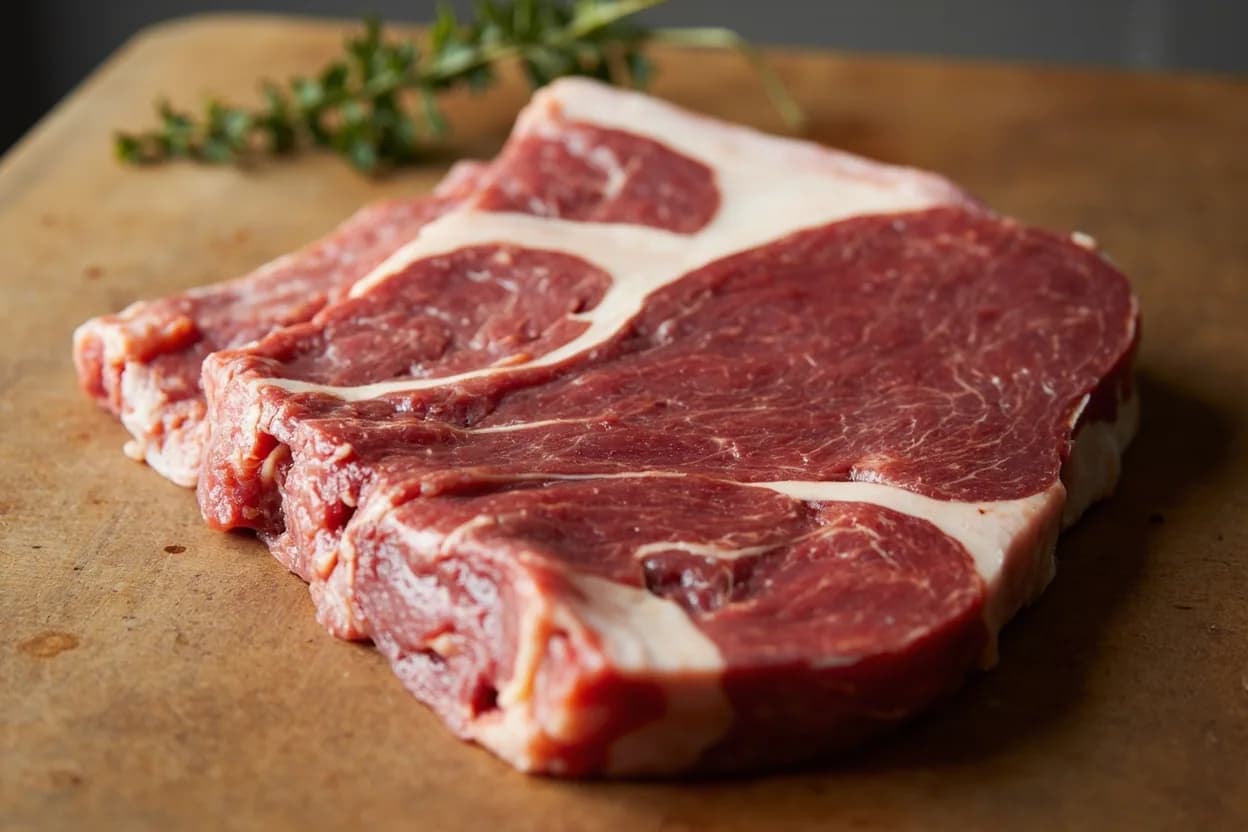
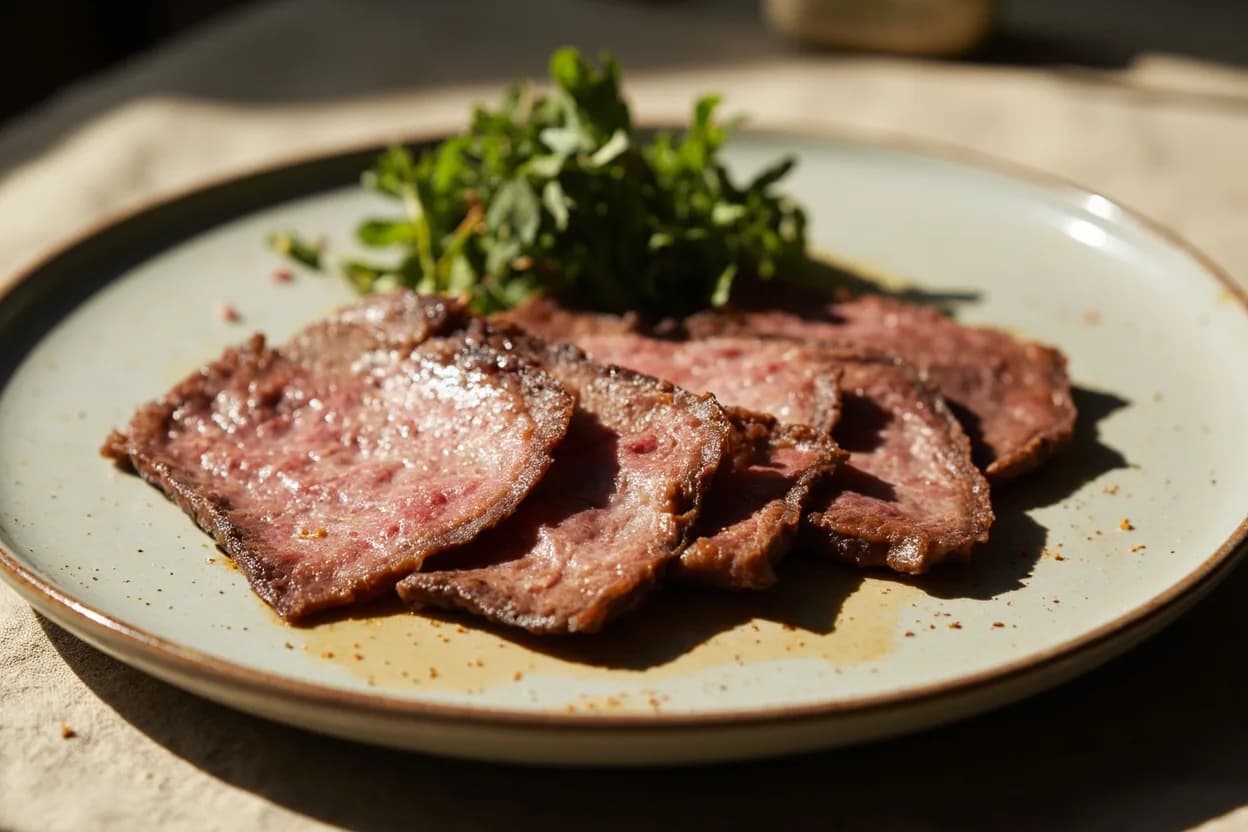
Chadolbaegi (차돌박이) is beef brisket—specifically the thick brisket flat and adjacent point—sliced to 1–2 mm on a commercial slicer while the block is semi-frozen. The result is translucent, ribbon-like sheets with a distinctive marbling of fat running in a lateral band across the lean muscle. Each slice is roughly palm-sized, curls as it hits a hot grill, and cooks through in under 30 seconds. The name is sometimes glossed as 'pebble-pattern' because the fat marbling resembles scattered stones.
In photos

Where it comes from
Beef brisket, specifically the brisket flat (양지머리 / yangji meori) and brisket point; the fat layer sits between muscle seams in the pectoral region. The slice orientation is perpendicular to the muscle fibers, cutting across the grain to produce a cross-section that shows the internal fat seam as a white horizontal stripe.
Best for
How to cook it
- 1Ensure the grill or pan is extremely hot—at least 230°C—before adding slices.
- 2Lay slices flat, single layer; they will curl within seconds.
- 3Cook 15–20 seconds per side, watching for fat to render and edges to brown.
- 4Remove immediately once opaque; residual heat continues cooking off the grill.
- 5Eat at once—chadolbaegi loses texture quickly as it cools.
- 6Classic accompaniments: sesame oil–salt dip, raw garlic slices, perilla leaves for wrapping.
Prep & butchery
- Freeze the brisket block at –10°C to –15°C (semi-hard, not rock-solid) before slicing; this prevents the thin slices from tearing.
- A commercial deli or meat slicer set to 1–2 mm is standard; hand-cutting at this thickness requires a very sharp knife and a fully frozen block.
- The fat cap should face the blade side so the fat seam stays intact in each slice rather than being shaved off.
- Separate slices immediately as they come off the slicer before they thaw and stick together; layer between parchment.
Substitutes
- Bulgogi slice (ribeye)
Thicker (2–3 mm) and marbled throughout; richer flavor but needs longer cook time and is usually marinated.
- Shabu-shabu beef
Japanese hot-pot beef cut similarly thin; interchangeable in broth but lacks the fat seam signature of chadolbaegi.
- Brisket flat, hand-sliced frozen
Acceptable substitute if a commercial slicer is unavailable; freeze the brisket block solid and shave with a sharp knife at a low angle.
Related cuts
- Yangji (Beef Brisket Flat)
The parent primal; chadolbaegi is the sliced retail presentation of yangji.
- Bulgogi Slice
The thicker-sliced Korean BBQ counterpart, typically ribeye or sirloin, always marinated.
Pork belly equivalent in Korean table-grill culture—similarly thin-sliced, similarly cooked to order at the table.
Appears in
References
- 1.Korean Food Culture — Chung Jae Lee, Seoul National University Press
- 2.The Korean Cookbook — Judith Ridner & Taekyung Chung, Phaidon
- 3.On Food and Cooking — Harold McGee (brisket anatomy + slicer mechanics)
Confidence: high
Notes
Why frozen slicing matters
Brisket at room temperature is too pliable to hold together at 1–2 mm; it tears and bunches. Semi-freezing stiffens the connective tissue and fat so the slicer blade shears cleanly through both muscle and fat seam simultaneously, preserving the signature stripe. This technique is standard across East Asian paper-thin meat traditions (Japanese shabu-shabu beef, Chinese hot-pot lamb) for the same mechanical reason.
Fat seam as identity
The white fat stripe is not incidental—Korean diners specifically seek it out. In Korean butchery, the cut is positioned so the fat seam runs horizontally through each slice. A piece of pure brisket lean without the seam is considered inferior chadolbaegi even if the thickness is correct.