Regional Meat Cuts
Corte en Láminas (Tiradito Thin Slice)
Also: corte en láminas, tiradito slice, Nikkei thin slice, láminas de pescado, Japanese-Peruvian fish slice
A Peruvian Nikkei knife technique — a single low-angle drawing stroke that yields paper-thin, wide fish slices for tiradito, contrasting with the diced cube of ceviche and revealing Japanese sashimi lineage.
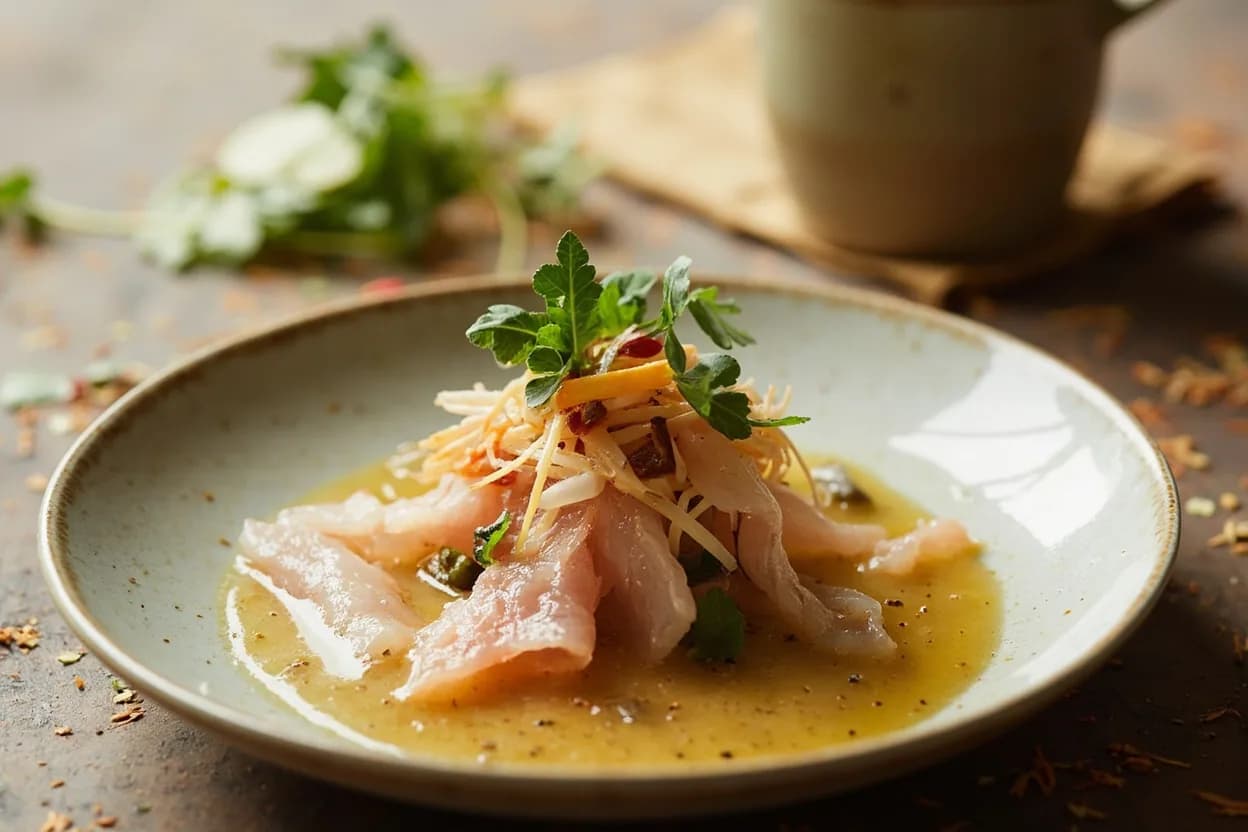
Corte en láminas (literally 'sheet cut' or 'laminate cut') is the defining knife move of tiradito, Peru's Nikkei-influenced raw fish dish. A single uninterrupted drawing stroke at a 20–30° angle to the cutting board produces a thin, wide, translucent fish slice — a lámina — typically 3–5 mm thick and 5–8 cm long. Unlike the 1–2 cm cubes of ceviche (which are marinaded until opaque), tiradito slices are served immediately over a pool of leche de tigre or ají amarillo sauce, the translucency of the fish being a visual signal of freshness and restraint. The technique is directly derived from Japanese sashimi cutting — hira-zukuri and sogi-zukuri — carried to Peru by Japanese immigrants (Nikkei) in the late 19th and early 20th centuries.
In photos
Where it comes from
Firm, fresh white-fleshed ocean fish: corvina (sea bass), lenguado (sole or flounder), atún (yellowfin tuna), or mero (grouper) are canonical. The fillet must be skinned, pin-boned, and cold (just above 0 °C) for the slice to hold its shape.
Best for
How to cook it
- 1PREPARATION: Use only sashimi-grade fish, ideally purchased the day of service. Remove skin, all pin bones, and any bloodline. Chill the fillet to just above 0 °C — 20–30 minutes in a bowl set over ice is sufficient. Cold fish slices cleanly; warm fish compresses and tears.
- 2BLADE SETUP: Use a long, thin, single-bevel or very thin double-bevel knife — a Japanese yanagiba (柳刃) is ideal; a thin Chinese sashimi knife or a granton-edge slicing knife are workable alternatives. The knife must be razor-sharp; any burr will drag and tear the delicate slice.
- 3THE STROKE: Place the fillet flat on the board, thicker side away from you. Position the knife at the far left edge of the fillet with the spine tilted toward the board at 20–30° (shallower than a 45° bias cut). Draw the knife from heel to tip in a single smooth, uninterrupted motion — never push back into the fillet. The slice peels away from the block as the tip clears the far end. Thickness is controlled by the angle and the starting position of the heel.
- 4PLATING: Fan slices across the plate, overlapping slightly. Add leche de tigre or sauce immediately before service — do not pre-sauce, as the acid begins denaturing the protein (cooking the fish) within 2–3 minutes, mimicking the ceviche process and losing the tiradito's translucent character.
- 5YIELD: A single fillet of 200–250 g yields approximately 12–18 láminas at 4 mm thickness. Work from the same starting point on the fillet for each slice to maintain uniform width.
Prep & butchery
- Chill the fish to near 0 °C before slicing — partially freezing for 15 minutes gives extra firmness for very thin láminas
- A long, thin, sharp yanagiba or thin slicer is non-negotiable — a thick or dull blade destroys the slice
- Always draw the knife away from the body in a single stroke; hesitation mid-stroke leaves a ridge in the slice
- Remove bloodline (dark lateral meat) before slicing — its flavour overwhelms leche de tigre
- Place a damp cloth under the cutting board to prevent slipping during the long drawing stroke
Substitutes
- Ceviche cube cut
The deliberate alternative: 1.5 cm cubes marinade in leche de tigre for 3–10 minutes until opaque — the opposite result to tiradito, with acid-'cooked' texture and flavour
- Japanese sashimi hira-zukuri
Direct antecedent technique: thicker (8–10 mm) rectangular slices served without sauce — tiradito is a Peruvian adaptation of the same stroke at reduced thickness
- Carpaccio thin-slice (beef)
Analogous technique for beef tenderloin; pounded thin after slicing rather than angle-cut; different context but same single-stroke principle
Related cuts
- Japanese sashimi hira-zukuri
The direct ancestor cut — same single-stroke, same low angle, thicker output
- Japanese sogi-zukuri (oblique slice)
Even lower angle variant used for flounder and sole in Japan; functionally identical to the tiradito lámina
- Ceviche cube cut
The contrasting Peruvian raw fish cut — the distinction between cube and lámina is the defining difference between ceviche and tiradito
Appears in
References
- 1.The Art of Peruvian Cuisine — Tony Custer (2000)
- 2.Nikkei Cuisine: Japanese Food the South American Way — Luiz Hara (2015)
- 3.Central: Exploring the New World Gastronomy of Peru — Virgilio Martínez (2016)
- 4.Japanese Cooking: A Simple Art — Shizuo Tsuji (1980), sashimi knife technique
Confidence: high
Notes
Tiradito vs. ceviche: a philosophical cut
The distinction between tiradito and ceviche is entirely a function of the knife cut. Ceviche cubes are large enough to marinade through — the acid denatures proteins inward, producing the opaque, firm, 'cold-cooked' texture that Peruvians call 'cooked in citrus.' Tiradito láminas are too thin to marinade: the sauce pools on the plate surface, and the fish is eaten before any significant acid penetration occurs. You taste raw fish dressed with sauce, not acid-cured fish. The cut is the concept.
Japanese immigration and the Nikkei synthesis
Japanese immigrants began arriving in Peru in 1899 as contracted agricultural workers. By the 1930s, first-generation Nikkei cooks were operating restaurants in Lima that combined Japanese knife discipline and a preference for raw fish with Peruvian citrus, ají, and seafood. Tiradito emerged from this synthesis — specifically from Japanese sashimi chefs who encountered leche de tigre and recognised it as a sauce that matched their raw-fish aesthetic. The resulting cut is the most direct anatomical evidence of this cultural exchange: the lámina speaks Japanese, the sauce speaks Peruvian.