Fish — Fabrication & Breakdown
Gomai Oroshi (Five-Piece Fish Breakdown)
Also: gomai, go-mai oroshi, 五枚おろし, five-piece breakdown, Japanese flatfish filleting
The Japanese standard for breaking down flatfish into five pieces — four fillets (two per face) plus the central spine — adapted from sanmai oroshi to exploit the unique four-lobe musculature of hirame, karei, and turbot.
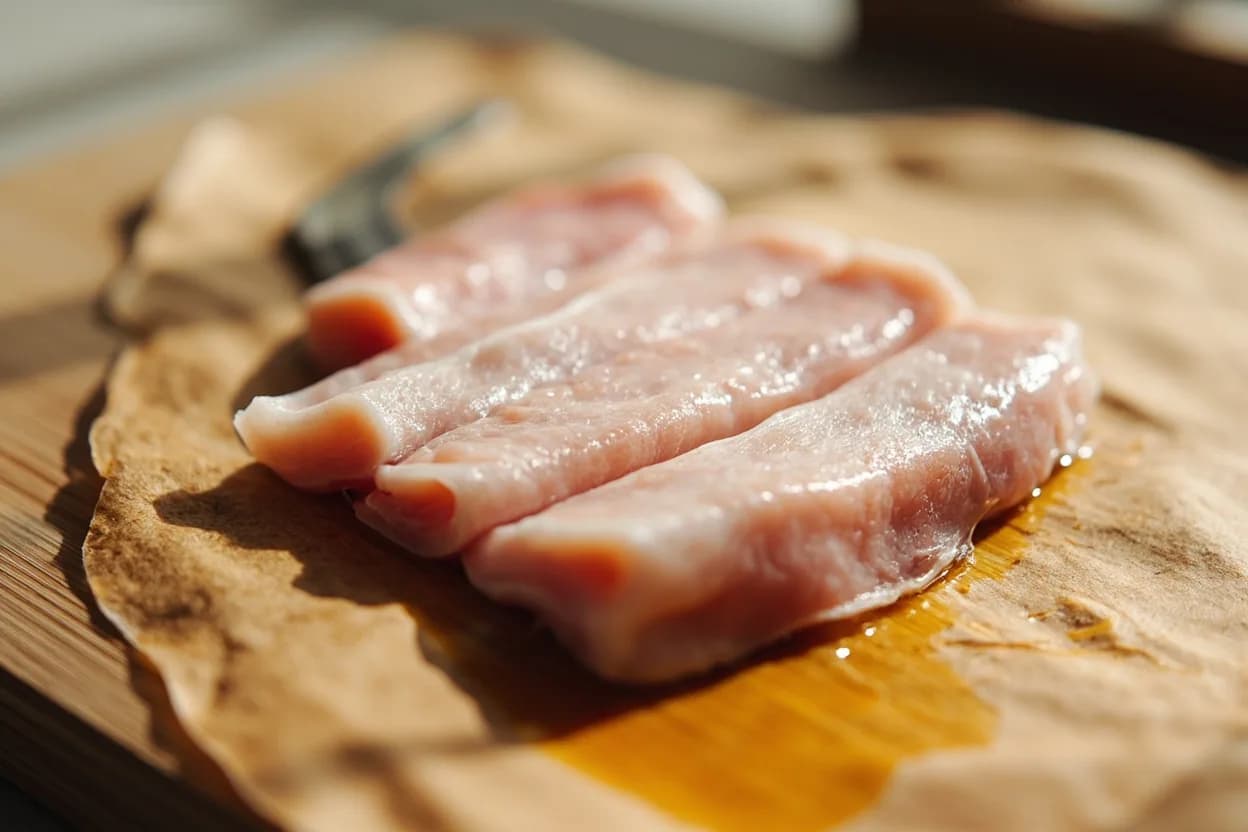
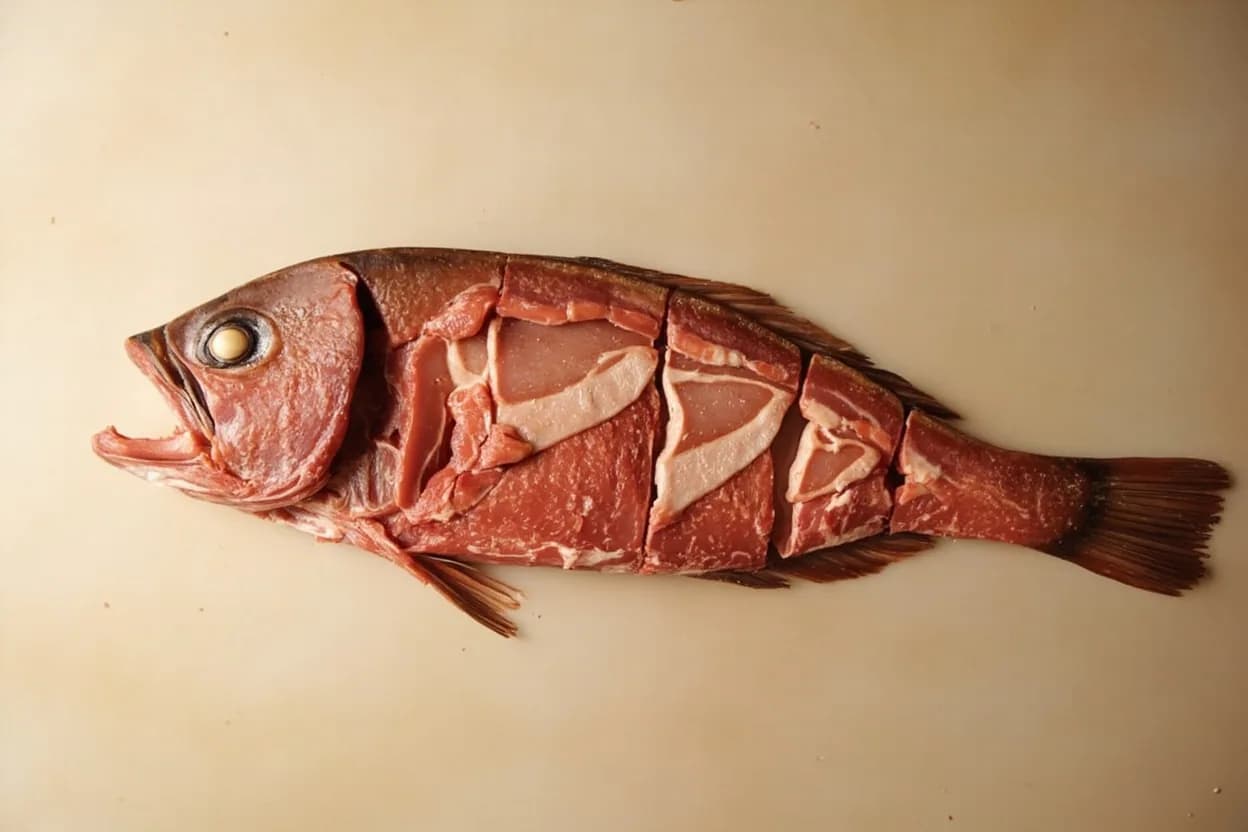
Gomai oroshi (五枚おろし, 'five-sheet disassembly') is the prescribed Japanese method for fabricating flatfish. Because flatfish have four distinct muscle lobes — two on the upper (dark) face and two on the lower (white) face, each pair separated by the lateral line — the gomai breakdown runs two cuts per face along the lateral line outward to the fin base, yielding four thin, flat, boneless fillets and the central spine frame. It is the direct analog of sanmai oroshi for flatfish anatomy, producing one additional piece per fish. The result is five named pieces: kami-fushi (upper back fillet), shimo-fushi (upper belly fillet), kami-ura (lower back fillet), shimo-ura (lower belly fillet), and the nakagone (spine).
In photos
Where it comes from
Applied exclusively to flatfish (Pleuronectiformes): hirame (Japanese flounder, Paralichthys olivaceus), karei (right-eye flounders, Pleuronectidae family), shitagarei (turbot relatives), and occasionally large kawahagiage-grade fish. The technique is unsuitable for round fish. Hirame is the prestige subject; its white, fine-grained flesh is one of the most prized sashimi fish in Japan.
Best for
How to cook it
- 1Scale and gut the fish through the head side; rinse the cavity clean. Pat dry. The dark (upper) face is addressed first.
- 2Make a shallow incision along the central lateral line from head to tail on the dark face, running the deba tip along the spine's surface.
- 3From that central incision, angle the deba flat and run it outward toward the dorsal fin base in a series of long drawing strokes, freeing the upper back fillet (kami-fushi). Keep the blade in contact with the ribs throughout.
- 4Repeat from the central incision outward toward the ventral fin base to free the upper belly fillet (shimo-fushi).
- 5Flip the fish to the white face and repeat both outward cuts to yield kami-ura and shimo-ura.
- 6Trim the engawa from the fin edge of each fillet (it can be left on or separated for serving as sushi).
- 7To remove the skin for usuzukuri or sashimi: hold the tail end, grip the skin firmly (use salt for friction), and draw the knife forward between flesh and skin in a single pulling motion.
Prep & butchery
- Use a deba for the backbone work on larger flatfish; a ko-deba (small deba) or even a yanagiba can be used for small karei under 500 g.
- Flatfish skin on the dark face has fine, embedded scales (ctenoid) that must be scraped thoroughly — they are tightly adherent and often missed.
- The lateral line incision must be decisive and straight; any wandering produces asymmetric fillets that look unacceptable on a sashimi plate.
- Hirame are seasonal — peak in winter (November–February) when they are fattest and most prized; summer hirame are leaner and less sweet.
Substitutes
- Western four-fillet flatfish method
Achieves the same four-fillet result using a flexible Western filleting knife; adequate for cooked preparations but lacks the precision required for usuzukuri sashimi.
- Sanmai oroshi (round fish)
Not a substitute — a different anatomy; round fish cannot be broken into four fillets using this method.
Related cuts
- Sanmai Oroshi
The three-piece round-fish analog; the conceptual parent of gomai oroshi extended to flatfish anatomy.
- Flat Fish Filleting — Four-Fillet Method (Western)
Western equivalent producing four fillets via different knife geometry and motion.
- Engawa
The fin-muscle margin strip separated from each gomai fillet; treated as a distinct cut for sushi.
- Daimyo Oroshi
A simplified single-stroke method for very small round fish — not applicable to flatfish.
Appears in
References
- 1.Japanese Cooking: A Simple Art — Shizuo Tsuji (1980)
- 2.The Sushi Experience — Hiroko Shimbo (2006)
- 3.Sushi Shokunin — Yamamoto Kiyoshi (2019, Japanese)
- 4.Nobu: The Cookbook — Nobu Matsuhisa (2001)
Confidence: high
Notes
Why five pieces, not four
Western flatfish filleting also produces four fillets, but the 'five pieces' designation in gomai oroshi is deliberate: the nakagone (spine) is counted as a distinct, valued product, not a byproduct. In Japanese fish cookery, the entire fish is considered; the flat, large spine from a hirame is routinely grilled salted (yaki-nakagone) and served as a separate course, the fin-edge meat eaten directly off the bone with chopsticks.
Usuzukuri and the flatfish
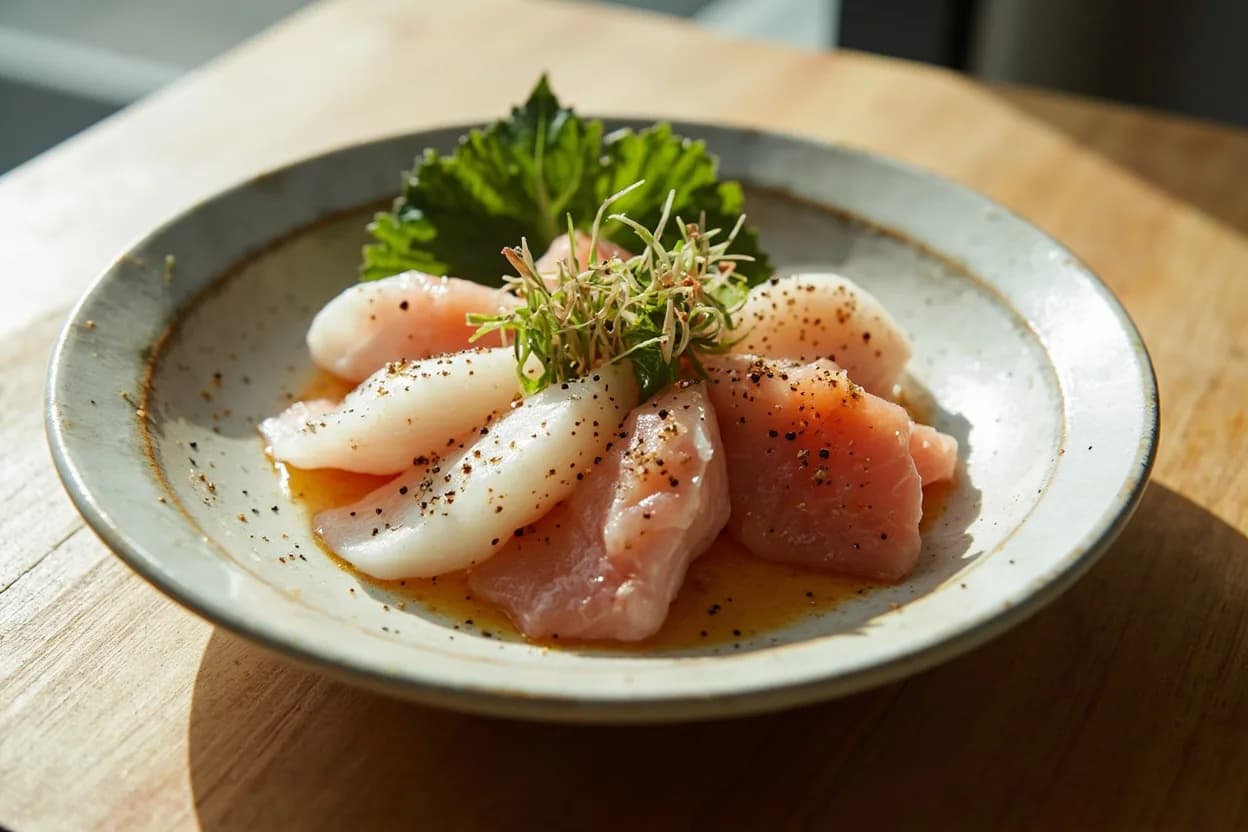
Usuzukuri (薄造り) is a sashimi cutting style using diagonal, translucent slices so thin the plate pattern shows through. Hirame is the canonical fish for this presentation precisely because its flesh is lean, firm, and white — it holds an ultra-thin slice without tearing and displays beautifully when fanned on a round lacquer plate. The gomai breakdown is the prerequisite: only the clean, skin-free upper fillets have the geometry and even thickness to produce usuzukuri of requisite quality.