Knife Cuts — Japanese
Hangetsu-giri (Half-Moon Cut)
Also: hangetsu giri, 半月切り, half-moon slice, demi-lune cut
Japanese half-moon cut produced by halving a cylindrical vegetable lengthwise, then cross-slicing into uniform semicircular rounds — a workhorse cut for soups, simmered dishes, and salads.
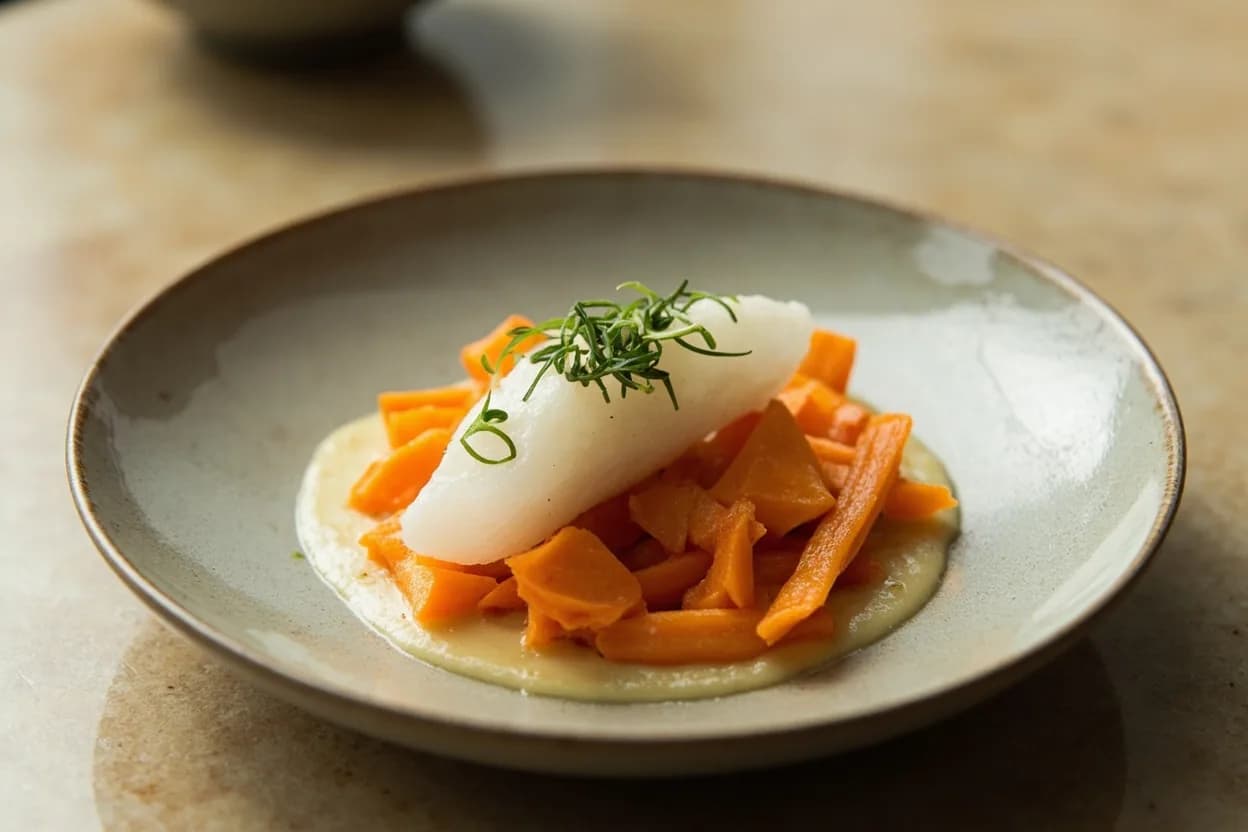
Hangetsu-giri (半月切り, literally 'half-moon cut') halves a cylindrical vegetable — daikon, carrot, lotus root (renkon), zucchini, or nagaimo — along its length first, then cross-slices the flat-sided half into uniform semicircular pieces. The result is a D-shaped cross-section that lies flat on the plate or settles evenly in broth, cooking more predictably than a full round while still showing the vegetable's natural growth rings. Thickness is typically 3–8 mm depending on the application.
In photos
Where it comes from
Knife technique applied to cylindrical and tubular vegetables: daikon, carrot, zucchini (courgette), lotus root (renkon), nagaimo (Japanese mountain yam), gobō (burdock), Japanese cucumber, and kabocha squash (quartered then sliced). The cut requires a single lengthwise halving cut as setup, then a series of perpendicular cross-slices.
Best for
How to cook it
- 1Peel the vegetable fully if required (daikon, carrot) or leave skin on for firmness (zucchini, lotus root).
- 2Place the vegetable horizontally and halve it lengthwise with a single firm cut, using the full length of the blade rather than a sawing motion — a single push-cut produces the cleanest flat face.
- 3Place the flat side down on the board; this stabilises the vegetable completely and allows the cut hand to remain safely on the curved top.
- 4Cross-slice at even intervals perpendicular to the cut face — 3–5 mm for salads and soup, 6–8 mm for simmered dishes that need the vegetable to hold shape.
- 5For lotus root, pre-soak in water acidulated with rice vinegar for 10 minutes after cutting to prevent oxidation and preserve the white colour.
- 6For daikon in miso soup, cut slightly thicker (7–8 mm) to maintain pleasant texture after 10 minutes of simmering.
Prep & butchery
- A nakiri (flat-bladed vegetable cleaver) excels here — the flat blade presses down uniformly across the full cross-section without the rocking that a gyuto tip causes.
- Make the lengthwise halving cut first with a rocking gyuto if needed, then switch to the nakiri for the cross-slicing where consistency and speed matter.
- For very large daikon (sometimes 8–10 cm in diameter), the half-moon pieces may still be too large to eat comfortably; switch to icho-giri (quarter moon) in that case.
- Mark a consistent slice thickness by keeping the tip of the blade touching the board as the knuckle moves back in 5 mm increments.
Substitutes
- Icho-giri (quarter-moon / ginkgo-leaf cut)
Halve the half-moon lengthwise again; used when daikon or carrot are very wide and half-moon pieces would be too large.
- Full round slices
Retain the complete circle shape; use when the full cross-section is decorative (especially lotus root), at the cost of pieces that roll around on the plate.
- Oblique roll cut (rangiri)
Alternative for simmered dishes that increases surface area further; loses the flat-lying stability of hangetsu-giri.
Related cuts
- Icho-giri
Quarter-moon (ginkgo-leaf) cut — halves the hangetsu-giri piece lengthwise for wider vegetables.
- Wagiri
Full round cross-slices — the parent cut from which hangetsu-giri diverges by the preliminary lengthwise halving.
- Sainome-giri
Small dice (~1 cm cube); produced from thicker hangetsu-giri planks sliced in one further direction.
- Sogigiri
Diagonal bias slice; same cylindrical vegetables, angle-cut rather than perpendicular for different surface geometry.
Appears in
References
- 1.Japanese Cooking: A Simple Art — Shizuo Tsuji
- 2.Washoku: Recipes from the Japanese Home Kitchen — Elizabeth Andoh
- 3.The Japanese Kitchen — Hiroko Shimbo
- 4.Japan: The Cookbook — Nancy Singleton Hachisu
Confidence: high
Notes
Aesthetic function
Hangetsu-giri is one of the cuts Japanese home cooks reach for when they want a dish to look composed without elaborate effort. The half-moon shape is immediately legible — it communicates care and precision to the diner. In kaiseki, the same cut is sometimes used in kaiseki-zukuri (arranged small dishes) where the D-shaped piece creates a stable, visually restful geometry against the curve of a round lacquer bowl.
Lotus root consideration
When hangetsu-giri is applied to lotus root, only half the characteristic hole pattern is visible on each piece. This is generally considered slightly less decorative than a full wagiri (round) cut; if the lotus root's visual motif is the main attraction — as in kakiage tempura or New Year (osechi) dishes — use full wagiri rounds instead. Reserve hangetsu-giri for lotus root when the visual pattern is secondary to a uniform cooking time.